Ambassador Youth Article
India: Land of Colors
By Nestor A. Toro
It is 6:00 a.m. on a typical Monday in the Indian city of Hyderabad. There, 15-year-old Diya wakes up to the first rays of sunshine and begins preparing for school.
Dressed in her uniform, after having the family’s staple breakfast—rice, lentil soup and roti (whole-wheat flatbread)—Diya is ready for the most adrenaline-filled experience of her day: the morning commute.
She hops on the back of her dad’s mustard-yellow two-wheeler and the adventure begins. For the next 30 minutes, they narrowly dodge large and small vehicles, throngs of pedestrians, street vendors, stray dogs and the occasional cow, water buffalo or monkey as they navigate the populous city. They arrive safely at school at 8:50 a.m. with 10 minutes to spare!
After school, it is time for another eventful journey. Diya first gives dad the good news of how well she did on her math exam. This time, on the way home, her dad detours to an open market for a last-minute purchase. The bustling bazaar is located around an area in which modern-architecture mixes with vestiges from past centuries, such as the Charminar—a colossal stone arch with four minarets standing about 79 feet tall.
Juxtaposed against the massive, beige stone structures, vivid colors pop everywhere. Tent stores feature elaborate turbans, picturesque traditional dresses, and jewelry. Textile shops display delicate scarfs with intricate patterns weaved in turquoise, magenta, orange and others, some embroidered with golden threads. Of course, assorted traditional foods and local produce are sold too, especially mangoes.
Back at home, the family enjoys a light snack before Diya dives into her schoolwork. Afterward she plays a round of chess with her aunt until dinner time. Meanwhile, her older brother Vihaan plays cricket with his friends outside.
Dinnertime is usually around 8:30 p.m. This evening, mom has made a special treat: dosa—a pancake made from the fermented batter of rice and lentils, topped with a green chutney, a sauce. The family enjoys their meal together, as always.
Diya and her family are based on real-life accounts. She represents one girl, in one family, out of one of the approximately 27 million urban cities in India.
Interestingly, many of these cities are identified by certain contrasting colors.
“India is colourful, so colourful that even some of the cities in our country are renowned for their prominent coloured-nicknames,” Times of India stated. “For example, Jaipur is also known as Pink City, Jodhpur goes by the name of Blue City while Jaisalmer is the Golden City of India.”
The article goes on to explain how some of this came to be. Of Jaipur, it states that “in 1876, to welcome the Prince of Wales and Queen Victoria, the city of Jaipur was painted in terracotta pink” and later a law was passed “which said that buildings and houses in the city would be painted in pink, which is still followed.”
The kaleidoscope that forms when one takes in the story of India is a mesmerizing representation of its diversity and rich history as one of the oldest continuous civilizations on the planet.
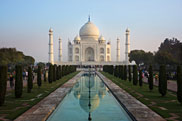
Taj Mahal
Photo: Getty Images
All artists know colors can complement or clash with each other. Likewise, as with any nation under the government of men, India’s wide scope of cultures and resources does not come without its strengths and challenges.
We will take a broader look at both ends of the country’s spectrum.
Strengths
First, we should note some of the strongest aspects of Indian society.
Population: Currently at 1.3 billion and growing fast, India’s population could be considered its greatest asset. About one out of every seven people alive today lives in India. For some perspective, there used to be one billion people inhabiting the planet in 1800. Also, India’s population is the equivalent of the number of people in all the Americas—both North and South—and fitting them into a land that is roughly a third the size of the United States. It is rare to find a place to be alone.
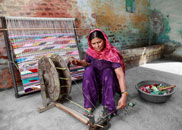
Weaving Durries (Rugs)
Photo: Getty Images
The country stands second only to China in sheer amounts of people, although it is expected that it will overtake China’s population by 2028 (though China’s population is distributed across about three times more land than India.)
The benefit of a large population is a gargantuan workforce, especially since it is also the country with the largest population of youngsters. The book Dreamers: How Young Indians Are Changing the World describes how India’s youth “make up the world’s largest ever cohort of like-minded young people, and they see absolutely no reason why the world shouldn’t run by their rules.”
Strong Family Ties: Family is treasured in India. According to the nonprofit educational institution Asia Society: “The essential themes of Indian cultural life are learned within the bosom of a family. The joint family is highly valued, ideally consisting of several generations residing, working, eating, and worshiping together.” Parents are very involved in the lives of their children well into adulthood. Marriage is not seen as two people coming together, but rather two families coming together. India’s divorce rate is the lowest in the world.
Entrepreneurship: A 2019 CEOWORLD magazine assessment ranked India fifth within the 62 most business-startup-friendly countries in the world. It was only surpassed by the United States, United Kingdom, Canada and Israel.
A shining example is the Secmol school, where students implement ecological practices in the middle of a desert. “Pupils are all from the regular Ladakhi school system and only those who have failed their year 10 exams are permitted to attend,” BBC reported. “In a typical maths lesson, they may calculate if the water from the spring is enough for tree planting, or work out the efficiency of the solar cooker that they use for heating water…Each student must perform daily responsibility shifts and develop their confidence with nightly presentations to the rest of the school and visitors.”
Another example comes from India’s largest slum, Dharavi. “Located in the central area of Mumbai, its residents have long dealt with problems of infrastructure and security. But now entrepreneurs are turning the slum into a thriving business region,” French radio station RFI reported.
Prime Location: It is hard to miss India on a world map. “Modern India is situated between the Middle East, Central Asia, China, Southeast Asia, and the Indian Ocean,” The Diplomat noted. “India must remember that it can use its location to its strategic advantage by projecting power outwards into all those regions. Additionally, India can also use its central location in the Indian Ocean to become a hub of transportation, communication, and trade. Although these facts should be obvious to anyone who looks at a map, India has often punched below its weight instead of taking full advantage of its strategic location.”
Natural resources: According to Encyclopaedia Britannica, India’s “diversity of resources, especially of minerals, exceeds that of all but a few countries and gives India a distinct advantage in its industrial development.” The country is rich in iron ore, copper, zinc, gold, silver and lead. It also boasts large amounts of petroleum and coal. As for agriculture potential, “more than 52 percent of the land area is considered arable,” according to export.gov. “India is among the highest-ranking countries in production volume for various commodities like rice, wheat, cotton, and dairy.”
Being a peninsula, another staple resource is fish. “With diverse resources ranging from deep seas to lakes in the mountains and more than 10% of the global biodiversity in terms of fish and shellfish species, the country has shown continuous and sustained increments in fish production since independence,” India’s National Fisheries Development Board stated.
Economy: India is currently considered the world’s fastest-growing major economy. Its engineering goods are its most exported product.
Challenges
Next is a glance at some of the country’s major challenges.
Illiteracy: “India is home of the largest population of illiterate adults in the world—287 million, amounting to 37% of the global total,” stated The Northeast Today, based on recent UNESCO data. The article added that “India is ranked 123rd out of 135 countries in female literacy rate.” Extreme poverty is also tied to this problem.
Inequality: The nation struggles with a long-held reputation for a caste system. “Caste is similar to a social class, but mobility is impossible and discrimination can occur among those of the same economic class” The Conversation explained. “It is similar to the idea of race, but can be perpetuated by those within the same ethnic group. It originated in Hinduism, but has been absorbed by Muslims, Christians and Sikhs.”
The article continues: “This origin ordained an occupational hierarchy. You inherited your caste from your father, and that determined your future. The Brahmins were the priests and advisers—and primary enforcers of the caste system. The Kshatriyas were warriors and soldiers. Then Vysyas farmers and traders. The Shudras workers and tradespeople.
“Beneath the Shudras were the Dalits—the ‘untouchables’—tasked with all menial jobs, including cleaning and disposing of the dead.”
Dalit discrimination has been outlawed in India since 1950, but it is still one of the challenges the country faces.
Another societal issue is child marriage. Despite a 1929 law against it, India still has the highest rate of underage brides on the planet.
Pollution: Out of 12 cities known as the most polluted in a World Health Organization report last year, 11 were in India. “Delhi, India’s capital region, home to nearly 19 million people, is notorious for choking air that is now turning the iconic white marble walls of the Taj Mahal green,” Vox reported. Yet most of the Indian population lives in rural areas. The Vox article added that “80 percent of these households rely on biomass like wood and dung for cooking and heating. Agricultural practices like burning crop stubble also remain widespread.”
Limited Water Supply: Many parts of India do not have access to flowing water. The infrastructure exists, but some places only receive water every few days and it generally is not very clean. Rain only comes during the monsoon season and overpopulation is putting a burden on the country’s already stressed water supply.
Spat with Pakistan: Ever since India was split into two nations, forming Pakistan in 1947, both sides have engaged in fighting over the disputed land of Kashmir. “Pakistan views Kashmir, which like it has a Muslim majority, as a natural part of its state,” the Council on Foreign Relations reported. “For secular but Hindu-majority India, Kashmir is vital to its identity as a multiethnic state.” Recently, the conflict has been reignited and the biggest concern is that both countries possess nuclear weapons.
Religious Differences: Most major religions—Hinduism, Islam, Christianity, Sikhism, Buddhism, Jainism and more—are found in India. It is the world’s largest “religiously pluralistic and multiethnic democracy” (Pew Research Center). The same report revealed that “legal restrictions on religious conversions” exist “in at least six states that have at times been used to arrest and intimidate Muslims and Christians who proselytize, according to the U.S. Commission on International Religious Freedom. Additionally, Buddhists, Jains and Sikhs are legally considered Hindus and are unable to access social services or employment and educational preferences available to other religious minority groups.”
Bright Future
Looking at both sides of India’s spectrum, it is clear its tremendous potential is stymied by seemingly impossible obstacles.
Picture all those elements as different colors in a pallet. Then imagine the Creator of all mankind putting those colors together to form a masterpiece that He ultimately has in mind for India.
After the establishment of His Kingdom on Earth, India’s strengths will be magnified and its challenges will be resolved. It will enjoy unity of religion and peace with all its neighbors (Micah 4:1-5), abundant access to pure water and clean air (Rev. 22:1-2), equity and the right form of education for all (Micah 4:2-3).
That will be only the beginning of this nation’s bright future. Only then will India’s most beautiful, vibrant colors come to light!
Published August 1, 2019