Ambassador Youth Article
Lives in Limbo
How the Israel-Hamas War Impacts Teens
by Samuel C. Baxter
“When I was first reading…about the Israel-Gaza war, the only thing that was in my mind was ‘why?’”
Sherry, a teenager in the U.S., wrote this on a New York Times forum created for young people to comment on the conflict. She continued: “Why would Palestine launch this sudden attack against Israel? Why all the violence and bloodshed and murder? Why all the death and destruction and excessive force?”
You have likely asked the same questions as Sherry. Why did Hamas cross into Israel on October 7, 2023, to attack, rape and murder civilians, leaving about 1,200 dead? Why does the Israeli government think the only solution to the problem is to utterly destroy Hamas—a tactic that has already killed some 26,000 people in Gaza?
Iris said this on the forum: “I think that Hamas’s attack was wrong and certainly not ethical, but I also think that Israel’s attack that went back to Gaza was bad. Very bad. That is definitely not the way (in my opinion) to respond to an attack…I still can’t tell who’s to blame, but regardless, it’s all just bad for all the citizens, I think. I think that it is important to remain unbiased because otherwise we assume something that isn’t true, and there’s honestly no point in that.”
The conflict in the Middle East is incredibly complex. It is difficult to know whose side, if any, you should take.
Some background: Israel took certain regions in a 1967 war with Egypt, Syria and Jordan. Those areas have a majority Palestinian population that would like the territories to become an official Palestinian state rather than being controlled by Israel. The Islamic militant group Hamas was voted into power in Gaza in 2006 and began oppressing its citizens, instead focusing its resources on continual attacks on Israel.
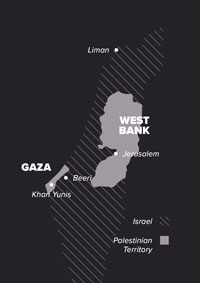
Graphic by Kyle M. Holcombe
Since Israel began its military campaign in Gaza after October 7, over half of those who have died have been civilians, most of whom were women and children, the Palestinian health ministry reported. A further 62,000-plus Gazans have been injured, they added.
Angelina said this on the Times forum: “I have so many questions and I feel gutted to hear about everything that is going on. Thousands of civilians who are just trying to live their lives are the ones who are paying for all of this…I hate so much how violence seems to be what people think will get them what they want and solve everything.”
We all should feel like Angelina. War is awful, especially when you consider how it affects individual lives. World events like this can be difficult to stomach, but you should still pay attention. Keeping up to date with what is happening in the news helps remind us of the awful realities of a world cut off from God.
On the Times forum, Conan named one of those realities: “In the world there will always be war,” and “peace sadly is almost impossible to achieve.” Mathias said something similar: “No matter how hard the world tries at this, [peace] just seems unattainable.”
Little do these teens know, this bedrock truth about humanity is explained in Isaiah 59: “The way of peace they have not known, and there is no justice in their ways; they have made themselves crooked paths; whoever takes that way shall not know peace” (vs. 8, New King James Version).
Things look bleak in this age. The Israel-Hamas war is just one example. Yet we should continue to watch the horrible things occurring to remember that man’s ways do not work.
This is why God wants us to regularly pray “Your Kingdom come” (Matt. 6:10). We can see all the awful events happening around the globe and yearn for the time when God will fulfill Isaiah 2:4, when “nation shall not lift up sword against nation, neither shall they learn war any more.”
To make your yearning for God’s Kingdom more vivid, keep your eye on current events. As hard as this can be, how the Israel-Hamas war is impacting teens makes clear God needs to intervene in world affairs.
Life on October 7
While you were keeping the Last Great Day in 2023, Hadar Bachar had what Reuters called “a blood-soaked Saturday.” In a few harrowing hours, she “transformed from an ordinary 13-year-old girl into the coordinator of her family’s fight to survive a Hamas onslaught.”
As Palestinian militants attacked residents in Israeli border villages on October 7, Hadar and her family retreated to the “safe room” they typically use to be protected from the all-too-frequent rocket barrages from Gaza. This day, the room was anything but safe.
“First the gunmen fired through the door, seriously wounding both Hadar’s father, Avida, and her 15-year-old brother Carmel,” Reuters continued. “Eventually, the militants would rupture the reinforced window with explosives and shoot her mother, Dana, through the gap.”
Hadar furiously worked to stop the bleeding of her family’s injuries while using mobile phones to contact emergency services. Help would not arrive at the Bachars’ home in Kibbutz Beeri until hours later.
“It needs to be understood: A 13-year-old girl is running an operations room, with three phones at the same time,” Mr. Bachar told Reuters while lying in a hospital bed. One of his legs had to be amputated because of injuries.
In real-time, the village’s WhatsApp groups informed the Bachars of Hamas’ movements. They were warned of what would come next: The Islamist invaders built a fire to try to smoke the family out.
“They also used tires,” Hadar explained to the news outlet. “They brought tires from vehicles, spare tires, anything they could. They torched the tires to create a thicker smoke—black, that you can’t breathe—to make people escape outside through the windows.”
“And then they would die during their escape.”
Help did eventually make it to the village, but not before more than 100 residents of Kibbutz Beeri had been killed.
Among the many dead were Hadar’s mom and her brother Carmel.
The atrocities that occurred on October 7 reveal the extremes of human nature, which is really Satan’s nature. John 8:44 shows the devil was “a murderer from the beginning.”
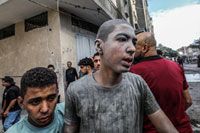
An injured Palestinian teen walks out of the Abu Lebda family home following an Israeli raid on Rafah, south of Gaza (Oct. 17, 2023).
Source: Abed Rahim Khatib/Picture Alliance via Getty Images
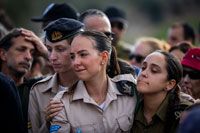
Young soldiers attend the funeral of members of Israeli Kutz family following their murder by Palestinian militants (Oct. 17, 2023).
Source: Ilia Yefimovich/Picture Alliance via Getty Images
Hearing Hadar’s story, it can be easy to think Israelis are the good guys in the conflict. This feels even truer when learning more about Hamas. The group sets up its bases in residential areas, which means civilians are often in the way when Israel attacks, despite the nation’s efforts to warn ordinary Palestinians beforehand.
Yet be careful of picking sides—either Israelis or Palestinians—in this conflict.
Life in Gaza
“When the Israeli army told Palestinians in the Beach refugee camp in Gaza City to flee south because it was safer, 18-year-old Dima Al-Lamdani’s family prayed they would escape relentless air strikes,” Reuters reported.
Just days later, her parents, seven siblings and four members of her uncle’s family were dead after an Israeli air strike. She had to identify their bodies in the southern city of Khan Younis, where they had traveled.
“They told us to evacuate your place and go to Khan Younis because it is safe,” Dima told the news outlet, feeling utterly betrayed by Israel because they bombed the area.
Here is how the teenager described it: “At 4.30 a.m. I was awake and sitting with my aunt drinking coffee. Suddenly I woke up in the middle of ruins. Everyone around me was screaming, so I screamed.”
After finding the bodies of her relatives in the morgue on October 17, she realized just her brother and two young cousins had survived with her.
“This is a nightmare. It will never be wiped from my memory,” she said. “I had a sister, 16. They wrote my name on the white sheet they wrapped her body in, they thought it was me.”
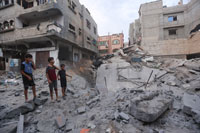
Palestinian boys sift through rubble among damaged buildings in the aftermath of Israeli strikes in Gaza City (Oct. 9, 2023).
Source: Ahmed Zakot/Sopa Images/Lightrocket via Getty Images
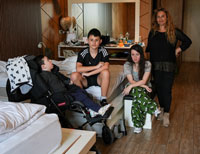
Hadar Shusterman, her brothers Dekel and Almog and her mother, Riki, pose for a picture in their temporary accommodations after being evacuated from their home near the Lebanese border due to the ongoing cross-border hostilities between Hezbollah and Israeli forces, in the village of Regba, Israel (Jan. 8, 2024).
Source: Miro Maman/Reuters
Warfare always has unintended consequences. Violence and death beget bitterness, and this leads to more violence and death. For Israel and the Palestinians, their blood feud has continued for thousands of years. Read our Real Truth article “Israel vs. Hamas: 4,000 Years in the Making” to understand the biblical roots of the conflict.
One example of unintended consequences: While trying to stamp out violence now, Israel may be inadvertently creating the next generation of militant Palestinians.
Life in the West Bank
Fourteen-year-old Abdelrahman al-Zaghal was one of the youngest Palestinians released by Israel in exchange for hostages seized during the October 7 Hamas-led raid on Israel.
Weeks later, his life still bore little resemblance to that of a normal teenager—he is recovering from serious injuries sustained the day of his arrest, and said his school is still awaiting Israel’s permission for him to attend.
He was shot in August. Abdelrahman said he had left home to buy bread, only to wake up cuffed to a hospital bed flanked by two police officers. He had bullet wounds to the head and pelvis.
Israel charged Abdelrahman with hurling a petrol bomb, which he denies. His mother Najah said he was shot by a man guarding a Jewish settlement near their home in East Jerusalem.
A police statement released the night Abdelrahman was shot said Border Police officers shot at and critically wounded an unnamed teen after they sensed their lives were in danger.
While we do not know whether Abdelrahman threw a petrol bomb, his story does highlight the clashes in the West Bank. Israeli settlers have been increasingly moving into the region, many of them Jewish extremists who feel God wants them to take the land by any means necessary. Militant Palestinians feel Allah wants the opposite and are looking to wipe Israel off the map.
The region’s children are often the ones caught in the middle.
As a Jerusalem resident, Abdelrahman’s case went to an Israeli civil court. The judge ordered him to be placed under house arrest, but outside his neighborhood, until the end of his trial.
The day of his release, Abdelrahman said he jumped for joy. But the celebrations were muted, since he was about to undergo surgery for brain damage caused by the shooting, his mother said.
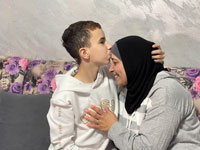
14-year-old Palestinian Abdelrahman Zaghal kisses his mother Najah in their house in Jerusalem. The left side of his head (not pictured) has many stitches after being shot (Dec. 6, 2023).
Source: Sinan Abu Mayzer/Reuters
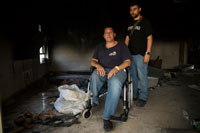
Hadar Bachar’s dad, Avida, and her brother Rotem are pictured at their home, which was damaged during Hamas’ deadly attack on the Kibbutz in Beeri, Israel (Jan. 8, 2024).
Source: Amir Levy/Getty Images
Abdelrahman is far from alone. Since 2000, the Israeli military has detained some 13,000 Palestinian children, almost all boys between the ages of 12 and 17, according to the human rights organization Defense for Children International-Palestine (DCIP).
Israel says it arrests Palestinians on suspicion of attacking or planning attacks against its citizens. Its military said enforcement agencies in the occupied West Bank “work to protect the rights of minors throughout all administrative and criminal proceedings.”
Based on collected affidavits from 766 children detained between 2016 and 2022, DCIP found about 59 percent were abducted by soldiers at night. This was the case with Yousef Mesheh.
At 3 a.m., Israeli forces stormed into Yousef’s home in Balata refugee camp in the northern West Bank. The 15-year-old Palestinian was quickly dragged from his bunkbed to the floor, where the troops punched him and shouted insults, The Associated Press reported.
A soldier used the butt of his rifle to hit Yousef’s mother in the chest before locking her in the bedroom. The boy and his 16-year-old brother, Wael, were taken.
“I can’t forget that night,” Yousef told AP in his living room, which was decorated with photos of the still-imprisoned Wael. “When I go to sleep I still hear the shooting and screaming.”
DCIP said some 75 percent of children arrested were subjected to physical violence and 97 percent were interrogated without a family member or lawyer present. One in four are placed in solitary confinement for two or more days even before the beginning of a trial, said DCIP advocacy officer Miranda Cleland.
Throwing stones is the most common charge against Palestinian minors detained in the West Bank, punishable by up to 20 years in prison under Israeli military law, said Palestinian rights group Addameer.
Abdelrahman is eager to get back to a more normal life. He said he remembers going to swim at a Tel Aviv pool with his late father on the weekends, and wants to become a lifeguard. He said he loved school and is eager to go back.
These are all teenagers who want ordinary lives. Their hopes and dreams often must be put on hold because they were born into a dangerous region of the world. Sadly, the Israel-Palestinian conflict threatens to expand even further.
Lives in Limbo
Stuck in a hotel with little to distract her from her thoughts, teenager Hadar Shusterman—not to be confused with Hadar Bachar—longs to return home to her northern Israeli village close to the Lebanese border, but she fears being killed there by Hezbollah.
She is one of more than 96,000 Israelis from a fringe of land along the border who have fled since October 7 over fears that Hezbollah—a militant group that opposes Israel, the U.S. and other Western nations—could attack.
Hezbollah’s ties to Iran and Syria have transformed it into an increasingly effective military force, the Council on Foreign Relations stated. If the group entered the fray, the Israel-Hamas war could quickly turn into a larger regional conflict.
“These guys are stronger than Hamas. Can you imagine the things they can do to us?” said Hadar, 17, who, like many Israelis, has been closely following accounts of killings, rapes and mutilations by Hamas that have emerged since October 7.
From her coastal village, Liman, the Lebanon border fence is visible at the top of a hill about 1.9 miles to the north. She has imagined Hezbollah militants coming in cars or boats to kill her and her family.
Returning home is unthinkable while that risk remains, but no one knows if, when or how the risk will be eliminated.
Hadar described herself as “a train wreck of emotions,” too agitated to settle down with a book or homework or a drawing.
“It feels like a long day that never stops and you’re just waiting for this day to end,” she said.
With more than 117,000 Israelis displaced from southern areas close to Gaza, the combined threat of Hamas and Hezbollah has effectively made parts of Israel’s territory unlivable, which the nation says it cannot tolerate indefinitely.
For now, Hadar and her parents and her two younger brothers, one of whom is disabled and wheelchair-bound, are living in two rooms at the Aqueduct Hotel in Regba, a village just south of the evacuated zone.
The Shustermans are among 260 displaced people staying at the hotel, including 40 children and 70 aged over 60, as well as 62 pet dogs. The government is footing the bill.
Hadar’s school is closed, but she and other evacuee children have been enrolled in other schools.
Given she is 17, however, Hadar’s life will soon revolve even more around weapons and warfare than it already does. Every young adult in Israel must serve at least two years in the Israeli Defense Force. After that, until age 40, they can be called up to fight—and even later in cases of national emergency.
War is completely built into the system in the Middle East. Hamas runs Gaza. Hezbollah is both a militant organization and a political party in Lebanon. Israeli teens must take up arms and serve their country.
There are no winners in this conflict. It is not as simple as picking a side of either #freepalestine or #standwithisrael. The more you learn about it, the clearer it becomes that the situation is unsolvable without God’s intervention.
As the Israel-Hamas war rages on, remember Hadar Bachar and Hadar Shusterman. Remember Dima Al-Lamdani and Abdelrahman al-Zaghal. Remember Yousef Mesheh and his brother Wael.
Their stories can help you remember God’s viewpoint in all of this. He is allowing humanity to learn a difficult lesson: They do not know the way to peace.
Take comfort that very soon, the Kingdom of God will come. When it does, all teens who have ever lived will finally have bright futures ahead of them.
This article contains information from Reuters and The Associated Press.
Published February 7, 2024