Ambassador Youth Article
Watching World News—A Teen’s Guide
by Garrick R. Oxley
Social media has become an inseparable part of our lives. It helps us keep up with friends, shop and discover new music—and it is now often a primary news source. You likely get your news from TikTok, Instagram, YouTube and the like. How can you make sure you do it the right way?
An article by Common Sense Media said: “Teens’ news habits reflect the diversity of the modern media landscape. And, while most news organizations maintain accounts on social media and other platforms, they are competing for attention with corporate brands, celebrities, influencers, and personal connections. Of those teens who get their news from YouTube, for example, six in 10 say they are more likely to get it from celebrities, influencers, and personalities rather than from news organizations utilizing the platform.”
It can be hard to know who to trust. There are traditional newsrooms, such as The Wall Street Journal and The New York Times, that have been around for many decades. But there are now independent voices as well, individuals or small organizations who bring news without having to answer to corporate bosses or wealthy advertisers.
While many journalists and personalities are sincere in their efforts to inform, others are not—they are creating content to farm engagement, not deliver truth. There has never been so much fake and biased news.
Let’s sum this up: Getting news from social media is both convenient and challenging.
Yet despite the difficulty, a survey quoted in the article found that “a large majority of teens age 13 to 17 in the U.S. (78%) say it’s important to them to follow current events.”
You value keeping up with current events more than those outside the Church because you know this habit is important to God. He wants you to keep up with what is happening in the world.

A view of wreckage on the Patapsco River after a massive container ship caused Baltimore’s Key Bridge to collapse (March 29, 2024).
Jonathan Newton/The Washington Post via Getty Images

People demonstrate in support of political prisoners being held in Cuban jails, in Miami, Florida (March 18, 2024).
Joe Raedle/Getty Images
How can you get the most out of news watching through modern outlets? Is the evolving news landscape something to be resisted or embraced?
Relax. Using social media and YouTube to stay informed is not necessarily a bad thing. You should not feel guilty that your news habits do not mirror those of your parents and others you know. You can take advantage of the latest tools and technology if you do so wisely.
Guiding principles from the Bible will train you how to watch world events. Applying them will ensure you get out of the news what God wants.
Why We Do It
You often hear the term “watching” during Sabbath services. This comes from the Bible. It can refer to the habit of keeping your eyes on world news and trends.
In Luke 21:36, Jesus Christ said, “Watch you therefore, and pray always, that you may be accounted worthy to escape all these things that shall come to pass, and to stand before the Son of man.” The primary meaning of “watch” is to guard your spiritual condition. Diligent news watching can help you do this. It helps you see that mankind cannot solve its own problems. It helps remind you of the incredible blessing it is to know the truths of the Bible.
Other places in Scripture also inform how we look at the news, even if they do not use the word “watch.” In Ezekiel 9:4, God gave an instruction to “Go…through the midst of Jerusalem, and set a mark upon the foreheads of the men that sigh and that cry for all the abominations that be done in the midst thereof.”
Watching world events is often heartbreaking. The sins, evils and ills of this world should make you sigh and cry. This will help keep your mind on the Kingdom of God. Of course, this does not mean literal tears have to be shed—though they sometimes will. Yet we should have a sighing and crying mindset when we look at what is occurring in this world.

A U.S. Border Patrol agent looks for immigrant footprints at the U.S.-Mexico border fence in Yuma, Arizona (March 9, 2024).
John Moore/Getty Images
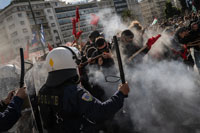
Riot police clash with protesters during a student demonstration against the Greek Parliament in Athens (March 8, 2024).
Angelos Tzortzinis/AFP via Getty Images

A crater near destroyed residential buildings that were hit by Russian night shelling in Selydove, Ukraine (March 19, 2024).
Global Images Ukraine/Getty Images
The spiritual reasons for watching the news are huge. Yet there are many other benefits. It helps you relate to people in different parts of the world and what they are going through. It allows you to see trends coming that could affect you, giving you a chance to prepare for them—financial trends, technological advancements, shifts in education and more. Staying aware of world events also enables you to converse with others and navigate sensitive topics without being caught off-guard.
To maximize these spiritual and physical benefits, you must consume news wisely.
Pursue Truth, Not Entertainment
One of the great things about watching through social media is that it makes the news interesting. Depending on your platform of choice, you can hear about developments in the world through a short, pithy post, a video with engaging graphics or a free-flowing panel discussion.
Making the news enjoyable is good because it helps you stay committed to watching it. If consuming media feels burdensome, it becomes easy to skip. You may find a particular app, website or news network you like best and certain voices that stand out.
However, remember that while news can be interesting, it is not meant to be entertainment alone. You could be sacrificing truth and accuracy if you only seek out the most exciting presentation or viewpoint. Also, while short posts or videos are easy to digest, make sure you are not missing important context that could change your view of events. We do not need to dive deeply into every story, but sometimes this is required to properly understand what happened. The first guiding principle is to pursue truth.
Proverbs 14:15 says, “The simple believes every word: but the prudent man looks well to his going.” Do not believe every word without proof. Instead, be prudent. Check whether what is being said is actually true. Are the statements being presented as facts really facts? Is the organization or person showing their work by citing sources? Or are they just making claims with no proof? If they do cite sources, do the sources say what you were told they said?
I Thessalonians 5 tells us to “Prove all things; hold fast that which is good” (vs. 21). While this primarily applies to spiritual subjects, the principle also fits news. By proving what you hear, you ensure you do not hold onto anything false.
This could feel like a daunting task. But you do not have to be an expert researcher. You can use resources like AllSides, Ground News, or Media Bias/Fact Check. They can help you decide which way a news company leans politically and how trustworthy they are.
Often, news is reported with opinions mixed in—this means personal perspectives and political ideals will color how something is portrayed. In newspapers, articles are often titled “Op-ed,” “Opinion” or “Commentary.” When you see this, know that you are not getting straight news.
Often, however, opinions are not labeled. Beware of any news reporting that tries to sway readers to its point of view. This can come in the form of rhetorical questions, emotionally charged language and twisting facts to fit the journalist’s narrative.
Straight news is different: It will be even-handed, impartial and largely free from the journalist’s viewpoint. It will avoid sensationalism—and will strive to present all sides on a controversial topic fairly. The problem with this sort of news is it can be a little dry and boring.
A good approach is to watch news that is engaging but not sensational—and to prioritize sources committed to factual accuracy.
Seek Different Perspectives
In the process of watching, it is helpful to become familiar with opposing viewpoints. This includes positions taken by the political left and right. People tend to jump to conclusions about what others believe. But Proverbs 18:13 cautions, “He that answers a matter before he hears it, it is folly and shame unto him.”
The second principle is to seek different perspectives. As you consume opinion-based media, try to avoid watching exclusively left-leaning or right-leaning content.
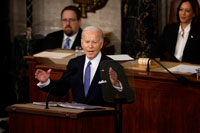
U.S. President Joe Biden delivers the State of the Union address at the U.S. Capitol in Washington, DC (March 7, 2024).
Chip Somodevilla/Getty Images

Former president Donald Trump speaks at Mar-a-Lago in Palm Beach, Florida (March 4, 2024).
Alon Skuy/Getty Images
If you tend to empathize more with people on the political right, try to understand what people on the left believe. If you personally find the arguments of liberals more persuasive, seek out what conservatives believe. Of course, keep in mind that God’s people identify with neither side—your politics are in heaven. Review Philippians 3:20 and II Corinthians 5:20.
Go to the source and listen to what they have to say. If you see comments on social media saying the president or his chief rival gave a terrible speech, before you believe it, listen to at least a portion of the speech yourself and draw your own conclusions. Do not automatically take the word of other people.
Even if a position seems misguided, consider why people believe it. What factors in their lives contributed to their viewpoint? Look at issues more deeply than the surface level.
Proverbs 18:15 says, “The heart of the prudent gets knowledge; and the ear of the wise seeks knowledge.” Seek knowledge from a variety of sources. Read and watch content from people of various backgrounds and cultures. Do not stick only to news from the country you live in. Try watching a report from another place in the world to gain perspective. While it is fine to have favorite sources, venture out of your bubble to try something new from time to time.
But you do need to be discerning. Some “different perspectives” are not worth your time such as a journalist who has been repeatedly caught lying or a content creator who uses profanity or racial slurs.
Avoid Fringes
Some news falls into a gray area—it cannot be easily proven or disproven. You need to be OK with that and let it go. If you dig too deeply into “what really happened,” you are treading into conspiracy theory territory. Stay away from such fringe ideas, as they are dangerous and have often pulled people out of God’s Way over the years.
Philippians 4:5 tells us what to do: “Let your moderation be known unto all men. The Lord is at hand.”
If you encounter news asserting something incredible you have never heard before, this should throw up a red flag. One line of defense is to check to see if other news outlets have reported the same story. If only one or two obscure outlets have reported it, this should be a sign that what you are reading is unprofitable. This even applies to when a news story says something that appears biblical.
Some people are attracted to fringy, conspiratorial ideas more easily than others. If this is you, be careful. Set limits for yourself. Block or mute certain accounts if you need to. If you have a friend in the Church who is this way, be your brother or sister’s keeper—help them stay balanced.
Hebrews 5:14 speaks of those who “by reason of use have their senses exercised to discern both good and evil.” There are news stories that are not just unreliable or inaccurate, they are simply evil. As you continue to watch, you can hone your senses to discern this.
While you are young, take advantage of your parents’ wisdom. They have valuable experience over years of exercising their senses, as the verse says, in God’s Way and life in general. They can answer your questions and provide context and guidance when something you come across does not smell right.
Also, use The Real Truth as a resource. We post reliable news content daily and produce a weekly email and bimonthly magazine designed to help people watch the news the way God wants.
Stay balanced and in the middle of the road. Err on the side of reliable outlets and do not go down rabbit holes.

A picture taken from northern Israel, along the border with southern Lebanon, shows smoke billowing following Israeli bombardment on the Lebanese village of Markaba (March 4, 2024).
Jalaa Marey/AFP via Getty Images

Travis Kelce of the Kansas City Chiefs reacts at head coach Andy Reid during the first half of Super Bowl LVIII at Allegiant Stadium in Las Vegas, Nevada (Feb. 11, 2024).
Jamie Squire/Getty Images
See the Big Picture
You have been armed with principles to help ensure the news you get is accurate, balanced and relevant. However, remember that diligent news watching has deeper purposes.
Keeping up with current events should help you remember the world needs the Kingdom of God and that man’s ways do not work (I Cor. 4:20; Jer. 10:23).
The news should remind you that God is in control. Sometimes God’s guidance and involvement can feel obvious, and less obvious at other times. But He is working out a great purpose here on Earth (Dan. 4:17; Isa. 40:15, 22; 55:10-11).
Developments in the world should also point your mind to the knowledge that God’s Word is true. As you witness trends reflecting what the Bible said society would be like at the end of the age, this should cause you to grow in respect for every word of Scripture (Prov. 30:5).
Watching takes effort, but it is tremendously rewarding. Take advantage of your news outlets, apply what you have learned, and allow it to help you draw closer to your God.
Published April 11, 2024