Pillar Article
What a Christian Can Learn from South Africa
By F. Jaco Viljoen
South Africa is known for its breathtaking natural beauty and biodiversity. The combination of rugged African landscape and unique plants and animals reflects the creative brilliance of the God we serve.
The Creator’s fingerprints are everywhere, from the golden cornfields of the Highveld (an inland plateau), the sheep farms of the Karoo, the Mediterranean climate of the Garden Route perfect for vineyards, to the many pristine blue flag beaches.
Another of those fingerprints is the discovery of diamonds in Hopetown in 1867. Describing the find, colonial secretary Sir Richard Southey stated: “This is the rock on which the future success of South Africa will be built.”
Since then, the country has had many successes largely made possible by South Africa’s vast mineral resources.
In 1905, the Cullinan diamond was discovered. It was the largest rough diamond ever found and weighed 3,106 carats (1.4 pounds). Think of holding a diamond in your hand that has such heft!
The stone was first cleaved in two and later divided into nine separate pieces. The largest stone, known as The Great Star of Africa, is set atop the scepter in the Crown Jewels of the United Kingdom. The combined value of all the cut stones is more than $2 billion.
South Africa also had huge gold reserves. The total amount of gold mined around the globe (between 1493 and 2017) is roughly 6 billion ounces. South Africa produced 1.7 billion ounces or 28 percent of that total. The United States came second, producing 600 million ounces. In the 1980s, when I grew up, the country produced nearly 1,000 metric tons of gold per year.
But these past achievements are overshadowed by the current state of the nation.
The economy is stagnant and crippled by corruption and political nepotism. The country’s credit rating has frequently been downgraded and is now at “rubble” status. The national electricity supplier, Eskom, is bankrupt, and countrywide rationing of blackouts to save power is the norm, costing the economy 1 billion rand ($69 million) in production per day.
According to the World Bank, South Africa has the worst income inequality rating in the world. Half of South Africans are in households with a per capita income of $90 or less a month, with little chance to change their situation despite working hard as maids or security guards.
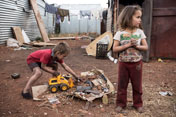
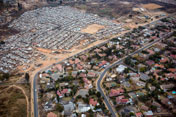
The unemployment rate in the country of 56 million people soars past 25 percent. The rich live in gated communities while the poor try to survive in tin shacks. There are tire-burning protests almost every day over the lack of basic services such as working toilets.
The nation has the highest prevalence of HIV in the world, with 7.2 million people infected.
In addition, crime is overwhelming protection agencies. South Africa’s homicide rate is six times higher than that of the U.S. Here, 40 percent of women will be raped at some point in their lives. Also, 41 percent of all rape cases are against children.
Cape Town has been voted the “World’s Best City to Visit” six years in a row by readers of The Telegraph.
Despite this, it is plagued by crippling urbanization and poor planning. It also recently suffered its worst drought in 100 years. Last year, its nearly 4 million inhabitants came close to running out of the most basic necessity, water.
Stop for a moment and let what you read sink in!
It is heartbreaking to witness the fast demise of your birth country. More than just statistics on paper, you are reading about real situations affecting real people.
There are many lessons Christians can glean from both the nation’s successes and downfalls.
Greatest Blessings
“South Africa: A world in one country.” These seven words fitly describe this complex nation with 11 official languages. They also summarize the land’s biodiversity.
The country has 1,770 miles of coastline and ecoregions ranging from forests, savannah (grasslands), mountains, bushveld (subtropical woodlands), fynbos (shrubland) and deserts. Tourists come from all over the world to see the big five—lions, elephants, buffalos, rhinoceroses and leopards—in their natural habitats.
Just as popular with tourists is the annual flower spectacle in Namaqualand. It can serve as a forerunner of what the prophet Isaiah wrote, “The desert shall rejoice, and blossom as the rose” (Isa. 35:1). Daisies of various colors cover the desert floor for miles without end during early spring.
To put the diversity of the flora into perspective, there are more plant species on Table Mountain in the Western Cape alone than the whole of the United Kingdom.
Most do not realize God is the source of the country’s physical beauty and mineral wealth. Think about God’s promise to Abraham: “Surely blessing I will bless you, and multiplying I will multiply you” (Heb. 6:14). Truly Abraham’s descendants, specifically Ephraim (English), Zebulun (Dutch), and Rueben (French Huguenots), received God’s promised physical blessings in abundance at the southern tip of Africa.
These blessings were unconditional and given to the modern-day descendants of Abraham solely because that patriarch’s obedience to God. The prosperity of the United States and the British colonies stand as towering proof that the Bible is God’s Word.
Yet, with the influence of Abraham’s descendants waning in South Africa, the nation has trended toward decline.
“For the past several decades, inequality has been on the rise in developed and developing countries alike,” Time magazine reported. “But in an age of widening divides between rich and poor, South Africa stands out because of its squandered hopes. [Nelson Mandela’s] rainbow nation was supposed to show the world how a new, equitable society could be built out of the ashes of repression and racism. But by some measures, inequality in the country today is worse than it was under apartheid.”
Our book America and Britain in Prophecy explains in detail the fascinating story about God’s promise to Abraham and his descendants. Take the time to read it.
There is no mystery to the meaning of the word “blessing” found in Hebrews. According to Thayer’s Greek Lexicon, it means “to cause to prosper” or “favored of God.” South Africa is an example of God’s favor and He caused the nation to prosper.
But Strong’s Concordance adds another crucial element that is generally missing in South African society, and elsewhere in the world.
“Blessing” can also mean “to thank.” It is vital that we as Christians acknowledge the source of our blessings and “in everything give thanks” (I Thes. 5:18).
Just as the physical blessings of South Africa have been obvious for all to enjoy, we should recognize God’s spiritual blessings to us—which He can pour out on us if we are obedient. We have been given a precious calling and an opportunity to live the give way of life. Be sure your prayers are filled with thankfulness and gratitude!
On the Streets
I spent most of my upbringing during the 1980s and mid-90s in the gold-mining town of Welkom, which means “welcome.”
As youngsters, we roamed the streets on our bicycles, visiting friends or practicing golf in the beautifully manicured public parks. You could leave your bicycle unattended at the entrance of the local grocer knowing it would still be there when you returned. Sometimes I walked many miles to visit my grandparents at work or their home. We could do so at any time of day or night without fear.
Enter Welkom today and you feel anything but welcome. Most gold mines have closed and thousands of workers have been laid off. Sidewalks are covered with litter and overgrown with weeds. Parks are rundown or nonexistent. The environment has been polluted by toxins and byproducts of gold mining for many decades. Also, the infrastructure is ill-kept and the quality of roads, buildings and basic public services has drastically declined.
 view full size
Children play outside their family shack in Krugersdorp, a suburb of Johannesburg (July 9, 2018).
Photo: Per-Anders Pettersson/Getty Images
 view full size
An aerial view of Kya Sands squatter camp with the Bloubusrand, a middle class area with larger houses and swimming pools, across the road in Johannesburg, South Africa (July 8, 2018).
Photo: Marco Longari/AFP/Getty Images
 view full size
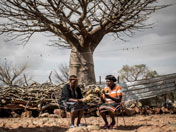
Harvesters hold baobab fruits in the village of Muswodi Dipeni (Aug. 28, 2018).
Photo: Per-Anders Pettersson/Getty Images
This has resulted in daily crime sprees. Just in the last few months, a man was killed in a hitman-style murder in the same parking lot where I left my bicycle as a young boy. A few weeks ago, a neighbor of my parents was shot while he was in his driveway. He died of his injuries later while at a hospital.
Several brethren in the pastorate have fallen victim to theft and robbery. One man’s mother was severely assaulted. Others barely escaped the destructive effects of mob riots. There had been three car hijacking attempts. Nevertheless, not one member suffered physical harm or bodily injury!
The experiences of God’s people show what it is like to have divine protection in a society where you need it. They should remind us of God’s promises for protection. Notice: “You shall not be afraid for the terror by night; nor for the arrow that flies by day” (Psa. 91:5). A few verses later, God states, “He shall call upon me, and I will answer him: I will be with him in trouble; I will deliver him” (vs. 15).
In any dangerous situation, we should be “instant in prayer” (Rom. 12:12) and call out to God for deliverance. Yet we should still be prudent, circumspect and “foresee the evil” to avoid such situations where possible (Prov. 22:3).
I worked in a dangerous neighborhood as a medical practitioner. Doctors in this area received “danger pay.” I had to be vigilant while walking from my office to my car in a shopping center by observing the movement of people in the reflection of shop windows and being ready to react.
Suffering
Despite some blessings still apparent in the country, South Africans continue to live against God’s Law. Decades of man’s rule and way of life have resulted in the misery of so many of its citizens today.
Almost a third of South African children under 5 years are chronically malnourished. Chronic hunger eventually leads to stunting of development and growth. As a general practitioner I have seen this daily. Several children have died in my or their mothers’ arms. When the most fragile members of society suffer like this, it is an indicator society as a whole is struggling.
Christians, too, while called and blessed by God, must endure suffering and the purpose is not always clear in the moment. If the majority of South Africans can endure suffering, and in many cases be content, how much more should it be for us, God’s elect?
Notice the Beatitudes in Matthew 5. Nine times from verses 3-11 Christ uses the word “blessed.” According to Strong’s, it means: “supremely blessed, well off or happy.” The Complete Word Study Dictionary adds an additional element: “Those receiving God’s favor, regardless of what their circumstances may be.”
Regardless of our circumstances, God has favored us to build His character. That knowledge should make us full of happiness!
Your fellow brethren go through tests and trials. For this reason, we should fervently pray for one another: “And whether one member suffer, all the members suffer with it” (I Cor. 12:26).
More so, Christ’s disciples follow in His footsteps. Since we recently came through the Passover and Days of Unleavened Bread, the lessons of Christ suffering for us should be fresh in our minds (I Pet. 2:21).
As we allow Christ to live His righteous life in us (Gal. 2:20), we should allow Him to teach us the same lesson. Jesus, even though He was the Son of God, learned “obedience by the things which He suffered” (Heb. 5:8).
Right Foundation
Recall Sir Southey’s hopeful words that South Africa’s prosperity would be built on diamonds. Fast forward more than a century. The nation’s mineral wealth has brought it lasting success, but its wrong foundation has resulted in growing problems and destructive effects.
On one end of the spectrum is the extreme poverty of most South Africans. On the other end of the spectrum is decadence—expensive cars, extravagant vacations and luxury toys. Instead of using the success brought by the rich mineral resources to benefit all, it only benefits a few.
King David described this state of indulging in luxury: “Verily every man at his best state is altogether vanity…Surely every man walks in a vain show…he heaps up riches, and knows not who shall gather them” (Psa. 39:5-6). Human effort alone leads to a “vain” or empty existence.
Regardless of our circumstances, Christians should learn to be content. Notice a passage in Proverbs: “Two things have I required of you; deny me them not before I die…give me neither poverty nor riches; feed me with food convenient for me. Unless I be full, and deny you, and say, Who is the Lord? Or unless I be poor, and steal, and take the name of my God in vain” (30:7-9).
Riches can lead to decadence and forgetting about God’s purpose for our lives. On the other hand, poverty can create an entitlement attitude and can lead to crime. Ask God to keep you from the pitfalls of both poverty and riches.
Matthew 7 reveals the rock God’s people must build our lives on now: “Therefore whosoever hears these sayings of Mine, and does them, I will liken him unto a wise man, which built his house upon a rock: and the rain descended, and the floods came, and the winds blew, and beat upon that house; and it fell not: for it was founded upon a rock” (vs. 24-25).
Soon all nations will learn to build on that same rock-solid foundation—God’s Word.
Royal Jewels
Two processes are required to produce diamonds: extreme temperature (at least 2,000 degrees Fahrenheit) and pressure. Geologists believe that diamonds were brought to the Earth’s surface by volcanic activity after they were formed about 90 miles deep in the mantle.
Discovered by accident, the Cullinan diamond was so big that it filled the palm of a man’s hand. It was later entrusted to I.J. Asscher and Co. in the Netherlands to be cut. Joseph Isaac Asscher, a famous diamond cutter, studied the diamond for many months before he started his work.
As mentioned, The Great Star of Africa and its smaller counterparts shine in the British Crown Jewels. They no longer resemble the original rough diamond. Their shape and size have changed as they went through a meticulous cutting and grinding process. The completed product is a multifaceted, brilliant, clear gem.
The spiritual parallel for Christians is unmistakable.
We have been given a precious calling to rule as king-priests with Christ in His Kingdom (Rev. 1:6). We will administer the many blessings of all nations. God “studied” us before the foundation of the world to be used for this great purpose (Eph. 1:4).
Just as diamonds are formed by extreme pressure under high temperatures, we must go through trials and pressure. To be part of the little flock that goes first, like gold being purified, our faith must be tried and tested as well (I Pet. 1:7). It can feel very hot!
Yet if we continue to build our faith and obedience based on the foundation of God’s Word, our character will shine like “gold, silver” and “precious stones” (I Cor. 3:12).
Just as a rough diamond must be cut and polished to shine, we must be shaped in character to become “perfect” as our Father (Matt. 5:48).
There is a time coming when God will “make up [appoint and accomplish] My jewels” (Mal. 3:17). Allow God to “finish” and “accomplish” His work of making you a precious stone. We can be confident “of this very thing, that He [the Father] which has begun a good work in you will perform it until the day of Jesus Christ” (Phil. 1:6).
When we are made into gleaming gems, we will be able to assist God in producing other precious jewels in every country and corner of the world.
Then people from all nations including South Africa will shine brightly.
Veröffentlicht April 28, 2021