Pillar Article
The Ephesian Era
The events of Pentecost, AD 31, are well-rehearsed in Christians’ minds. On that day, the Church that Jesus Christ promised to build (Matt. 16:18) began with a powerful display of miracles and the preaching of the gospel. By the end of the day, thousands of converts were baptized—and growth continued daily (Acts 2).
Fast-forward 64 years to an era of Church history not as well known. By AD 95, the Church of God was already a shadow of its former self. Most of the 12 apostles who were trained by Jesus were martyred—only John remained and he was exiled on the island of Patmos during the Roman persecution of Christians. Jerusalem had been demolished by the Romans in AD 70, forcing the Church to move its headquarters. A counterfeit movement was growing as deceivers within the Church worked to water down the truth, and thousands of members had gone along with it.
It is in this context that the last living original apostle wrote in the Bible’s last book: “John to the seven churches which are in Asia…” (Rev. 1:4).
As the author of the Church, God wanted its members—both then and throughout the ages—to know His thoughts about them and to know their place in history. Christ Himself told John in Revelation to “write in a book” everything He saw and “send it unto the seven churches which are in Asia; unto Ephesus, and unto Smyrna, and unto Pergamos, and unto Thyatira, and unto Sardis, and unto Philadelphia, and unto Laodicea” (vs. 11). Bible students know that these represent eras of the New Testament Church.
As the very first large subject in Revelation, it is a crucial message to Christians of all time periods. Verse 3 states: “Blessed is he that reads, and they that hear the words of this prophecy, and keep those things which are written therein: for the time is at hand.”
The instruction is plain: We must hear (pay attention) and keep (guard, note or prevent from escaping) all the words written in Revelation—particularly what is written to the Church eras—because of the imminence of “the time.”
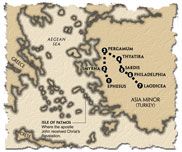
When John recorded this vision, the seven congregations were located in seven cities in Asia Minor that were part of a mailing and trading route. They are comparable to a megalopolis today—a chain of adjacent metropolitan areas such as Boston, New York City, Philadelphia, Baltimore and Washington, D.C.
Halley’s Bible Handbook explains: “These Seven Cities, connected by a great triangular highway, are named in their geographical order, beginning with Ephesus, thence north about 100 miles to Pergamum, and thence southeast to Laodicea, which was about 100 miles east of Ephesus.”
 view full size
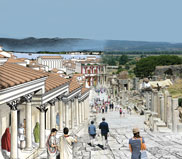
The ruins of the ancient city of Ephesus in Turkey are pictured next to an artistic representation of life in the city around the first century AD.
Photo Illustration: Paula C. Rondeau
Each city represented the corresponding attitudes that would exist in the seven eras they represented. They are personal messages from Jesus Christ to true Christians of all ages!
Knowing this, it is crucial we heed each era’s message. Not only does this allow us to glean lessons from them, it prepares us to soon live and work with Christians who have lived throughout 2,000 years of history.
A Strong Start
The first Church era, which lasted until approximately AD 98, is referred to as the “Apostolic Era.” The time period began on AD 31, on the day of Pentecost. Prior to this and before His ascension, Christ told His disciples how His Church would begin: “You shall receive power, after that the Holy Spirit is come upon you: and you shall be witnesses unto Me both in Jerusalem, and in all Judaea, and in Samaria, and unto the uttermost part of the earth” (Acts 1:8).
Then, the next chapter reads, “When the day of Pentecost was fully come, they were all with one accord in one place” (2:1). God then sent His Holy Spirit to 120 disciples, which was witnessed by many thousands gathered in Jerusalem for the Holy Day. For the next few decades, the Church performed incredible feats that are recorded throughout the book of Acts.
The early Church also faced constant persecution from the Roman government and Jewish authorities. They were challenged by some who even possessed miraculous (though demonic) power, including Simon Magus (Acts 8:9).
For these reasons, Christ inspired John to write this about the era: “Unto the angel of the church of Ephesus write; These things says He that holds the seven stars in His right hand, who walks in the midst of the seven golden candlesticks; I know your works, and your labor, and your patience, and how you cannot bear them which are evil: and you have tried them which say they are apostles, and are not, and have found them liars: and have borne, and have patience, and for My name’s sake have labored, and have not fainted” (Rev. 2:1-3).
Examining this message to Ephesus with historical context paints a clearer picture.
The Chief City
“Asia” in Revelation 1:4 referenced “a Roman Province in the west part of what we know as Asia Minor, now a part of Turkey,” Halley’s Bible Handbook states. “Ephesus was its chief city.”
Each of the seven cities had a congregation of Christians. For example, the apostle Paul requested that his epistle to the Colossians be “read also in the church of the Laodiceans; and that you likewise read the epistle from Laodicea” (Col. 4:13-16).
 view full size
Ancient Mail Route of Seven Cities in Asia Minor: The seven churches in Asia Minor, modern southwestern Turkey, were located in seven cities that were part of a triangular highway. The route was circular and included roads in between adjacent cities, yet this map depicts the route from Ephesus to Laodicea as outlined in Revelation chapters 2 and 3.
Source: The Restored Church of God
Ephesus itself was located off the Aegean Sea and had a population of around 225,000. Around AD 70, the New Testament Church Headquarters was moved to this city, and the congregation there typed the first of seven Church eras described in Revelation 2-3.
Here is a general description of the coastal city from Halley’s: “Ephesus was an old Ionian foundation at the mouth of the Cayster. Greek colonies which surround the Mediterranean and Black Sea were primarily trading-posts. Migrant communities of Greeks did not seek to dominate the hinterlands, but to secure an emporion or ‘way in,’ a bridgehead for commerce, and enough surrounding coast and territory to support the community. Great cities grew from such foundations from Marseilles to Alexandria, some of them royal capitals. And in all cases colonies became centers or outposts of Hellenism, distinctive, and civilizing.”
The city, “about halfway between Jerusalem and Rome, was the approximate geographic center of the Roman Empire; and it had, in John’s own lifetime, become the approximate geographic and numerical center of the Christian population of the world.”
The parallels here are distinct. God established His Church with power. He put 12 apostles in charge, not just for first-century converts, but as a foundation for Christians throughout the coming millennia (Eph. 2:20). The books of the New Testament are a source by which all future apostles would continue in truth.
The congregation at Ephesus was commended for its first works. The book of Acts records many of these impressive events. On the first day of the New Testament Church, 3,000 were added. Soon afterward, another 5,000 were added (2:41; 4:4).
The explosive increase during the first phase is best summarized by this brief description in Acts 12:24, “the word of God grew and multiplied.”
But the prosperity would not last, as Christ warned the first era that its candlestick would be removed if it failed to recover its initial zeal and works (Rev. 2:5).
Continuing in the handbook: “Ephesus displaced Miletus as a trading port, but when its harbor, like that of Miletus, in turn silted up, Smyrna replaced both as the outlet and emporion of the Maeander valley trade-route. In the hey-day of Asia Minor 230 separate communities, each proud of its individuality and wealth, issued their own coinage and managed their own affairs. The dominance of Persian despotism, wide deforestation, and the ravage of war in a natural bridge and highway between the continents slowly sapped this prosperity, but in early Roman times as in the days of its Ionian independence, Ephesus was a proud, rich, busy port, the rival of Alexandria and Syrian Antioch.”
Though powerful and influential at first, Ephesus’ downfall was its lack of staying power amid growing challenges and pressure.
The city was destroyed by the Goths in AD 263, thereafter rebuilt, partially destroyed in an earthquake in 614, and later captured by the Turks in the 1400s.
Today, Ephesus is nothing but ruins, not because of any one natural disaster or massacre by conquering forces, but because its own residents abandoned it.
Counterfeit Movement
Another commendation Jesus gave the Ephesians is recorded in Revelation 2:6: “This you have, that you hate the deeds of the Nicolaitans, which I also hate.”
The word Nicolaitan can mean “destroyer of the people.” They promoted lawlessness, especially regarding fornication. Some had infiltrated the Church and infused their pagan doctrines into God’s feast days, leading many Christians astray. Despite their teachings, there were still brethren in Ephesus who held fast to the truth.
Ephesus was home to the temple of Artemis, one of the Seven Wonders of the Ancient World and a sign of the city’s deep-rooted paganism. As such, the congregation faced numerous adversaries there, notably a silversmith who made figurines of Diana, the Roman name for Artemis (Acts 19:24-27). At one point, this craftsman riled a crowd against those worshipping the true God.
Some weathered the storm, but persecution across the Church left many beginning to grow impatient. Sixty-six years since the Church’s first Pentecost, corruption within increased. Persecution and infiltration of “destroyers” took a toll on Christians. Their “first love” wore off and they began to feel as though God’s way of life was routine.
Bear in mind that Christians of the Ephesian era had witnessed a time like no other in Church history. Many had interacted with Christ when He lived in the flesh. Most had seen awesome miracles performed by the apostles, and many members were given abilities that seem fantastical compared to the modern era—speaking different languages, performing healings, receiving prophecies and even bringing people back to life! Romans 12:6 and the entire chapter of I Corinthians 12 makes clear lay members were also granted certain gifts through God’s Holy Spirit.
But miracles faded, decades passed without Christ returning, apostles and other ministers were martyred, and antichrists tried to seduce brethren into denying Christ’s promises (I John 2:18). At that time, members increasingly may have thought, God is no longer working with us, and subsequently gave up hope.
Our book Where Is the True Church? – and Its Incredible History! states: “A period of declining zeal seemed to characterize the Church at this stage. The Nazarenes, as they were now called by the world, were at a low ebb, partly due to the disappointment of their great expectations for the imminent return of Christ, after the escape from Jerusalem surrounded by armies.
“This period of AD 70s marked the time when the organized preaching of the gospel was virtually halted. Certainly, most of the ministries in distant areas among the lost tribes of Israel still had momentum—from Britain to Parthia and beyond. But now, the organization and sense of unified mission that came from Headquarters was missing. Persecution and upheaval in Judea, in particular, crippled the momentum of the Church.”
Early Christians repeated the same mistake the ancient Israelites made after their exodus from Egypt—they let the memory of God’s power slip from their minds.
Because of this, Jesus sharply warned them: “Nevertheless I have somewhat against you, because you have left your first love. Remember therefore from where you are fallen, and repent, and do the first works; or else I will come unto you quickly, and will remove your candlestick out of his place, except you repent” (Rev. 2:4-5).
This passage carries a significant warning for all Christians.
“Do the First Works”
Widespread corruption can cause people to let up in wholeheartedly doing God’s Work. Notice Matthew 24:12: “And because iniquity shall abound, the love of many shall wax cold.”
If we find ourselves drifting away from our initial zeal as our Christian walk does not “go as expected,” look to Christ’s counsel to the Ephesians.
The first task to remember—meaning to “exercise memory…recollect…rehearse” according to Strong’s. Christ instructed the Ephesians living in the AD 90s—when the apostle John delivered the message to the Church—to actively think back to the state of the Church after its inception.
The epistles of Paul showcase the extraordinary love (agape, the type of godly love that can mean “benevolence” or “love feast”) of the first Christian congregations…
- To the Colossians: “We give thanks to God and the Father of our Lord Jesus Christ, praying always for you, since we heard of your faith in Christ Jesus, and of the love which you have to all the saints…” (1:3).
- To the Thessalonians: “We give thanks to God always for you all, making mention of you in our prayers; remembering without ceasing your work of faith, and labor of love, and patience of hope in our Lord Jesus Christ, in the sight of God and our Father…” (I Thes. 1:2-3). Also, “We are bound to thank God always for you, brethren, as it is meet, because that your faith grows exceedingly, and the charity of every one of you all toward each other abounds…” (II Thes. 1:3).
- And to the Philippians: “You have well done, that you did communicate with my affliction” (4:14).
As time passes from our initial calling, we may find ourselves in a similar condition as the Ephesians. We can no longer have the “first love” we had upon being led into God’s truth.
Think back to that time. Make it real in your mind. When you first realized God was working with you, it changed everything. You could not get enough of His Word. You prayed earnestly. You may have felt desperate to escape cataclysmic events in prophecy, to come out of the devil’s world, and to be in God’s Church and receive His Spirit. You recognized you were chosen for a special purpose reserved for only a select few in this world.
Look at any memorabilia you have from that time to recollect the mindset you once had.
After remembering, the next step is to repent and do. Jesus Christ counseled those who let their zeal slip to “do the first works; or else I will come unto you quickly, and will remove your candlestick out of his place, except you repent” (Rev. 2:5).
We can lose God’s Holy Spirit if we let our love wane. With that in mind, take active steps to “do the first works” again. Go back to the basics of Christianity: prayer, Bible study, meditation, fasting and exercising God’s Spirit.
Take to heart Christ’s encouraging words to Ephesus: “He that has an ear, let him hear what the Spirit says unto the churches; To him that overcomes will I give to eat of the tree of life, which is in the midst of the paradise of God” (Rev. 2:7).
With patience and diligent work, you can overcome the tendency to let down, and continue to maintain zeal and love for brethren and the Work—and effectively claim Christ’s promises given to all Christians since the Ephesian era.
Published September 12, 2019