Pillar Article
Smyrna: The Face of Persecution
An 86-year-old man stands defiant in a raucous amphitheater in mid-second-century Smyrna. He has a decision before him: Deny Christ or be burned alive.
This is Polycarp, a leading Church figure in the years following the death of the apostle John.
 view full size
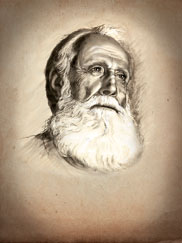
After the death of the original apostles, Polycarp (AD 69-156) was a Christian leader whose life exemplifies his era of the Church (Rev. 2:8-11).
Illustration: Paula C. Rondeau
The elderly man did not hesitate: “You threaten me with fire which burns for an hour, and after a little is extinguished, but are ignorant of the fire of the coming judgment and of eternal punishment, reserved for the ungodly. But why do you tarry? Bring forth what you will.”
Leading up to this time, many Christians were brutally martyred. Historian Eusebius recorded the intense persecutions of this period. He stated that Christians were “lacerated with scourges even to the innermost veins and arteries so that the hidden inward parts of the body, both their bowels and their members, were exposed to view; and then laid upon sea-shells and certain pointed spits, and subjected to every species of punishment and of torture, and finally thrown as food to wild beasts.”
Read that again. Put yourself in the shoes of brethren alive at that time. Imagine friends and family facing such ghastly ends.
Polycarp knew his likely fate when he was arrested, but he had already set in his mind to serve God rather than men (Acts 5:29). With his arrest imminent, he simply stated: “The will of God be done.”
Eusebius added to this, saying the aged leader remained “undisturbed” and “preserved a quiet and unshaken mind.”
According to the historian’s account, Polycarp refused to deny Christ and was burned at the stake, however, the flames did not touch him. Ultimately, the executioner pierced the elderly Christian with a dagger and gave him a swift death.
This was how the Smyrnan era of the Church began, a dark time when men and women held fast to the truth taught by the original apostles—many to the point of death.
Here is what the apostle John said about believers alive during this period from roughly AD 100-330: “And unto the angel of the church in Smyrna write; These things says the first and the last, which was dead, and is alive [Christ]; I know your works, and tribulation, and poverty, (but you are rich) and I know the blasphemy of them which say they are Jews, and are not, but are the synagogue of Satan. Fear none of those things which you shall suffer: behold, the devil shall cast some of you into prison, that you may be tried; and you shall have tribulation ten days: be you faithful unto death, and I will give you a crown of life. He that has an ear, let him hear what the Spirit says unto the churches; he that overcomes shall not be hurt of the second death” (Rev. 2:8-11).
Tribulation. Battling apostate brethren. Facing death. These qualities defined the life of Polycarp, but they also describe this entire chapter of Church history.
Yet we alive today also have an “ear to hear” what was said to the church of Smyrna. The historical record of those stalwart Christians can inspire us to hold fast now—and work earnestly to escape all the evils that Bible prophecy declares are imminent.
Christianity: “A Crime Against the State”
The reason for the intense persecution in Smyrna was linked to its past. The ancient city vied with Ephesus and Pergamos as the leading city of Asia Minor. Early on, Smyrna hitched itself to the rising star of the Roman Empire—first aligning with the city at the end of the third century before Christ. According to Halley’s Bible Handbook, “The city had worshipped Rome as a spiritual power since 195 B.C.; hence Smyrna’s historical pride in her Caesar-cult.”
It was this cult—the deification and worship of Roman emperors both alive and dead—that killed Polycarp and his contemporaries.
A 1912 article titled “The Worship of the Roman Emperors” published in the journal The Biblical World described why these religious fanatics hated Christians: “They honored the emperor as ruler, but declined to recognize him as god. This distinction the Roman authorities refused to admit. They insisted that the worship of the national gods—and the emperor in particular—was the duty of every citizen and that to refuse was an act of disloyalty. Hence the mere profession of Christianity was regarded as a crime against the state.”
If accused, all one had to do to avoid death was through “the simplest act or word implying reverence for the gods or acceptance of the divinity of the emperor.”
Consider. When faced with this intense trial, all a person had to do was imply reverence for the emperor. A few whispered words could mean the difference between eternal life or eternal death.
Polycarp himself was commanded to swear by the divinity of the emperor. He refused, choosing death.
The apostle Peter wrote to “honor the king” (I Pet. 2:17), but he also stated to “fear God.” Early Christians obeyed this command, often to the point of death.
Battling Heresy
While Smyrnans suffered violent persecution, there was also growing heresy—as groups drifted further from what the Bible, Jesus Christ, and the original apostles taught. The main offenders came from so-called Christians in Rome.
Polycarp worked hard to pull back those who had fallen into doctrinal error.
Mr. David Pack references Polycarp’s influence in his book Where Is the True Church? – and Its Incredible History!: “His efforts of admonishing and encouraging the brethren must have been of vital importance at this crucial period. Equally encouraging as his letters, was his example of boldly standing up for the truth when so many had given in to heresy.”
The book continues: “But the vast majority of those who left the fold were unmoved by Polycarp. Perhaps God intended that His servant Polycarp give them ample, merciful warnings of the seriousness of their actions. This he did.”
Under the influence of the teachings of Simon Magus, who claimed he was a true apostle, as early as AD 120, the Church of God in Rome gradually began to twist Church doctrines and substituted them with pagan teachings from the Babylonian mystery religion.
As heresy spread, a conflict arose in the Church of God regarding Passover observance. The bishop at Rome insisted on keeping the celebration of the pagan festival of Easter.
Polycarp determined to go to Rome and personally confront the presiding bishop, Anicetus, about it. But the Smyrnan elder’s efforts to proclaim the truth were useless against the rising tide of paganism infiltrating what was considered the true Church at the time.
The Passover controversy was recorded by Irenaeus, who sided with those drifting from the truth. He wrote: “For neither could Anicetus persuade Polycarp not to observe it [the Passover], because he had always observed it with John the disciple of our Lord, and the rest of the apostles, with whom he associated; and neither did Polycarp persuade Anicetus to observe, who said he was bound to maintain the practice of the presbyters before him” (An Ecclesiastical History to the Year 324 of the Christian Era).
After Polycarp’s death around AD 160, his faithful student, Polycrates, became leader of the Church. A strong and committed man, Polycrates faced many of the same issues as his predecessor. He too was forced to confront Roman leaders over the issue of observing Passover on the 14th of Abib.
Here is what he wrote to Victor, the presiding bishop of Rome: “As for us, then, we scrupulously observe the exact day [Abib 14], neither adding nor taking away. For in Asia great luminaries have gone to their rest, who shall rise again in the day of the coming of the Lord, when He comes with glory from heaven and shall raise again all the saints. I speak of Philip, one of the twelve apostles, who is laid to rest at Hierapolis; and his two daughters, who arrived at old age unmarried; his other daughter also, who passed her life under the influence of the Holy Spirit, and reposes at Ephesus; John, moreover, who reclined on the Lord’s bosom…Then there is Polycarp, both bishop and martyr at Smyrna; and Thraseas from Eumenia, both bishop and martyr, who rests at Smyrna.”
Polycrates then listed many other notable brethren from his time who held to the Bible truth of Passover observance. He concluded: “These all kept the passover on the fourteenth day of the month, in accordance with the Gospel, without ever deviating from it, but keeping to the rule of faith.”
This letter was written around AD 200. The friction between those who faithfully kept God’s Word and those who adopted the ideas of men continued to grow as the decades rolled on.
“Tribulation Ten Days”
As the years ticked by, the Smyrnan era continued to suffer violence. Foxe’s Book of Martyrs stated that under Emperor Maximinus Thrax, around AD 235, “numberless Christians were slain without trial, and buried indiscriminately in heaps, sometimes fifty or sixty being cast into a pit together, without the least decency.”
Foxe recorded that one man was captured for being a Christian around AD 250. He was then “put in a leather bag, together with a number of serpents and scorpions” and then thrown into the sea. Another man, refusing to sacrifice to the goddess Venus, was “stretched upon a wheel, by which all his bones were broken” before being beheaded.
Still others at this time were stoned, beaten with staffs, torn with hooks, and burned with red-hot irons.
This all led to the “ten days” of tribulation mentioned in Revelation 2. According to the prophetic day-for-a-year principle (Num. 14:34; Ezek. 4:6), this accounts for 10 years of intense persecution. On February 23, AD 303, Emperor Diocletian issued the first of a series of edicts that ordered Christians to worship the Roman gods. A man named Galerius, who later became emperor, enforced these rulings with murderous relish.
Foxe recorded the martyrdom that began that day in the city of Nicomedia: “All the Christians were apprehended and imprisoned.” Reportedly, Galerius secretly ordered the imperial palace to be set on fire and to frame the Christians so he could more easily carry on his persecution.
The book continues: “No distinction was made of age or sex…Many houses were set on fire, and whole Christian families perished in the flames; and others had stones fastened about their necks being tied together were driven into the sea. The persecution became general in all the Roman provinces, but more particularly in the east; and as it lasted ten years it is impossible to ascertain the numbers martyred, or to enumerate the various modes of martyrdom.”
The 10 years officially ended when Constantine legalized Christianity in 313. While this eased the persecution for true Christians, it also marked the start of Roman-flavored Christianity mingling with the government. The movement that Polycarp and Polycrates vehemently opposed set the table for the next Church era Pergamos, which opened with God’s people being demonized as “Judaizing Christians.”
Smyrna-Philadelphia Connection
True Christians during the late apostolic era and onward were given various names such as Nazarenes—as in those who follow Jesus of Nazareth. Yet other names were more derogatory. “Ebionites” is one such example. It comes from the Hebrew word for pauper or poor. Recall what Jesus said about Smyrna in Revelation 2: “I know your works, and tribulation, and poverty, (but you are rich)” (vs. 9).
These brethren followed Jesus’ command to lead simple lives (Luke 18:22) and stayed true to how the New Testament Church began: “And all that believed were together, and had all things common; and sold their possessions and goods, and parted them to all men, as every man had need” (Acts 2:44-45).
 view full size
A view of Izmir, Turkey’s third most populous city and known anciently as Smyrna.
Photo: Getty Images
Of course, those in the Church of God follow these same standards and commands today. While we currently live in the Laodicean era, we strive to maintain the Philadelphian standard.
The links between Smyrna and Philadelphia are compelling. These are the only two eras to receive a completely positive report from Jesus Christ. All others are mixed or completely negative.
Halley’s Bible Handbook made this connection: “Smyrna and Philadelphia, the two cities with good churches, are still flourishing cities. Sardis and Laodicea, the two cities with bad churches, are now deserted and uninhabited sites.”
Yet there is a strong difference between Smyrna and Philadelphia. Before we look at it, we must step back and examine what Jesus said events would surround His coming.
Matthew 24:3 states: “And as He sat upon the mount of Olives, the disciples came unto Him privately, saying, Tell us, when shall these things be? And what shall be the sign of Your coming, and of the end of the world?”
Verses 9-13 describe a coming period of persecution and apostasy, even surpassing what Smyrna went through millennia ago: “Then shall they deliver you up to be afflicted, and shall kill you: and you shall be hated of all nations for My name’s sake. And then shall many be offended, and shall betray one another, and shall hate one another. And many false prophets shall rise, and shall deceive many. And because iniquity shall abound, the love of many shall wax cold. But he that shall endure unto the end, the same shall be saved.”
In other words, horror and evil will precede Christ setting up the Kingdom of God. Yet here is where Smyrna and Philadelphia differ. In Luke’s companion account to Matthew 24, Jesus states: “Watch you therefore, and pray always, that you may be accounted worthy to escape all these things that shall come to pass, and to stand before the Son of man” (Luke 21:36).
God promises this for those of Philadelphian condition: “Because you have kept the word of My patience, I also will keep you from the hour of temptation, which shall come upon all the world, to try them that dwell upon the earth” (Rev. 3:10).
Brethren, we can be kept from this global “hour of temptation”!
Salvation is already settled for the brethren martyred in the era of Smyrna. For us alive today, let’s heed Christ’s words. Let’s watch the darkening events around us and be ever vigilant in our lives. Let’s beseech God that we may be accounted worthy to escape the horrible trial coming.
Allow the reality of what Smyrna went through to settle in your bones. Read and reread what they endured. May these tales of martyrdom motivate us to action—so we may be spared from all that is coming.
Published November 26, 2019