Pillar Article
Philadelphia: The Grand Pattern Established!
The Philadelphian era of the Church would be markedly different from the one that preceded it (Sardis). Instead of being considered “dead” (Rev. 3:1), this Church era was noted for the characteristics of the city it was named after: brotherly love, faithfulness and patient perseverance, even through times of upsets and upheavals. It was to be vibrant with life—and the impact of its Work was prophesied to reach far and wide!
Read Jesus Christ’s words to Philadelphia in Revelation 3: “These things says He that is holy, He that is true, He that has the key of David, He that opens, and no man shuts; and shuts, and no man opens. I know your works: behold, I have set before you an open door, and no man can shut it: for you have a little strength, and have kept My word, and have not denied My name” (vs. 7-8).
When studying the preceding periods of Church history, it can be difficult to accurately learn about the leaders of those times, such as Polycarp, Constantine of Mananali, and Peter Waldo. This is not the case with the leader of God’s Work during the Philadelphian era.
Herbert W. Armstrong led the Worldwide Church of God (formerly the Radio Church of God) from 1934 until his death in 1986. Over the course of his ministry, hundreds of millions heard his voice and read his literature. The scope and power of his ministry was unprecedented in almost 2,000 years of New Testament Church history—and probably in all history!
Over time, God revealed through this man true doctrines that had been lost over the centuries. Even though he came under extraordinary attack throughout his life, he never allowed this to deter him. Although Mr. Armstrong is gone, the huge impact of his ministry still resonates.
But aside from taking a deeper look at the accomplishments of Christians during this brief, prosperous period, it is important to review the characteristics of those in the Philadelphian era and God’s special promises to them.
Note the rest of the passage in Revelation: “Behold, I will make them of the synagogue of Satan, which say they are Jews, and are not, but do lie; behold, I will make them to come and worship before your feet, and to know that I have loved you. Because you have kept the word of My patience, I also will keep you from the hour of temptation, which shall come upon all the world, to try them that dwell upon the earth.”
“Behold, I come quickly: hold that fast which you have, that no man take your crown. Him that overcomes will I make a pillar in the temple of My God, and he shall go no more out: and I will write upon him the name of My God, and the name of the city of My God, which is new Jerusalem, which comes down out of heaven from My God: and I will write upon him My new name” (vs. 9-13).
The zeal of the Philadelphian era has been replaced by the lukewarm attitude of those in the Laodicean era. Therefore, the sixth era has become the example for those today who wish to strike up and maintain their enthusiasm for God’s Way!
Humble Beginnings
Christ began opening doors for the Philadelphian phase of His Work through Mr. Armstrong in 1934 through radio (The World Tomorrow program) and printing press (The Plain Truth magazine). At the same time, Mr. Armstrong slowly added certain crucial pieces of literature that could be offered to the public. Within its first 19 years, the broadcast grew tremendously, until it blanketed North America.
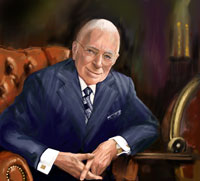
Herbert W. Armstrong, founder and pastor general of the Worldwide Church of God.
Illustration: Paula C. Rondeau
The next phase, beginning in 1953, saw the gospel broadcast in Europe over Radio Luxembourg, the world’s most powerful station at that time.
The Plain Truth began in the form of 350 copies cranked by hand on a mimeograph. Years later, Mr. Armstrong wrote: “It is doubtful whether any institution in human history started from as humble and small beginnings. When God starts something on His power alone, it is big from the beginning. For example, the creation of the universe—the creation of the earth. But when God starts something through humans, it usually, like the grain of mustard seed, starts the very smallest and most humble, and then grows as the spiritual character of the humans develops” (“Now It Must Be Revealed How the Worldwide Church of God Began,” Good News, May 1979).
This magazine was part of what Mr. Armstrong called a “Three-Point Campaign”: The radio broadcast brought in listeners—the magazine gave readers greater details of what the Bible actually teaches—and these were followed and reinforced by nightly evangelistic campaigns.
Explosive Growth
During the turbulent 1960s, the Work and God’s Church continued to mushroom in size and power. By the end of the decade, The Plain Truth reached more than 2.2 million copies per year. The Radio Church of God exploded in attendance, from approximately 7,000 in 1960 to more than 54,000 in North America by 1969.
Up until 1960, there had only been one Feast site for brethren to attend God’s fall festival. By the end of the 60s, there were five major (and two smaller) Feast sites in North America, ranging from 7,602 to 12,250 attendees, with many additional sites located in other parts of the world.
In the meantime, Ambassador College was also growing, acquiring new properties on the Pasadena campus, including the addition of properties nearby that were not directly contiguous with the 59-acre campus. The college began to take on a breathtaking beauty, noted for its Italian sunken gardens and Japanese gardens. In the 1970s, the college won national awards year after year recognizing it as the most beautiful campus in America.
In 1960, a second campus opened, this time in the United Kingdom. Once again, Mr. Armstrong was led to another magnificently landscaped property, located on a 10-acre estate 19 miles northwest of London, in Bricket Wood. With the Work growing around the world in quantum leaps, it was necessary to train more students with an international background so that they could return to serve in their own countries, either in the ministry or in the growing number of regional offices serving an expanding Church, now with members on every continent and in scores of countries.
Also in 1960, Mr. Armstrong completed his first trip around the world, during which he had arranged for 39 radio stations to blanket Australia with the program.
In 1964, God inspired Mr. Armstrong to establish yet one more Ambassador College campus, this time in Big Sandy, Texas.
International offices of the Work were set up and staffed in several countries, including the United Kingdom, Canada, Australia, the Philippines, South Africa, New Zealand, Germany, Mexico and the Caribbean.
With the growing presence of The World Tomorrow, now expanded to include television, and the Work continuing to increase by 30 percent each year, the Church changed its corporate name to better reflect its size and growth. In 1968, the Radio Church of God became the Worldwide Church of God.
Visiting Heads of State
In 1968, Mr. Armstrong’s ministry entered an unprecedented new stage. King Leopold III of Belgium sent word through the Church’s German office that he would like to meet Mr. Armstrong. The two met at the king’s Belgian chateau and started what became a long friendship. It also led to the opening of a monumental door—one that would put Mr. Armstrong in the presence of kings, presidents, prime ministers, and other heads of state around the world.
Nothing in the first 35 years of the Church’s existence—or its first 1,900 years—would have signaled to Mr. Armstrong what God was about to do. He could not have imagined that he would eventually meet leaders such as India’s Indira Gandhi, Israel’s Golda Meir, the president of Indonesia, the president of the Philippines, Prince Mikasa of Japan, Egypt’s Anwar Sadat, England’s Prime Minister Margaret Thatcher, the king of Thailand, and a great many others—over one-third of the world’s heads of state!
Growth Continues
By the 1970s, congregations existed in all of the larger and mid-size cities in the United States and Canada. Many existed in Britain, Australia and Africa, throughout Latin America, and around the world, with members in over 120 countries. Television was also utilized, beginning in earnest in the 1970s (with the exception of a brief 13-week television trial in the mid-1950s).
By the late 60s, and constantly until 1977, Mr. Armstrong was visiting world leaders. Preaching the gospel of the soon-coming Kingdom of God occupied over 80 percent of his time—about 300 days a year. Not since the time of the original apostles had the gospel message gone out in such power.
In 1977, Mr. Armstrong suffered complete heart failure. Those present insisted that, according to his vital signs, he was lifeless. CPR was administered and he was revived.
Upon rehabilitation, he found himself having to quell a rebellion, in which a liberal element within the ministry had been posturing for control of the Church during his extended absence. He was able to purge most of the instigators. In 1979, a small group of dissidents petitioned the state of California, which led to an attack by the state. They attempted to place the Worldwide Church of God into receivership, pending investigation of the dissidents’ charges. This amounted to a major crisis for the Church and the Work. But, as He always had, Christ saw His Church through this crisis. Through Mr. Armstrong, He made some major moves over the next three-and-a-half years to put the Church back on track.
The result was dramatic!
One by one, Mr. Armstrong re-established doctrines that had been watered down or discarded by the liberals who had been at work behind his back while he was traveling the world.
Mr. Armstrong also turned his attention to the youth of God’s Church. In Y.O.U. (Youth Opportunities United), weekend activities were set up for teenagers—basketball, track and field, dances, etc. The camps comprising the S.E.P. (Summer Educational Program) had already existed, teaching teens to broaden their interests and helping them to build confidence.
In 1981, a youth magazine (Youth 81, 82, 83, etc.) was launched. Each issue offered articles that pointed teens in the Church in the right direction, while helping them prepare for life’s challenges. Y.E.S. (Youth Educational Services) lessons and activities were established for young children and preteens, teaching them God’s ways.
The Plain Truth magazine reached a circulation of 8,270,000. At no other time in Church history have God’s servants reached a fraction of this number!
The Feast of Tabernacles became the largest annual, multi-site convention on Earth. Full-page ads were published in The New York Times, The Wall Street Journal, The Washington Post, and the Los Angeles Times, among others. A massive international Plain Truth Newsstand Distribution Program was put into action.
The scope of Mr. Armstrong’s ministry was unprecedented in the almost 2,000 years since the Church was founded on Pentecost AD 31. Truly, God had set before the Philadelphian era “an open door” that no man could shut (Rev. 3:8).
Of course, this phase of God’s Work ended soon after Mr. Armstrong’s death in 1986. Yet we should never allow what occurred during Mr. Armstrong’s ministry to become a mere account in Church history.
The Work done in the 20th century was a forerunner of what will yet occur. Mr. Armstrong believed at the end of his life, “The greatest work lies yet ahead…”
Zeal and Brotherly Love
God could have chosen to call this era by another name, perhaps one that more reflected the size of the Work it would do. But He chose to call it Philadelphia, which denotes brotherly love.
Many members of the Church during the 20th century seemed to reflect this meaning. Church members regularly invited one another to each others’ homes for meals and fellowship. There were frequent activities: sports, socials, youth camps, and Spokesman Clubs. In countless instances, genuine care and concern expressed themselves in clear ways. In general, members recognized and treated one another as brothers and sisters of a “Church family.”
Yet Christians possessing this Philadelphian mindset cannot allow their brotherly love to be only “skin deep.” We must also develop and grow in true godly love, which in the Greek is the word agape.
Notice the definition of agape from Thayer’s Greek-English Lexicon of the New Testament: “affection, good-will, love, benevolence.” The lexicon summarizes one use of this word as “the love of God towards men.” Other Bible passages show this word can also signify the “love of Christians towards Christians.” (See II Corinthians 2:4 and Philippians 1:7-8.)
Remaining focused on the Kingdom of God—and the part you can play in it—is the ultimate expression of “agape.”
The love of a Philadelphian-minded Christian urges him on in the face of opposition and hardship. His heart is set to help do his part in rebuilding the Church and Work. He sees the door is still open and time is short. He does not flag in his commitment. He keeps holding fast no matter how long it takes.
Mr. Armstrong lived every day believing and hoping Christ would return. Yet, instead of becoming comfortable, that spurred him on to work, live and pray fervently each day.
In one of his last letters to members and co-workers, he explained his deteriorating health had kept him from fulfilling his usual work. He wrote: “Until the present moment I felt that God might provide a way for complete recovery, and he still may. So I have withheld this statement until now, but I feel it is better that you all know the condition. I am now in my 94th year.”
“Remember, this is the work of the living Creator God…I will continue to give my all to the work of God up to the last breath. I hope you will all realize the seriousness of the time in which we live and that nothing is important any longer other than to be close to God and assured of a place in his very soon-coming Kingdom.”
Decades later, may this describe all of us!
It takes concerted effort to remain zealous in God’s Work. It takes determination to hold fast to the truths of God, especially in these tumultuous times. Look back to the zeal of true Christians during the 20th century. Let their examples exhort you to press on.
Determine to be a pillar in the Church and set your will to never give up. Remember, faithful Christians today must continue in the Philadelphian mindset by exhibiting true brotherly love for all of mankind.
Megjelent July 31, 2020