Pillar Article
‘Closer than a Brother’
Learning from Bonds Forged in War
By F. Jaco Viljoen
When they came together for basic training in Georgia, they were strangers from all walks of life across America. A college baseball and football player in Los Angeles. A world-traveler and Yale student from New York City. A factory worker from West Virginia. A volunteer firefighter in Oregon.
But as paratroopers of Easy Company—part of the U.S. 101st Airborne Division made famous in the TV miniseries Band of Brothers—they would learn to lean on each other to survive some of the war’s most gruesome battles.
First dropped behind enemy lines prior to the June 6, 1944, D-Day invasion of Normandy, France, to secure key points, the soldiers had to regroup in the pre-dawn darkness. During their last major engagement in Battle of the Bulge that December, they held on despite being surrounded by German forces in Bastogne, supplied with little winter clothes, food and ammunition.
What helped the “Screaming Eagles” (the company’s nickname) withstand tremendous pressure to surrender?
That is summed up in their motto, “Currahee”—a Cherokee word for “stand alone together”—which came from the name of the mountain in Georgia on which they would run up three miles and down another three during boot camp.
“Stand alone together” would define the group’s characteristics well after training. As it implies, this group of soldiers are remembered for their loyalty and trustworthiness toward each other in action—despite often being separated from supply lines and surrounded by enemies.
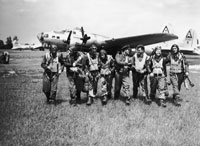
A bomber crew of the U.S. Air Force returning from a mission over Europe (June 14, 1944)
Fox Photos/Getty Images
These types of bonds are not limited to the men of the 101st. Veterans often experience a special closeness with their comrades. Author and war journalist Sebastian Junger said this brotherhood makes veterans “miss war” after returning home. They “missed in some ways the opposite of killing,” he explained. “What they missed is connection with the other men” with whom they fought.
Mr. Junger calls this brotherhood the “core experience of combat…The willingness to die for another person is a form of love, and is a profound and essential part of the experience,” as quoted by PBS.
“Some combat veterans have felt that their lives never mattered more than when they were in combat,” PBS continued. “This sense of meaning and purpose grows out of protecting, and being protected by, their comrades in arms—a shared commitment to safeguard one another’s lives that is non-negotiable and only deepens with time.”
While deployed, the men knew by experience that those around them had their backs, and would be willing to sacrifice themselves if “it came down to it.” This brought a level of comfort that gave them tremendous courage in the face of fear. That type of relationship they often could not find when back in society—a “friend that sticks closer than a brother” (Prov. 18:24).
Christians, who are compared to soldiers enduring hardness (II Tim. 2:3), should seek the same level of bonds with one another. We are part of a tight-knit group forged by the spiritual battles we face.
The apostle Peter charged God’s people: “Honor all men. Love the brotherhood. Fear God. Honor the king” (I Pet. 2:17).
Let’s explore why those called to be Christian warriors are to understand that they are part of a brotherhood, and how they are to love it.
The Strongest Kind of Bond
As Christians in God’s Church, we are to have close ties. Let’s take a closer look at Peter’s fourfold command to see how this works.
This verse highlights four entities and how we are supposed to relate to each. First, we read about honoring all men, referring to humanity as a whole. The verse also states we are to fear God and honor “the king”—man’s government.
The way we are to relate to the second group is special. Peter specifically chose the term “brotherhood” so that readers would know he was not referring to physical family members.
A brotherhood is defined as a group of people having a common interest or shared purpose. The Greek word Peter used to denote brotherhood can mean a fellow believer.
Recognize that Christians have more than just common interests. We are united in the belief that we are God’s begotten children, and thus are spiritual brothers. We have the same Father, and Christ is our older brother.
Peter instructed us to “love” this body of believers. Why? He could have said that we are to “honor” it, as we are to do with individuals in society and government officials.
Love implies you have a strong affinity for something. If you love music, you are naturally drawn to listen to it. You are willing to spend thought, time and energy on the things you love without having to be told to do so.
While this should definitely be the case with our brethren, the first-century apostle went a step further. He used the Greek form of love that refers not to human love, but to the love of God—agape. This is different from philia, which is the bond between siblings, for instance.
Christians should of course be friends with one another and strive to be as connected as siblings. But having godly love toward the brotherhood runs deeper. God set the example. It is His love that moved Him to give His only Son for us.
We should have the same commitment toward each other. As Christ told His disciples: “Greater love has no man than this, that a man lay down his life for his friends” (John 15:13).
The term “lay down” can also mean to ordain, purpose or set forth. In effect, Jesus had told His disciples that the purpose of your life is to support each other. In other words, “loving the brotherhood” requires more than just a feeling.
Doing Your Part
Romans 15 explains a way we can “purpose” our lives for our Christian brothers and sisters. Read verses 1-2: “We then that are strong ought to bear the infirmities of the weak, and not to please ourselves. Let every one of us please his neighbor for his good to edification.”
Soldiers in battle work in teams and must be ready to fulfill any part with a moment’s notice. For example, if the leading member of the team is suddenly brought down by gunfire, another must drum up the courage to keep the rest of the team’s morale high—else the squad could break and flee. If one infantryman gets hit by shrapnel, other team members will put themselves in harm’s way to retrieve him and take him to a medic.
Just as soldiers in battle realize war is about the man next to you, Christians should be at the ready to put the needs of the group in front of their own desires.
Are you dependable and reliable? Can your brothers and sisters rely on you “when it comes down to it”?
It might be as simple as fulfilling your duty to bring a meal or snack item to your congregation for after services. Your team depends on you to provide that one item each week. Or it could be making the effort to deliver a smile to show others you are approachable.
Starting with these basics, take it further. Instead of just “showing yourself friendly,” take initiative and ask how others are doing. If during your conversation you learn that there is an area you can help with, volunteer yourself. Perhaps you hear a widow talking about having problems with her lawn mower and has not been able to cut her lawn for a couple of weeks. If you are physically able to help, offer to bring your mower and cut her lawn. Think about how this simple act helps build a lasting bond between you and the widow.
Christ emphasized the importance of recognizing those who have need and giving out of your abundance to satisfy those needs. Read Luke 3:11: “He that has two coats, let him impart to him that has none; and he that has meat, let him do likewise.”
This principle carries beyond the offer of physical items. You might be strong in a specific area with training and experience.
For instance, if you have a background in building or repairs, be sure to make those in your congregation know that you can and are willing to help. Or if you have the time, resources and desire to bake and cook, make extra for those who struggle to obtain food because of circumstances beyond their control.
Be ready to “bear you one another’s burdens” (Gal. 6:2). A “burden” is simply something that is too heavy to carry alone.
Stay in contact with those who are going through tests and trials and do what you can to lighten the load. Put yourself in others’ shoes—treating them the way you would want to be treated if you were going through a challenging time yourself.
This involves real sacrifice—giving of yourself—and going against the human tendency to stay comfortable. Recall James deemed visiting the “fatherless and widows in their affliction” as “pure religion and undefiled before God and the Father” (1:27).
Fulfilling your part as a brother in the Church will ensure you reap the rewards God intended for His saints.
Pushing Forward Together
Many soldiers accredit their deep bonds to helping them eradicate the fear of battle. Overcoming their fear not only helped them survive to the end of the war, it strengthened their bonds even further.
Men cut off from God learn these lessons through one of life’s most harrowing experiences. Yet this important principle has been written down for all who are willing to take heed. Notice: “There is no fear in love; but perfect love casts out fear: because fear has torment. He that fears is not made perfect in love” (I John 4:18).
A major reason Peter urged brethren to “love the brotherhood” is because he knew it is the way to overcome fear. Fear prevents us from advancing toward our ultimate goal.
As Christian soldiers, our goal is so much greater than simply surviving. We are all striving to be full, glorified members of God’s Family and rule in the Kingdom of God (Matt. 6:33).
Relying on one another will ensure we can make it there together! The more love we exhibit toward each other, the tighter our brotherhood will be, which will provide the confidence to get through any challenge that might take us off the path toward the Kingdom.
Living God’s Way daily is our training ground to qualify for membership in God’s Family. During periods of personal or collective hardship, remember that what you do to care for others is what will help you through.
As we march in unity, know that the brothers on our sides have our backs in times of need.
Publicado December 14, 2021