Pillar Article
Another Way to View Christ’s Sacrifice
He was beaten with fists. Bloodied by a whip. Bruised with a rod. Brutally nailed to a wooden stake. Yet all this could not compare to the emotional anguish Jesus Christ was suffering at the end of His life.
In Matthew 27:46, Jesus cried to His Father: “My God, My God, why have You forsaken Me?”
Christ was experiencing something He never had throughout His eternal existence—being cut off from the Father He had lived with and trusted for His every need (John 5:19).
Jesus was quoting Psalm 22:1, which states: “My God, My God, why have You forsaken Me? Why are You so far from helping Me, and from the words of My roaring?”
“Forsaken” in Matthew 27:46 can mean to abandon, leave in straits, or be helpless, according to Vine’s Expository Dictionary of New Testament Words.
Take a moment to wrap your mind around this: A God-being felt helpless.
This separation was the price both Father and Son were willing to pay for humanity’s sake. Because all of our sins were imputed to Christ, God the Father had no choice but to separate Himself. Isaiah 59:2 shows God’s relationship with sin: “Your iniquities have separated between you and your God, and your sins have hid His face from you, that He will not hear.”
This is difficult for us to grasp. For one, the extent of the physical pain Christ endured through this brutal execution method was unfathomable. His bones were all out of joint. His skin and muscles were ripped out by the cat-o-nine tails to the point He could see and identify all His bones (Psa. 22:17). His body was bloodied from the lashings, and the crown of thorns pressed deep into His vascular head. Isaiah 52:14 declares He was “marred more than any man.”
Yet it is even more challenging to comprehend the utter helplessness brought on by the abandonment of the Father.
Reading further in Psalm 22, Christ gives a comparison that can help us better understand His emotional state: “I am a worm, and no man; a reproach of men, and despised of the people” (vs. 6).
Let these words sink in.
The term “worm” could describe many creatures, such as tiny grubs and 5-inch-long earthworms. All of them live under man’s foot. They are disregarded by all above them and are subject to being stepped on and crushed.
Christ, as the Word (John 1:14), had lived for eternity before His birth as a physical human being. Under the Father’s direction, He created billions of galaxies and planets. His glory was like the sun in its strength (Rev. 1:16). He had limitless power. And His joy never ceased.
Jesus gave that up to become a mere fleshly human being. Yet that was still far above a worm. Recognize what it took for Him to feel like a pitiful ground crawler.
Job, too, referred to himself this way to describe his emotional turmoil. He stated: “I have said to corruption, You are my father: to the worm, You are my mother, and my sister” (17:14).
The Hebrew word translated “worm” in this verse is rimmah, which is defined by Strong’s Concordance as a maggot.
Consider that Job had just lost all his livestock, his children and his health. He was treated maliciously by his wife and felt rejected by God. The best way he could summarize the crushing humility was by calling himself the son of a maggot.
How utterly worthless one must feel to compare himself to a larva that crawls on dirt and eats decomposing dead matter!
By labeling Himself a worm, Jesus Christ gave us a way to more deeply appreciate His sacrifice.
Unique Creature
The word “worm” referring to Jesus in Psalm 22 differs from the one Job used. The Hebrew word is tola. It also refers to a maggot but specifically “the crimson grub.”
When fully understood, this term sheds light on the full extent of Christ’s sufferings.
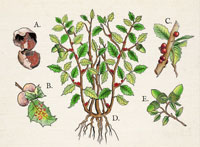
Anciently, dye makers would pull female Kermes ilicis from bushes and trees. Inside the bodies of these scale insects would be unfertilized eggs (A) that would be dried into “grains” to be used in the scarlet color-making process. During a normal life cycle, the insects often lay their eggs (B) in the kermes oak, which is a slow-growing evergreen shrub common in the Mediterranean region (C). The red-colored females fasten themselves to the trees (D) that provide sustenance for themselves and their offspring. The kermes oak’s ovoid shaped acorns (E) are similar to the Palestine oak, another common home for the insect.
Illustration by Jody E. Lydick
Crimson grub is an insect of the genus Kermes. Species in this group include Kermes vermilio and Kermes echinatus—yet this article will focus on the ilicis variety. While not technically a worm, as they hatch with legs, females eventually lose their limbs. This is possibly what gives them their worm designation.
The tiny insect—7 millimeters in diameter at largest—is notable for its color. Brownish-red when young, they become more reddish in color when maturing. According to The Encyclopaedia Britannica 11th Edition, when the insects reach maturity, they “appear full of a reddish juice resembling discolored blood.”
When the insects make it to this state, they are collected and killed to extract a crimson dye. Crimson is a deep red color, with tinges of blue or purple, close to the dark color of deoxygenated blood.
In calling Himself a crimson grub, Christ described His state in two ways.
First, it represents His sacrificial body and the blood He shed for mankind’s sake (Matt. 26:28). Interestingly, the dye produced from the crimson grub was so valuable that it was used as tribute paid to conquering Roman armies. Landlords in the Middle Ages also accepted it as payment for rent. Jesus Christ’s blood is the ransom payment for our sins (Rev. 1:5).
It is this blood we symbolically drink during the Passover service (I Cor. 11:25).
Second, the crimson grub comparison reveals Jesus’ state of mind as He was despised and rejected by men and separated from His Father (Luke 17:25).
Notice Isaiah 53:3-4: “He is despised and rejected of men; a man of sorrows, and acquainted with grief: and we hid as it were our faces from Him; He was despised, and we esteemed Him not. Surely He has borne our griefs, and carried our sorrows: yet we did esteem Him stricken, smitten of God, and afflicted.”
Not a man with sorrows—a man of sorrows. Acquainted with grief—which can mean anxiety and calamity.
Because of this emotional torment, “we have not a high priest which cannot be touched with the feeling of our infirmities; but was in all points tempted like as we are, yet without sin” (Heb. 4:15).
Sacrifice for All
God proclaimed that He would purge Israel of its sins: “Come now, and let us reason together, says the Lord: though your sins be as scarlet, they shall be as white as snow; though they be red like crimson, they shall be as wool” (Isa. 1:18).
Notice the word crimson—its Hebrew form is tola. This is the same term used to describe Christ as a crimson worm in Psalm 22!
This creates a direct association between Israel’s sins and the bloodshed of Jesus.
In Isaiah 1:15, the Eternal states that the nation’s “hands are full of blood.” While this includes the blood of innocent people, it also refers to the lifeblood of an incarnate God-being. Chapter 41 of the book labels Jacob a “worm” (vs. 14). The term for worm there is again tola.
The apostle Peter understood this and told listeners at the creation of the New Testament Church, “Let all the house of Israel know assuredly, that God has made that same Jesus, whom you have crucified, both Lord and Christ” (Acts 2:36).
The sacrifice of a perfect, sinless Being is the first step to purifying mankind’s sins completely. Yet that does not automatically bring righteousness—God states we must repent and be pardoned in order to have a clean, white-as-snow slate.
Hebrews 9 demonstrates the tremendous significance of Jesus Christ’s sacrifice: “Neither by the blood of goats and calves, but by [Christ’s] own blood He entered in once into the holy place, having obtained eternal redemption for us. For if the blood of bulls and of goats, and the ashes of a heifer sprinkling the unclean, sanctifies to the purifying of the flesh: how much more shall the blood of Christ, who through the eternal Spirit offered Himself without spot to God, purge your conscience from dead works to serve the living God?” (vs. 12-14).
Our Savior’s comparison to a tiny, blood-red insect helps us better understand just how much He lowered and afflicted Himself for our sakes. As it states in Isaiah 53:5, “But He was wounded for our transgressions, He was bruised for our iniquities: the chastisement of our peace was upon Him; and with His stripes we are healed.”
Note the distinction here. Christ gave His life for the forgiveness of sins. Yet His physical beating means we can be healed! These tie into the Passover symbols of wine and bread, respectively. (Read I Corinthians 11:23-31.)
Jesus suffered both physically and emotionally so that we can someday partake in the same eternal life and glory that He now has.
In preparation for taking the Passover, the most somber observance of the year, be sure to read “…And Jesus Suffered,” chapter nine of The True Jesus Christ – Unknown to Christianity.
Imechapishwa March 16, 2023