Pillar Article
How Should You React to Worsening Sins and Evils?
by Nestor A. Toro
A 14-year-old student opened fire at a Georgia high school and killed four people on September 4, 2024. Students scrambled for shelter in their classrooms as gunshots rang out. Officers swarmed the campus and parents raced to find out if their children were safe. Two teens and two instructors were killed with at least nine others injured.
Two school resource officers encountered the shooter within minutes after a report of shots fired went out. The suspect, a student at the school, immediately surrendered and was taken into custody. Investigators later discovered the teen carefully plotted the shooting in a notebook found with handwritten notes and a diagram of his second-period classroom. He and his father were later indicted on murder charges.
“I never imagined that I would be speaking to the media, in my career, over something that happened today, the pure evil that happened today,” said Sheriff Jud Smith (NBC News).
For those outside God’s Church, the event was just another school shooting—the latest among dozens across the U.S. in recent years. For those inside God’s Church, it was another sign that the Kingdom must be near.
As we watch such developments, whether through video, newspapers, social media or even firsthand, we are increasingly sobered. Each event is a reminder that similar or worse could hit close to home.
Naturally, this brings fear.
In addition to witnessing tragic violence, those who faithfully “watch” world events (Luke 21:36) are exposed to worsening behaviors and attitudes.
Disrespect toward parents, teachers and government authorities is rampant and practically encouraged. Wrong views of marriage and gender are mainstream. Politicians and entertainment moguls are caught in scandals. News networks, social media content creators and podcast hosts fuel public division by spreading news that is misguided, biased or entirely fake. Alcohol and drug abuse continue to run rampant. Despite a push for equality and justice, inequality and injustice are still major problems. The poorest individuals are oppressed and do not have a path to a better life. The list could go on.
For Christians, witnessing such behaviors can stir up anger, despair and other negative emotions. Naturally, these trends and events are disheartening—even sometimes infuriating in the eyes of someone who knows Scripture.
But how should we respond to the increasing sins and evils we see around us? God wants us to think and behave differently from the rest of the world.
The way you react to the conditions you witness should ultimately lead you to more earnestly seek the only solution to such problems—God’s Kingdom.
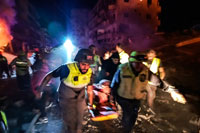
An injured person is evacuated following an Israeli airstrike in the southern Lebanese village of Abbasiyeh (Oct. 30, 2024).
Kawnat Haju/AFP via Getty Images
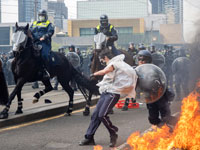
A police officer shoves a demonstrator during a protest in Melbourne, Australia (Sept. 11, 2024).
Alex Zucco/Sopa Images/Lightrocket via Getty Images
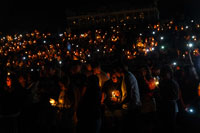
Students and faculty gather on the field at Apalachee High School in Winder, Georgia, to mourn shooting victims (Sept. 8, 2024).
Megan Varner/Getty Images
“Be Not Terrified”
A Christian’s response to increasing terror is in Luke 21. Jesus Christ cautioned: “But when you shall hear of wars and commotions, be not terrified…” (vs. 9).
While the fulfillment of the specific “wars and commotions” Jesus was speaking of is yet to come, the principle applies to any sin or evil we see today.
Here we are given a feeling that must be avoided. Strong’s Concordance defines the Greek word translated “terrified” as “through the idea of causing to fall, through that of causing to fly away, to scare, frighten.”
This does not mean that we should not run for cover in the face of imminent danger. It means we should not “fall to pieces” spiritually. In other words, we must remain confident that God is protecting us. This applies whether we are watching bad events in the news, or they take place in our local community.
Reflect on God’s inspiring promises of protection. Psalm 46 says, “God is our refuge and strength, a very present help in trouble. Therefore will not we fear” (vs. 1-2). Deuteronomy 31:6 also provides comfort: “Be strong and of a good courage, fear not, nor be afraid of them: for the Lord your God, He it is that does go with you; He will not fail you, nor forsake you.”
Obey God and be confident in His protection. With that foundation, you should not be fearful or anxious in your daily life.
Sigh and Cry
Avoiding feelings of terror is not the only way God commands us to react to end time events. There are feelings we should embrace when watching the sad state of current affairs.
They are found in Ezekiel 9:4, where God says, “Go through the midst of the city, through the midst of Jerusalem [a scriptural term symbolic of all the modern nations of Israel], and set a mark upon the foreheads of the men that sigh and that cry for all the abominations that be done in the midst thereof.”
Sighing and crying are two reactions Christians should have when they see the abominations of modern Israel.
The Outline of Bible Usage defines the words translated “sigh” and “cry” as: “groan (in pain or grief), gasp” and “lament,” respectively. These terms portray an attitude of sorrow, heaviness, mourning and longing for the Kingdom because of all the behaviors that we see that are contrary to God’s Way.
However, considering the many injustices plaguing this world, Christians can mistakenly feel it is their rightful duty to condemn the people who commit such acts.
It can be infuriating to think of the hundreds of thousands of innocent babies butchered through abortion in America each year, increasingly blurred lines between genders—which distorts the family institution that typifies God’s plan of salvation—or the rampant lying and deceit.
Granted, there is a place for righteous indignation when we witness or experience lawlessness and injustice. Yet this should not be focused on individuals, rather their sinful actions. What we see should lead us to pray more fervently for the arrival of God’s government.
As it says in Ephesians 4:26-27, “Be you angry, and sin not: let not the sun go down upon your wrath: neither give place to the devil.”
We must avoid vengeful feelings. Note Proverbs 24: “Rejoice not when your enemy falls, and let not your heart be glad when he stumbles: lest the Lord see it, and it displease Him, and He turn away His wrath from him” (vs. 17-18).
True Christians must be very careful not to succumb to a self-righteous attitude of “Yeah, sock it to them, God!”
An account in Luke 9 shows this. Jesus had determined to go to Jerusalem and “sent messengers before His face: and they went, and entered into a village of the Samaritans, to make ready for Him. And they did not receive Him, because His face was as though He would go to Jerusalem. And when His disciples James and John saw this, they said, Lord, will You that we command fire to come down from heaven, and consume them, even as Elijah did?” (vs. 52-54).
We could fall into the same wrong attitude if we are not careful. This may not have been the first time these men reacted in such a way, which may explain why, in Mark 3:17, Jesus somewhat humorously “surnamed them Boanerges, which is, the sons of thunder.”
Jesus’ response to the “sons of thunder” likely took the indignant disciples by surprise: “But He turned, and rebuked them, and said, You know not what manner of spirit you are of” (Luke 9:55).
The term “rebuke” in this context could also mean “to tax with fault, rate, chide, rebuke, reprove, censure severely…to admonish or charge sharply” (Thayer’s Greek Lexicon).
Christ’s admonition was strong, and He specifically warned about what spirit we should and should not follow.
Spiritual Source
“There is a spirit in man,” Job 32:8 states. It is through this spirit we can understand human knowledge. God also uses it to evaluate our hearts (Prov. 20:27).
Yet that same spirit can have dangerous tendencies. Other verses expand on the fruits of this human spirit when it is unbridled: “Pride goes before destruction, and a haughty spirit before a fall” (Prov. 16:18). And, “Be not hasty in your spirit to be angry: for anger rests in the bosom of fools” (Ecc. 7:9).
The spirit that James and John had when they wanted to deliver retribution on the Samaritans was both haughty and hasty.
Christians, motivated by God’s Spirit, are to defer to Him as the ultimate judge (Psa. 75:7). This means we must wait on Him, which naturally moves us to sigh and cry.
Note that this does not preclude you from making a judgment about wrong conduct. You can label sinful actions for what they are—sin! However, Christians are not to condemn individual people or seek retribution. Such behavior crosses a spiritual redline into something God reserves for Himself (Rom. 12:19; Jms. 1:19-20).
Instead, we are to pray for our enemies (Matt. 5:44-45) and continually draw closer to God. Knowing we were also once part of this present, evil world (Eph. 2:2; Col. 3:5-7), we are to fervently do the Work to help spread God’s truth to others.

Paramedics provide aid to an injured woman who lives in a 12-story apartment building that was damaged by Russian aerial bombing in Kharkiv, Ukraine (Nov. 8, 2024).
Viacheslav Mavrychev/Suspilne Ukraine/Global Images Ukraine via Getty Images
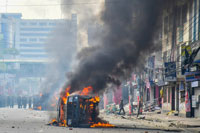
Flames engulf a military vehicle after protesters and police clash in Mirpur, Bangladesh (Oct. 31, 2024).
Md. Naimur Rahman/AFP via Getty Images
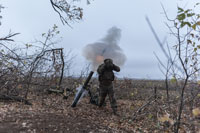
A Ukrainian soldier covers his ears during mortar fire (Nov. 7, 2024).
Diego Herrera Carcedo/Anadolu via Getty Images
Examples of Daniel and Lot
The prophet Daniel, one of the most righteous men who ever lived (Ezek. 14:14, 20), demonstrated the appropriate response to the evil he saw around him.
Chapter 9 of his book records Daniel’s prayer for Israel: “I set my face unto the Lord God, to seek by prayer and supplications, with fasting, and sackcloth, and ashes…and said, O Lord, the great and dreadful God, keeping the covenant and mercy to them that love Him, and to them that keep His commandments; we have sinned…” (vs. 3-5).
In this heartfelt prayer, Daniel continually included himself as part of the problem. Long before Paul wrote Romans 3:23, this humble servant understood that “all have sinned, and come short of the glory of God.”
That is a far cry from “Sock it to them, God!”
Do you ever pray like Daniel? Do you see yourself as having once been immersed in the same lifestyle as the world today?
Now look at Lot, who is a type for Christians in the end time (Luke 17:28-30).
The apostle Peter described how “just Lot,” while living in the cities of Sodom and Gomorrah, was “vexed with the filthy conversation of the wicked: (for that righteous man dwelling among them, in seeing and hearing, vexed his righteous soul from day to day with their unlawful deeds)” (II Pet. 2:7-8).
Both words translated “vexed” are noteworthy. In the Greek, the first (vs. 7) means “to tire down with toil, exhaust with labor” (Thayer’s).
The second “vexed” (vs. 8) is a different Greek word that can mean “to test (metals) by the touchstone, which is a black siliceous stone used to test the purity of gold or silver by the [color] of the streak produced on it by rubbing it with either metal…to torture…to vex with grievous pains (of body or mind), to torment…to be harassed, distressed…of those who at sea are struggling with a head wind” (Outline of Biblical Usage).
It could be said Lot’s character was purified as a precious metal by daily enduring the sinful conduct around him. He may have also felt like a sailor constantly going against a high wind.
Yet this difficult process of endurance rendered him worthy of deliverance.
The conclusion in verse 9 is instructive for us: “The Lord knows how to deliver the godly out of temptations, and to reserve the unjust unto the day of judgment to be punished.”
Lot and Daniel did not stand up and condemn everyone around them. Instead, they cried and sighed before God, longing for Him to solve the problem.
A Right Spirit
As conditions grow worse and we watch increasing evil in this world, keep in mind God’s overall goal in working with men. Jesus stated this while rebuking the “sons of thunder” in Luke 9: “The Son of man is not come to destroy men’s lives, but to save them” (vs. 56).
Know that God is working to save people. Although He may have to punish them severely to get their attention, He wants everyone to make it. Understanding this will help us to develop the fruits of His Spirit, which will manifest itself in the following ways:
Psalm 34:18: “The Lord is near unto them that are of a broken heart; and saves such as be of a contrite spirit.”
Psalm 51:17: “The sacrifices of God are a broken spirit: a broken and a contrite heart, O God, You will not despise.”
Proverbs 29:23: “A man’s pride shall bring him low: but honor shall uphold the humble in spirit.”
Ecclesiastes 7:8: “Better is the end of a thing than the beginning thereof: and the patient in spirit is better than the proud in spirit.”
I Peter 3:4: “But let it be the hidden man of the heart, in that which is not corruptible, even the ornament of a meek and quiet spirit, which is in the sight of God of great price.”
Matthew 5:3: “Blessed are the poor in spirit: for theirs is the kingdom of heaven.”
The goal is to have a contrite, broken, humble, patient, poor, meek and quiet attitude, which is precious in the eyes of God.
Prophecy shows character around us will continue to collapse until the Kingdom comes. We must be careful.
We need to have a different mindset, attitude and spirit. Along with not being terrified and sincerely sighing and crying over the abominations we witness, we must be driven by the right Spirit to view the world.
As David did in Psalm 51:10, we should often pray, “Create in me a clean heart, O God; and renew a right spirit within me.”
This is the Holy Spirit. It leads a person to see themselves and the world as God does and seek the arrival of the only Kingdom that will solve these problems.
Grow in God’s Spirit. It is the most hopeful response to what we see around us in a sick, troubled world.
Imechapishwa November 27, 2024