Key Moments of North Korean International Provocation
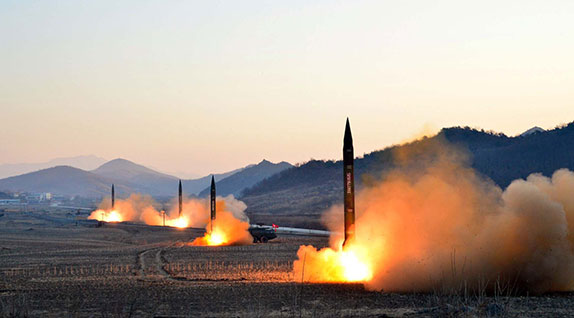
A series of missile launches by North Korea has renewed concerns among its Asian neighbors and United States officials that it could begin to use nuclear weapons.
United States Secretary of State Rex Tillerson declared the Oval Office’s foreign policy stance toward North Korea: “Let me be very clear: the policy of strategic patience has ended. We are exploring a new range of security and diplomatic measures. All options are on the table.”
In response, North Korean Vice Foreign Minister Han Song Ryol told an ABC News reporter: “The possibility of a preemptive strike against [North Korea’s] nuclear program is strong.”
He also said, “If you bring out a knife to attack us, we will take out a sword.”
The latest events follow a long pattern of provocations from North Korea. The following timeline shows key moments since the 1990s.
- 1993: North Korea threatens to quit the international Nuclear Non-Proliferation Treaty when the International Atomic Energy Agency accuses it of violating the terms of the treaty and demands inspectors be given access to nuclear waste storage sites.
- 1998: North Korea fires a long-range rocket that flies over neighboring Japan and lands in the Pacific Ocean—surpassing North Korea’s known military capability.
- 2002: Pyongyang declares it is reactivating nuclear facilities at Yongbyon and expels United Nations inspectors.
- 2003: North Korea withdraws from the Nuclear Non-Proliferation Treaty. This prompts a series of talks between North Korea, South Korea, China, the United States, Japan and Russia to resolve the threat of North Korea developing nuclear weapons.
- 2006: Pyongyang test fires seven missiles. Among them is a long-range missile that crashes shortly after takeoff, despite claims that it has the capability to strike the U.S.
- 2009: Pyongyang launches a long-range rocket it claims is used for carrying a communications satellite; neighboring countries accuse North Korea of testing long-range missile technology. The UN Security Council condemns it, prompting North Korea to walk away from talks and restart its nuclear facilities.
- 2010: North Korea sinks a South Korean warship near the North Korea-South Korea border.
- February 2013: The UN approves sanctions after North Korea stages its third nuclear test.
- July 2013: Panama impounds a North Korean ship carrying two MiG-21 jet fighters hidden under bags of sugar.
- September 2013: China, North Korea’s only ally, bans exports to North Korea of items that could be used to make missiles or nuclear weapons.
- August 2016: A North Korean submarine fires a ballistic missile off its east coast, which travels 300 miles before falling into the Sea of Japan.
- September 2016: Pyongyang carries out its fifth and reportedly biggest nuclear test, claiming it has mastered the ability to mount a warhead on a ballistic missile.
- January 2017: North Korean leader Kim Jong Un announces that his nation is in the final stage of developing long-range missiles capable of carrying nuclear warheads. China expands its ban on goods to North Korea.
- February 2017: Pyongyang fires a ballistic missile into the Sea of Japan; widespread international condemnation ensues. China suspends all coal imports from North Korea.
- March 2017: Pyongyang fires four ballistic missiles into the Sea of Japan.