Scientists Uncover 72 New Galaxies Deep in the Universe
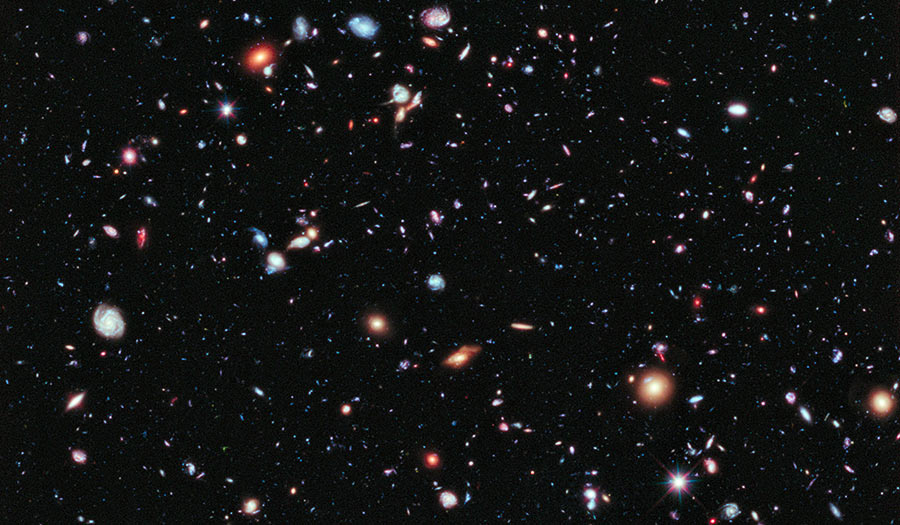
Astronomers discovered 72 new galaxies in the same patch of sky that the Hubble Space Telescope once explored in the deepest spectroscopic survey to date, according to scientists at the European Solar Observatory (ESO).
Researchers used the Multi Unit Spectroscopic Explorer, or MUSE, to make the findings.
“MUSE can do something that Hubble can’t—it splits up the light from every point in the image into its component colours to create a spectrum,” Roland Bacon, who conducted the study, said. “This allows us to measure the distance, colours and other properties of all the galaxies we can see—including some that are invisible to Hubble itself.”
“The MUSE data provides a new view of dim, very distant galaxies, seen near the beginning of the Universe about 13 billion years ago,” a press release by the ESO stated. “It has detected galaxies 100 times fainter than in previous surveys, adding to an already richly observed field and deepening our understanding of galaxies across the ages.”
According to the observatory: “The survey unearthed 72 candidate galaxies known as Lyman-alpha emitters that shine only in Lyman-alpha light. Current understanding of star formation cannot fully explain these galaxies, which just seem to shine brightly in this one colour. Because MUSE disperses the light into its component colours these objects become apparent, but they remain invisible in deep direct images such as those from Hubble.”
The original Hubble images, which were published in 2004, revealed the existence of millions of galaxies that were previously undiscovered as well as proved that the universe is continuously expanding.
The new MUSE technology takes what the Hubble used to do to an even higher level, Newsweek science writer Meghan Bartels explained.
“MUSE doesn’t simply take a photograph of a galaxy: It takes what scientists call a spectrum, a sort of fingerprint of the amount of each wavelength of light coming from a particular pocket of space. And MUSE doesn’t need to take its time to look at each object individually—it can grab these spectral fingerprints for every object in view at once. As it does, it creates a 3-D picture of the object scientists are studying, based on the light it emits.”
Scientists believe the new findings may also provide “insight into star formation in the early Universe” and “the motions and other properties of early galaxies,” according to ESO.
“MUSE has the unique ability to extract information about some of the earliest galaxies in the Universe—even in a part of the sky that is already very well studied,” Jarle Brinchmann, lead author of one of the papers describing results from the survey, said in an ESO release. “We learn things about these galaxies that is only possible with spectroscopy, such as chemical content and internal motions—not galaxy by galaxy but all at once for all the galaxies!”
Since MUSE was updated this year, and as technology’s ability to explore the sky at greater depths becomes more advanced, scientists are certain they will make even more discoveries about the vastness of the universe.