Portugal to Decide on Allowing Euthanasia, Assisted Suicide
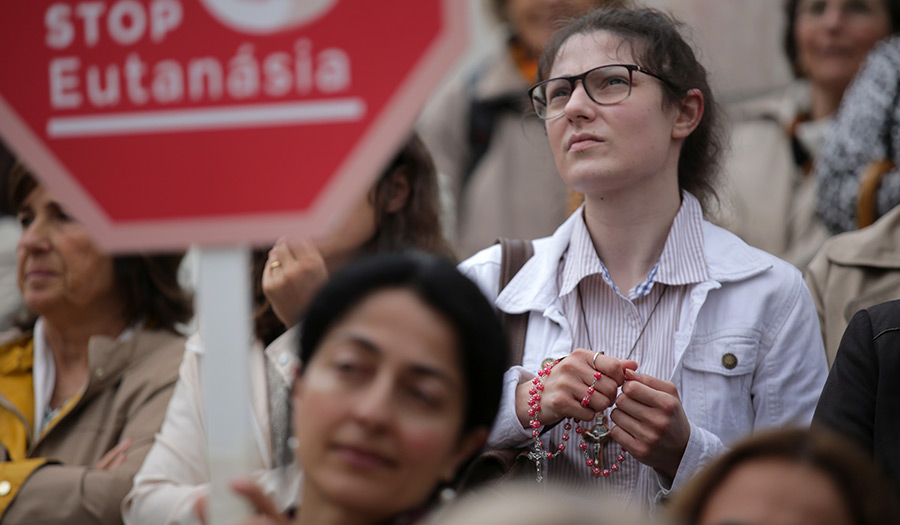
LISBON, Portugal (AP) – After legalizing abortion and same-sex marriage in recent times, Portuguese lawmakers will decide May 29 on another issue that has brought a confrontation between faith and politics in this predominantly Catholic country: whether to allow euthanasia and doctor-assisted suicide.
The outcome of the vote is uncertain and is likely to be close, but Portugal could become one of just a handful of countries in the world to permit euthanasia under certain circumstances.
Euthanasia—when a doctor kills patients at their request—is legal in Belgium, Canada, Colombia, Luxembourg and the Netherlands. In Switzerland, and some U.S. states, assisted suicide—where patients administer the lethal drug themselves, under medical supervision—is permitted.
A series of left-leaning governments determined to bring about what they call a “modernization” of the country, as well as the Catholic Church’s waning influence, have opened the door to deep cultural changes in Portugal. That trend has included permitting abortion on demand in 2007 and same-sex marriage three years later.
A 2016 petition by right-to-die activists pushed the contentious and divisive issue of euthanasia onto the political agenda. It got more than 8,000 signatures—more than double the amount needed to force a parliamentary debate last year.
The petition said allowing euthanasia would be “a concrete expression of an individual’s rights to autonomy, to religious freedom and freedom of conscience, which are rights enshrined in the Constitution.” It added: “It is of the utmost importance to end pointless and useless suffering, imposed by the convictions of others.”
In response, a petition by the Portuguese Federation for Life a few months later collected more than 14,000 signatures and told lawmakers that society and the state have a duty to protect human life.
Now, four left-leaning political parties—the governing center-left Socialist Party, the radical Left Bloc, the Green Party, and the People, Animals, Nature party—have tabled bills proposing euthanasia and doctor-assisted suicide. Inciting or assisting euthanasia is currently punishable by up to three years in prison.
The Socialist government’s bill has the best chance of success, having the most lawmakers of the parties proposing legislation, though there is little difference between the four parties’ proposals.
The Socialist bill covers patients who are “in a situation of extreme suffering, with an untreatable injury or a fatal and incurable disease.” Two doctors, at least one of them a specialist in the relevant illness, and a psychiatrist must sign off on the request to die. The case then goes to a Verification and Evaluation Committee, which can approve or turn down the procedure.
The process is postponed if it is legally challenged, or if the patient loses consciousness, and doctors can refuse to perform the procedure on moral grounds. Oversight is provided by the General-Inspectorate for Health.
To discourage people from traveling to Portugal to end their life, the bills all stipulate that patients must either be Portuguese citizens or legal residents.
Before the debate, the Portuguese Episcopal Conference has been distributing 1.5 million pamphlets arguing against legalizing euthanasia, arguing it would be “a backward step” for society.
“Life cannot be regarded as an object for personal use,” the pamphlet says.
The four bills are going to a Tuesday afternoon debate in the Republican Assembly, Portugal’s parliament. The 230 lawmakers will vote at the end of the debate.