China-India Clash in Himalayas Deadliest in 58 Years
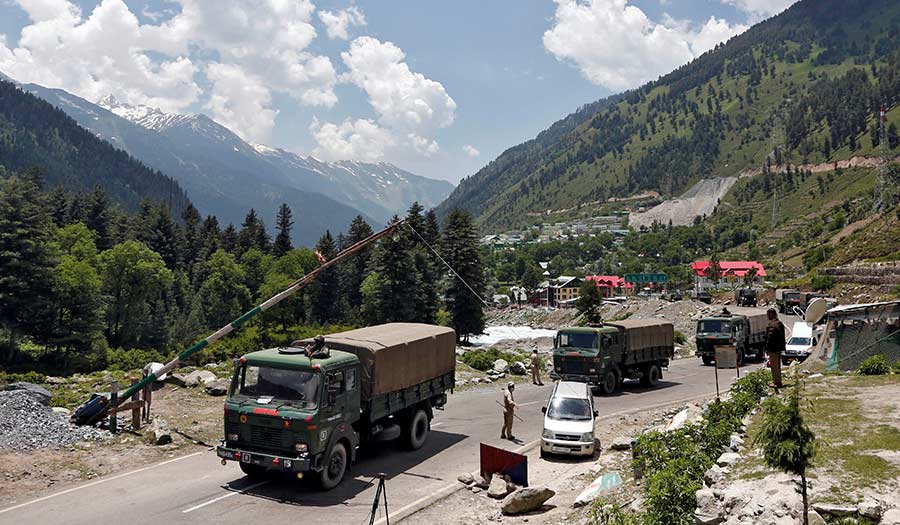
India and China said they wanted peace but blamed each other on Wednesday after soldiers of the two sides savagely fought each other with nail-studded clubs and stones on their Himalayan border, killing at least 20 Indian troops.
“We never provoke anyone,” Indian Prime Minister Narendra Modi said on national television, referring to Monday’s hand-to-hand fighting. “There should be no doubt that India wants peace, but if provoked, India will provide an appropriate response.”
In Beijing, foreign ministry spokesman Zhao Lijian said the clash erupted after Indian soldiers “crossed the line, acted illegally, provoked and attacked the Chinese, resulting in both sides engaging in serious physical conflict and injury and death.”
He said he did not know of any Chinese casualties, although Indian media quoted officials as saying at least 45 people were dead or injured on the Chinese side.
The skirmish in the desolate alpine area of Ladakh, in Kashmir, followed changes by India to the political status of Kashmir amid a geopolitical tug-of-war with the United States in the region.
Twenty Indian soldiers, including a colonel, died of severe injuries suffered in sub-zero temperatures, Indian officials said, after the two sides threw rocks and traded blows in the culmination of a months-long standoff in the Galwan Valley near the Line of Actual Control that separates the two countries.
No shots were fired because neither side’s patrolling soldiers carry firearms, in accordance with the terms of the unresolved border dispute, Indian officials said, speaking on condition of anonymity because they weren’t authorized to disclose information.
Still, it was the worst violence since 1962, when a war over completing claims on the remote Himalayan area ended with an uneasy truce.
Thousands of soldiers backed by armored trucks and artillery have been facing off near the border. Scuffles are not uncommon, but Indian authorities say China upped the ante when its troops breached the line of control.
As the countries around the region grapple with the coronavirus pandemic, China has been asserting its territorial claims and influence across the region, notably toward Hong Kong and Taiwan and in the South China Sea.
That has fanned anti-Chinese sentiments already running high due to Beijing’s opposition to India’s decision in August to revoke the statehood and semi-autonomy of Kashmir, parts of which are claimed by both Pakistan and China, and split it into two territories governed by New Delhi.
Tussles for power between China and India, the first and second-most populous nations, date back centuries, though the two have sought to keep political, economic and security ties and avoid outright bloodshed.
Prime Minister Modi and Chinese leader Xi Jinping have met more than a dozen times for talks, most recently in October in India, to smooth relations and build up trade. But India’s unilateral decision in August to split Kashmir rankled Beijing.
“I think what is interesting is how quickly Sino-Indian relations have deteriorated,” said Joe Fewsmith, a China politics expert at Boston University. “A few years ago, Xi Jinping expressed hope that China and India could build cooperative relations. [That’s] not likely now.”
The pandemic’s origins in the central Chinese city of Wuhan are another factor: With more than 354,000 coronavirus cases and 11,903 deaths India is now the fourth worst affected country in the world.
But the bigger cause for antagonism lies in the Himalayas: a region China has always considered a strategically vital corridor between its restive Muslim Xinjiang region and Tibet.
At the UN General Assembly, China has supported Pakistan’s opposition to India’s decision to split Kashmir into the union territories of Jammu and Kashmir and Ladakh.
The U.S. backed India’s assertion of its sovereign right to make such changes within its borders. While troops brawled in eastern Ladakh region in May, President Donald Trump offered to mediate.
The Trump administration has withdrawn U.S. support from Pakistan in favor of India, which it sees as a bulwark against China’s growing influence. After two high-profile meetings between Modi and Trump—including rallies in Houston, Texas, and Gujarat, Modi’s home state—India agreed to purchase $15 billion in American arms.
The U.S. and India have balked at China’s multi-billion-dollar Belt and Road Initiative, a string of infrastructure and finance development projects from the Pacific to the Atlantic Ocean.
In response to the pandemic, a movement has emerged to build up India as an alternative to China for Western markets and to boycott Chinese goods.
Chris Biggers, a former government satellite imagery analyst, said Monday’s clash fits a pattern of Chinese “intimidation” along the border. In 2017, similar low-scale hostilities along the tri-border area of Doklam broke out as China pushed into disputed territory, bringing in troops, building roads, expanding airbases, and flying drones and jets.
Yet, the forces amassed at Galwan dwarf what was seen at Doklam.
“I’ve never seen anything, outside of a military exercise, of this kind of mobilization of force, particularly between India and China,” Mr. Biggers said.
This article contains information from The Associated Press and Reuters.