Why Don’t Protests Bring Lasting Change?
After the death of George Floyd, a black man in Minneapolis who died in police custody when a white officer pressed his knee into his neck for several minutes, protests against police brutality and racial inequality raged around the globe.
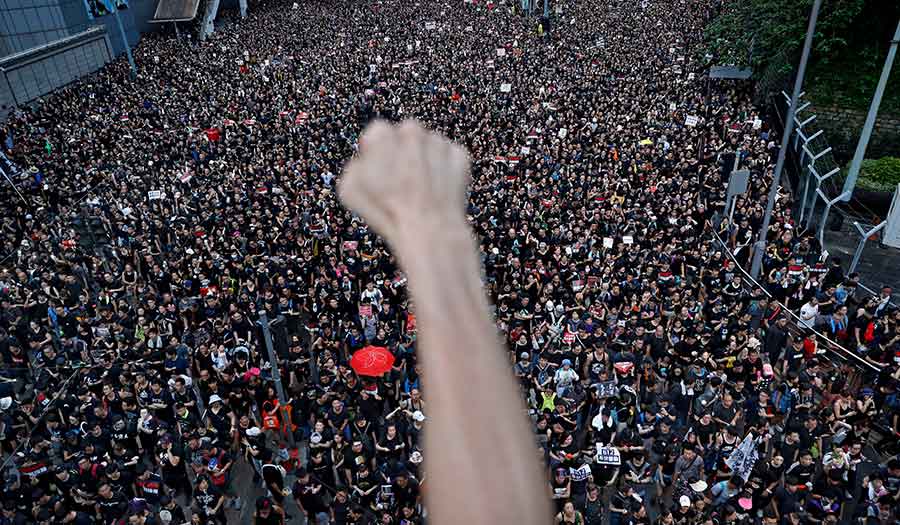
The current outrage may seem new to those in the United States but for others it is a continuation of the worldwide anger displayed in 2019 that was eventually slowed by the coronavirus pandemic.
From Hong Kong to Khartoum, Baghdad to Beirut, Gaza to Paris and Caracas to Santiago, people also took to the streets in 2019 for the pursuits of freedom, sovereignty or simply a life less shackled by hardship while few prospered.
The very nature of a protest suggests a fervent desire for change, the need to right a perceived historic injustice. It is a means to an end. But to what end? Depending on the government the activists are demanding change from, the results can be varied.
Here’s a look at some of the key protests of recent decades and what they achieved or failed.
American Civil Rights
During the critical era of the 1950s and ‘60s, Martin Luther King Jr., who led the 250,000 strong March on Washington in 1963, and Malcolm X were colossal 20th century figures, representing two different tracks: mass non-violent protest and getting favorable outcomes “by any means necessary.” The Civil Rights Acts, initiated by the Kennedy administration, and Voting Rights Act were passed by the Johnson administration, which was sympathetic to tackling endemic racism in the nation. These were key inflection points. But social injustice and the Vietnam War continued to dominate the American decade and beyond, reaching a crescendo of civil unrest in 1968 which has been echoed in 2020.
The Iron Curtain Falls
Revolution was in the air in Eastern Europe in 1989, powered by a flowering of civil resistance to overthrow Communist rule. One-by-one, countries fell in a reverse-domino effect—Washington had always been concerned about the dominoes falling in the Soviet Union’s favor. The final Soviet leader, Mikhail Gorbachev, laid the groundwork for this tectonic shift. The Berlin Wall fell and one-party rule was swept aside in East Germany, Poland and other states once cast as being behind the Iron Curtain, mostly bloodlessly—the exception being in Romania where the tyranny of Nicolae Ceausescu and his family was ended by a firing squad on Christmas Day.
The Arab Spring and the Current Redux
It was two decades before the world witnessed another wave of protests consume an entire region. This one was the first to be captured on a new digital platform, social media. After decades of dictatorship and kleptocracy, the Arab World became intoxicated by the heady mix of possibility and immediacy. And rulers did fall: in Egypt, Yemen, Libya and Tunisia in 2011. But only the latter transitioned to a democratic next chapter.
Egypt now lives under even more authoritarian rule, where all dissent is extinguished and thousands languish in prison. Yemen and Libya have been torn to shreds by conflict and humanitarian catastrophe. Syria exploded quickly from an uprising against the Assad dynasty to ruinous civil war which still continues with more than half million dead and millions displaced.
These mixed results beg the question, does protesting really work?
Yes, people are able to express their dissatisfaction and make their opinions known. But does it lead to lasting change? Often the core message of a given protest is lost in the cacophony of screaming voices. Labeling a protest as “peaceful” now just means that actual bullets may not be flying. It is hard to watch crowds throwing bottles and stones, yelling, cursing, spray painting vile messages, breaking windows and sometimes burning buildings and vehicles and call them “peaceful protests.” In most cases they are riots, plain and simple.
Slowing down to appreciate the common chant of protesters, “No Justice, No Peace,” proves the point.
The actions of the most violent do get the attention of the opposing side but not necessarily in the best way. Acts of incivility usually overshadow what could otherwise be a worthwhile message.
While God wants human equality and the end of oppression, He has never condoned rioting to get there. He says in Exodus 23:2: “You shall not follow a multitude to do evil; neither shall you speak in a cause to decline after many to wrest judgment.” When angry crowds get together, usually bad things result. The phrase “angry mob” is well known for a reason. When crowds of people come together it can draw out the worst in people. Individuals tend to do things they would never do if they were by themselves.
Protests are the result of fighting for a cause. However, most importantly, they remind us of the raw human nature all are capable of.
No cause, righteous or otherwise, seems to allow us to shake this reality.
For more on the nature of man, read {%521} It explains the reason people act the way they do in protests.
This article contains information from The Associated Press.