New Research of Oldest Light Confirms Age of the Universe
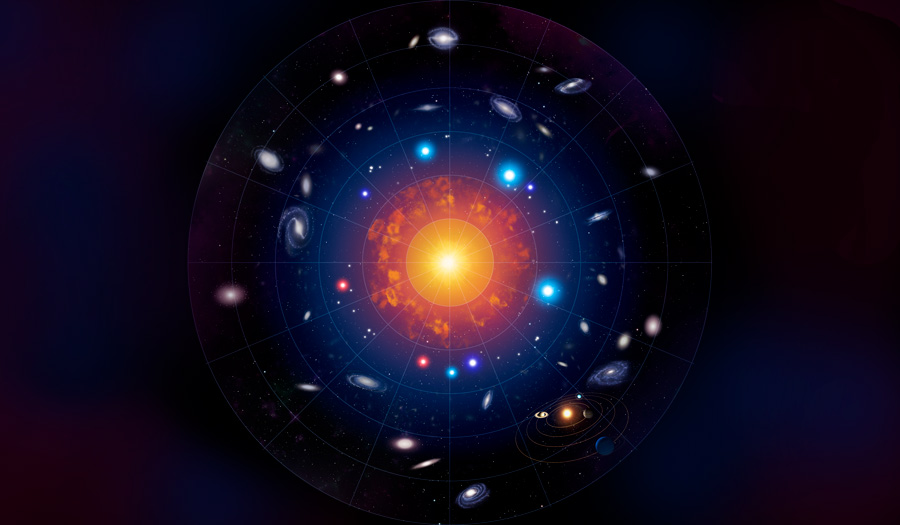
Just how old is the universe? Astrophysicists have been debating this question for decades. In recent years, new scientific measurements have suggested the universe may be hundreds of millions of years younger than its previously estimated age of approximately 13.8 billion years.
Now new research published in a series of papers by an international team of astrophysicists, including Neelima Sehgal, PhD, from Stony Brook University, suggest the universe is about 13.8 billion years old. By using observations from the Atacama Cosmology Telescope (ACT) in Chile, their findings match the measurements of the Planck satellite data of the same ancient light.
The ACT research team is an international collaboration of scientists from 41 institutions in seven countries. The Stony Brook team from the Department of Physics and Astronomy in the College of Arts and Sciences, led by Professor Sehgal, plays an essential role in analyzing the cosmic microwave background (CMB)—the afterglow light from the beginning of the universe.
“In Stony Brook-led work we are restoring the ‘baby photo’ of the universe to its original condition, eliminating the wear and tear of time and space that distorted the image,” explains Professor Sehgal, a co-author on the papers. “Only by seeing this sharper baby photo or image of the universe, can we more fully understand how our universe was born.”
Obtaining the best image of the infant universe, explains Professor Sehgal, helps scientists better understand its origins, how we got to where we are on Earth, the galaxies and where we are going.
The new ACT estimate on the age of the universe matches the one provided by the standard model of the universe and measurements of the same light made by the Planck satellite. This adds a fresh twist to an ongoing debate in the astrophysics community, says Simone Aiola, first author of one of the new papers on the findings posted to arXiv.org.
“Now we’ve come up with an answer where Planck and ACT agree,” says Dr. Aiola, a researcher at the Flatiron Institute’s Center for Computational Astrophysics in New York City. “It speaks to the fact that these difficult measurements are reliable.”
In 2019, a research team measuring the movements of galaxies calculated that the universe is hundreds of millions of years younger than the Planck team predicted. That discrepancy suggested that a new model for the universe might be needed and sparked concerns that one of the sets of measurements might be incorrect.
The age of the universe also reveals how fast the cosmos is expanding, a number quantified by the Hubble constant. The ACT measurements suggest a Hubble constant of 42 miles per second per megaparsec. That means an object 1 megaparsec (around 3.26 million light-years) from Earth is moving away from us at 42 miles per second due to the expansion of the universe. This result agrees almost exactly with the previous estimate of 41.9 miles per second per megaparsec by the Planck satellite team, but it is slower than the 45 miles per second per megaparsec inferred from the measurements of galaxies.
Science confirming the age of the universe can seem to contradict to the idea that the Earth was created by God 6,000 years ago. But science and the Bible are more in agreement than most think.
The Real Truth article {%555748} proves this.