Lebanese Government Resigns after Beirut Blast, Public Anger
BEIRUT (AP) – Lebanon’s prime minister stepped down from his job Monday in the wake of the catastrophic explosion in Beirut that has triggered public outrage, saying he has come to the conclusion that corruption in the country is “bigger than the state.”
The move risks opening the way to dragged-out negotiations over a new Cabinet amid urgent calls for reform. It follows a weekend of anti-government protests after the August 4 explosion in Beirut’s port that decimated the facility and caused widespread destruction, killing at least 160 people and injuring about 6,000 others.
In a brief televised speech after three of his ministers resigned, Prime Minister Hassan Diab said he and his government were stepping down.
“May God protect Lebanon,” he said, repeating the last phrase three times. As he spoke, protesters demonstrated in the streets near parliament for a third straight day.
The moment typified Lebanon’s political dilemma. Since October, there have been mass demonstrations demanding the departure of the entire sectarian-based leadership over entrenched corruption, incompetence and mismanagement.
But the ruling oligarchy has held onto power for so long—since the end of the civil war in 1990—that it is difficult to find a credible political figure untainted by connections to it.
Mr. Diab blamed corrupt politicians who preceded him for the “earthquake” that has hit Lebanon.
“They [the political class] should have been ashamed of themselves because their corruption is what has led to this disaster that had been hidden for seven years,” he added.
“I have discovered that corruption is bigger than the state and that the state is paralyzed by this [ruling] clique and cannot confront it or get rid of it,” said Mr. Diab, who was a professor at the American University of Beirut before he took the job.
After the catastrophe, Mr. Diab had sought to stay on for two months to organize new parliamentary elections and allow a map for reforms. But the pressure from within his own Cabinet proved to be too much. With the mass resignation, the call for early elections appears dead, so the same factions will debate on forming a new Cabinet.
His government, which was dominated by the Hezbollah militant group and its allies and seen as one-sided, was basically doomed from the start, tasked with meeting demands for reform but made up of all the factions that reformers want out.
Now the process must start again.
“I hope that the caretaking period will not be long because the country cannot take that. Let’s hope a new government will be formed quickly,” Public Works Minister Michel Najjar said. “An effective government is the least we need to get out of this crisis.”
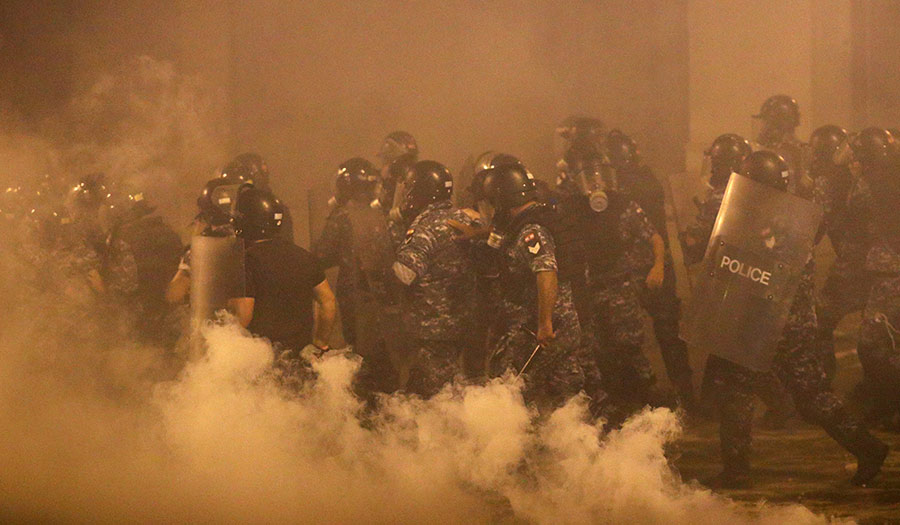
The weekend protests saw clashes with security forces firing tear gas at demonstrators.
The explosion is believed to have been caused by a fire that ignited a 2,750-ton stockpile of highly volatile ammonium nitrate that had been stored at the port since 2013 with few safeguards despite numerous warnings of the danger.
The result was a disaster that the Lebanese people blame squarely on their leadership’s corruption and neglect. Losses from the explosion are estimated at $10 billion to $15 billion, with nearly 300,000 people left homeless.
On Sunday, world leaders and international organizations pledged nearly $300 million in emergency humanitarian aid to Beirut, but warned that no money for rebuilding the capital would be made available until Lebanese authorities commit themselves to the political and economic reforms demanded by the people.