China Prepping for Mission to Bring Back Moon Rocks
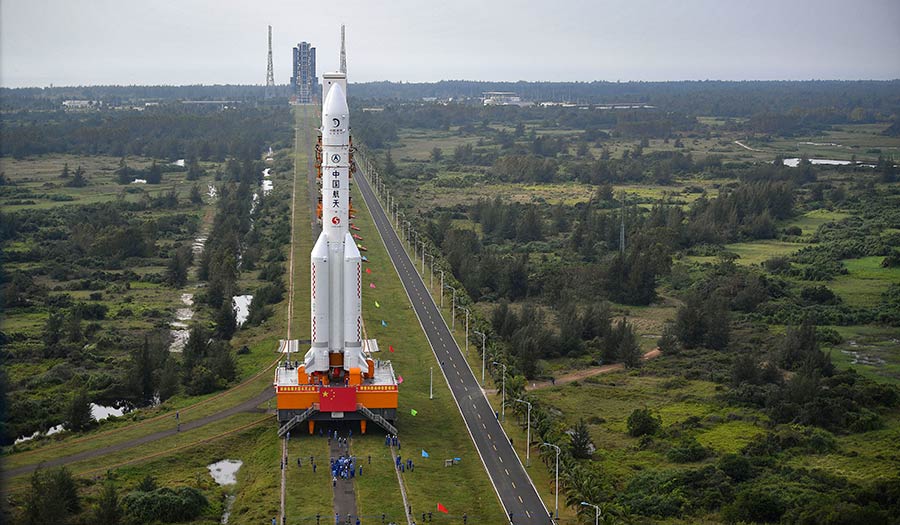
China plans to launch an unmanned spacecraft to the moon this week to bring back lunar rocks in the first attempt by any nation to retrieve samples from Earth’s natural satellite since the 1970s.
The Chang’e-5 probe, named after the ancient Chinese goddess of the moon, will seek to collect material that can help scientists understand more about the moon’s origins and formation. The mission will test China’s ability to remotely acquire samples from space, ahead of more complex missions.
If successful, the mission will make China only the third country to have retrieved lunar samples, following the United States and the Soviet Union decades ago. Some experts say it could pave the way for bringing samples back from Mars or even a crewed lunar mission.
Since the Soviet Union crash-landed the Luna 2 on the moon in 1959, the first human-made object to reach another celestial body, a handful of other countries including Japan and India have launched moon missions.
In the Apollo program, which first put men on the moon, the United States landed 12 astronauts over six flights from 1969 to 1972, bringing back 842 pounds of rocks and soil.
The Soviet Union deployed three successful robotic sample return missions in the 1970s. The last, the Luna 24, retrieved 6 ounces of samples in 1976 from Mare Crisium, or “Sea of Crises.”
China’s probe, scheduled to launch in coming days, will attempt to collect 4.5 pounds of samples in a previously unvisited area in a massive lava plain known as Oceanus Procellarum, or “Ocean of Storms.”
Chang’e-5 mission may help answer questions such as how long the moon remained volcanically active in its interior and when its magnetic field—key to protecting any form of life from the sun’s radiation—dissipated.
The Mission
The China National Space Administration said in a statement that the Long March-5Y rocket began fueling up on Monday evening, ahead of a launch scheduled for between 4 a.m. and 5 a.m. Tuesday at the Wenchang launch center on the southern island province of Hainan.
The typically secretive administration had previously only confirmed the launch would be in late November. Spacecraft typically take three days to reach the moon.
Once in the moon’s orbit, the probe will aim to deploy a pair of vehicles to the surface: a lander will drill into the ground, then transfer its soil and rock samples to an ascender that will lift off and dock with an orbiting module.
The mission’s key task is to drill almost 7 feet beneath the moon’s surface and scoop up rocks and other debris to be brought back to Earth, according to NASA.
The Chang’e 5 lander’s time on the moon is scheduled to be short. It can only stay one lunar daytime, or about 14 Earth days, because it lacks the radioisotope heating units to withstand the moon’s freezing nights.
China made its first lunar landing in 2013. In January 2019, the Chang’e-4 probe touched down on the far side of the moon, the first by any nation’s space probe.
Within the next decade, China plans to establish a robotic base station to conduct unmanned exploration in the south polar region.
It is to be developed through the Chang’e-6, 7 and 8 missions through the 2020s and expanded through the 2030s ahead of manned landings.
China plans to retrieve samples from Mars by 2030.
In July, China launched an unmanned probe to Mars in its first independent mission to another planet.
This article contains information from Reuters and The Associated Press.