Iran Blames Israel for Sabotage at Natanz Nuclear Site, Vows Revenge
DUBAI, United Arab Emirates (AP) – Iran blamed Israel on Monday for an attack on its underground Natanz nuclear facility that damaged its centrifuges—sabotage that imperils ongoing talks over Tehran’s tattered nuclear deal and brings a shadow war between the two countries into the light.
Israel has not claimed responsibility for the attack, but Israeli media widely reported that the country had orchestrated a devastating cyberattack that caused a blackout at the nuclear facility. Israeli officials rarely acknowledge operations carried out by the country’s secret military units or its Mossad intelligence agency.
While the nature of the attack and the extent of the damage at Natanz remains unclear, a former Iranian official said the assault set off a fire while a spokesman mentioned a “possible minor explosion.”
The attack also further strains relations between the U.S., which under President Joe Biden is now negotiating in Vienna to re-enter the nuclear accord, and Israel, whose Prime Minister Benjamin Netanyahu has vowed to stop the deal at all costs.
Mr. Netanyahu met Monday with U.S. Defense Secretary Lloyd Austin, whose arrival in Israel coincided with the first word of the attack. The two spoke briefly to journalists but took no questions.
“My policy as prime minister of Israel is clear: I will never allow Iran to obtain the nuclear capability to carry out its genocidal goal of eliminating Israel,” Mr. Netanyahu said. “And Israel will continue to defend itself against Iran’s aggression and terrorism.”
At an earlier news conference at Israel’s Nevatim air base, Mr. Austin declined to say whether the Natanz attack could impede the Biden administration’s efforts to re-engage with Iran in its nuclear program.
“Those efforts will continue,” Mr. Austin said. The previous American administration under Donald Trump had pulled out of the nuclear deal with world powers, leading Iran to begin abandoning the limits on its atomic program set by the accord.
Details remained scarce about what happened early Sunday at the facility. The event was initially described only as a blackout in the electrical grid feeding above-ground workshops and underground enrichment halls—but later Iranian officials began referring to it as an attack.
A former chief of Iran’s paramilitary Revolutionary Guard said the attack had set off a fire at the site and called for improvements in security. In a tweet, General Mohsen Rezaei said that the second assault at Natanz in a year signaled “the seriousness of the infiltration phenomenon.”
The facility seemed to be in such disarray that, following the attack, a prominent nuclear spokesman Behrouz Kamalvandi walking above ground at the site fell 23 feet through an open ventilation shaft covered by aluminum debris, breaking both his legs and hurting his head.
“A possible minor explosion had scattered debris,” Mr. Kamalvandi said, without elaborating.
Iran Foreign Ministry spokesman Saeed Khatibzadeh acknowledged that IR-1 centrifuges, the first-generation workhorse of Iran’s uranium enrichment, had been damaged in the attack, but did not elaborate. State television has yet to show images from the site, which saw new advanced centrifuges turned on there Saturday.
“The answer for Natanz is to take revenge against Israel,” Mr. Khatibzadeh said. “Israel will receive its answer through its own path.” He did not elaborate.
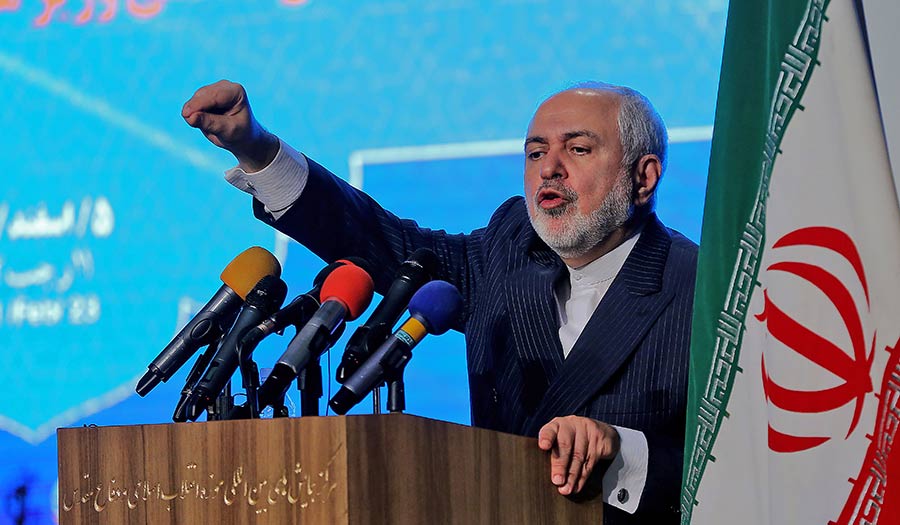
Iranian Foreign Minister Mohammad Javad Zarif, meanwhile, warned Natanz would be reconstructed with more advanced machines. That would allow Iran to more quickly enrich uranium, complicating the nuclear talks.
“The Zionists wanted to take revenge against the Iranian people for their success on the path of lifting sanctions,” Iran’s state-run IRNA news agency quoted Mr. Zarif as saying. “But we do not allow [it], and we will take revenge for this action against the Zionists.”
Natanz has been targeted by sabotage in the past. The Stuxnet computer virus, discovered in 2010 and widely believed to be a joint U.S.-Israeli creation, once disrupted and destroyed Iranian centrifuges there during an earlier period of Western fears about Tehran’s program.
In July, Natanz suffered a mysterious explosion at its advanced centrifuge assembly plant that authorities later described as sabotage. Iran now is rebuilding that facility deep inside a nearby mountain. Iran also blamed Israel for that, as well as the November killing of a scientist who began the country’s military nuclear program decades earlier.