Why Are Earthquakes So Devastating in Haiti?
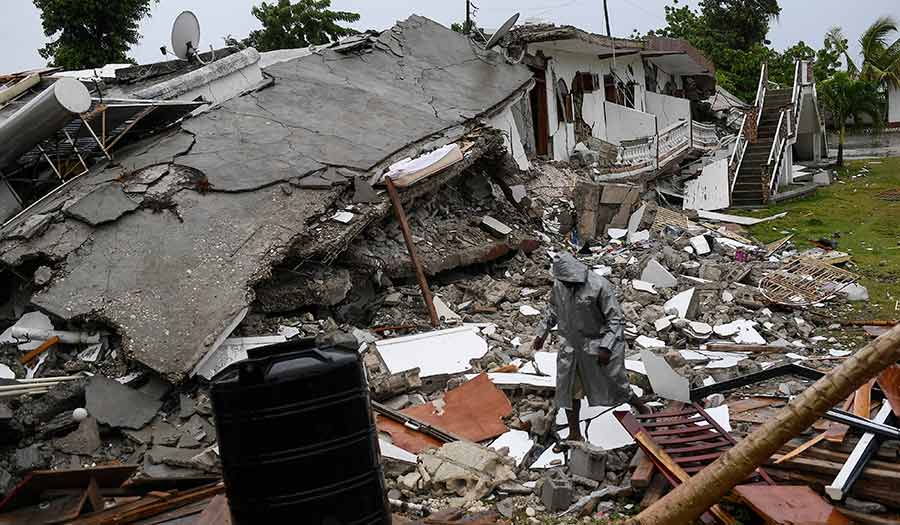
The Associated Press – The powerful earthquake that hit Haiti on Saturday killed 1,941 and injured thousands more. The destruction comes just 11 years after a temblor killed tens of thousands of people, if not hundreds of thousands. Some 100,000 buildings were destroyed in the 2010 quake.
As rescuers continue searching for survivors in the Caribbean nation—efforts dampened by the passing of two tropical storms in quick succession—here is a look at why Haiti has had so many devastating earthquakes over the centuries and why they are often so devastating.
What Makes Haiti Prone to Earthquakes?
The Earth’s crust is made up of tectonic plates that move. And Haiti sits near the intersection of two of them—the North American plate and the Caribbean plate.
Multiple fault lines between those plates cut through or near the island of Hispaniola, which Haiti shares with the Dominican Republic. What is worse, not all of those fault lines behave the same way.
“Hispaniola sits in a place where plates transition from smashing together to sliding past one another,” said Rich Briggs, a research geologist at the U.S. Geological Survey’s Geologic Hazards Science Center.
“It’s like a rock stuck in the track of a sliding glass door,” he said. “It just does not want to move smoothly because it’s got so many different forces on it.”
What Caused the Most Recent Quake?
Saturday’s magnitude 7.2 earthquake likely occurred along the Enriquillo-Plantain Garden fault zone, which cuts across Haiti’s southwestern Tiburon Peninsula, according to the USGS.
It is the same fault zone along which the devastating 2010 earthquake occurred. And it is likely the source of three other big earthquakes in Haiti between 1751 and 1860, two of which destroyed Port-au-Prince.
Earthquakes are the result of the tectonic plates slowly moving against each other and creating friction over time, said Gavin Hayes, senior science adviser for earthquake and geologic hazards at USGS.
“That friction builds up and builds up and eventually the strain that’s stored there overcomes the friction,” Dr. Hayes said. “And that’s when the fault moves suddenly. That’s what an earthquake is.”
Why Can Earthquakes in Haiti Be So Devastating?
It is a combination of factors that include a seismically active area, a high population density of 11 million people and buildings that are often designed to withstand hurricanes—not earthquakes.
Typical concrete and cinder block buildings can survive strong winds but are vulnerable to damage or collapse when the ground shakes. Poor building practices can also play a role.
The 2010 quake hit closer to densely populated Port-au-Prince and caused widespread destruction. Haiti’s government put the death toll at more than 300,000, while a report commissioned by the U.S. government placed it between 46,000 and 85,000.
“I think it’s important to recognize that there’s no such thing as a natural disaster,” said Wendy Bohon, a geologist with Incorporated Research Institutions for Seismology. “What you have is a natural hazard that overlaps with a vulnerable system.”
What Does the Future Hold?
Geologists say they cannot predict the next earthquake.
“But we do know that earthquakes like this can cause similar-sized earthquakes on the next portion of the fault,” said Dr. Hayes of USGS. “And it’s quite a significant hazard in places that don’t have the construction practices to withstand the shaking.”
Construction of more earthquake-resistant buildings remains a challenge in Haiti, which is the poorest nation in the Western Hemisphere.
Before Saturday’s quake, Haiti was still recovering from the 2010 earthquake as well as Hurricane Matthew in 2016. Its president was assassinated last month, sending the country into political chaos.
And while there have been some success stories of Haitians building more earthquake-resistant structures, the country has lacked a centralized effort to do so, said Mark Schuller, a professor of anthropology and nonprofit and NGO studies at Northern Illinois University.
Haiti’s government has become increasingly weak, while non-governmental organizations focus on their own compartmentalized projects.
“There is technical knowledge in Haiti. There are trained architects. There are city planners. That’s not the problem,” Dr. Schuller said. “The problem is a lack of funding for coordination, and lack of political will from donors [to organizations providing aid].”