China Chases ‘Rejuvenation’ with Control of Tycoons, Society
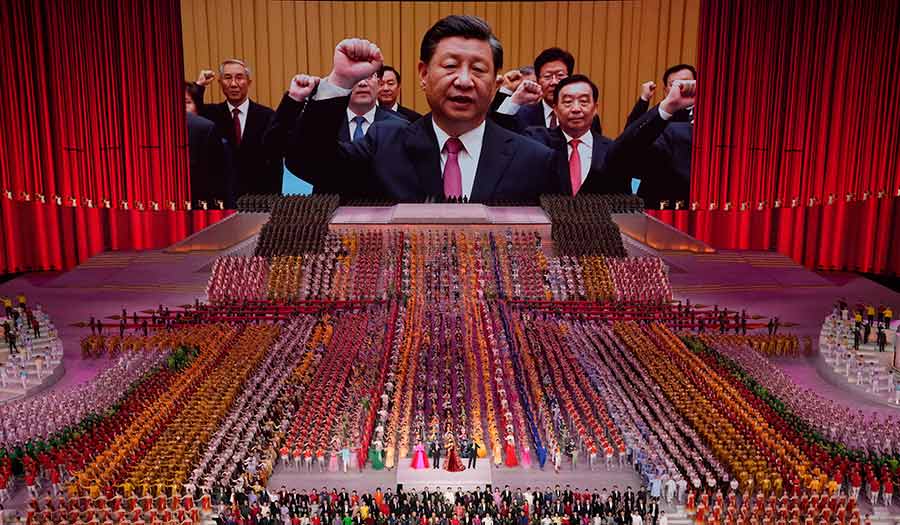
BEIJING (AP) – An avalanche of changes launched by China’s ruling Communist Party has jolted everyone from tech billionaires to school kids. Behind them: President Xi Jinping’s vision of making a more powerful, prosperous country by reviving revolutionary ideals, with more economic equality and tighter party control over society and entrepreneurs.
Since taking power in 2012, Mr. Xi has called for the party to return to its “original mission” as China’s economic, social and cultural leader and carry out the “rejuvenation of the great Chinese nation.”
The party has spent the decade since then silencing dissent and tightening political control. Now, after 40 years of growth that transformed China into the world’s factory but left a gulf between a wealthy elite and the poor majority, the party is promising to spread prosperity more evenly and is pressing private companies to pay for social welfare and back Beijing’s ambition to become a global technology competitor.
To support its plans, Mr. Xi’s government is trying to create what it deems a more wholesome society by reducing children’s access to online games and banning “sissy men” who are deemed insufficiently masculine from TV.
Chinese leaders want to “direct the constructive energies of all people in one laser-focused direction selected by the party,” Andrew Nathan, a Chinese politics specialist at Columbia University, said in an email.
Beijing has launched anti-monopoly and data security crackdowns to tighten its control over internet giants, including e-commerce platform Alibaba Group and games and social media operator Tencent Holdings Ltd., that looked too big and potentially independent.
In response, their billionaire founders have scrambled to show loyalty by promising to share their wealth under Mr. Xi’s vaguely defined “common prosperity” initiative to narrow the income gap in a country with more billionaires than the United States.
Mr. Xi has yet to give details, but in a society where every political term is scrutinized for significance, the name revives a 1950s propaganda slogan under Mao Zedong, the founder of the communist government.
Mr. Xi is reviving the “utopian ideal” of early communist leaders, said Willy Lam of the Chinese University of Hong Kong. “But of course, huge question marks have arisen, because this will hurt the most creative and lucrative parts of the economy.”
Alibaba, Tencent and others have pledged tens of billions of dollars for job creation and social welfare initiatives. They say they will invest in developing processor chips and other technologies cited by Beijing as priorities.
The party’s anti-monopoly enforcement and crackdown on how companies handle information about customers are similar to Western regulation. But the abrupt, heavy-handed way changes have been imposed is prompting warnings that Beijing is threatening innovation and economic growth, which already is declining. Jittery foreign investors have knocked more than $300 billion off Tencent’s stock market value and billions more off other companies.
“I expect that over the next year or two we are likely to see a very rocky relationship develop between the political elite and the business elite,” Michael Pettis, a finance professor at Peking University’s Guanghua School of Business, said in a report.
Chinese officials say the public, consumers and entrepreneurs will benefit from higher incomes and more regulatory oversight of corporate giants. Parents welcome curbs announced last month that limit children under 18 to three hours of online games a week and only on weekends and Friday night.
“I feel this is a good rule,” said Li Zhanguo, the father of an 8-year-old boy and a 4-year-old girl in the central city of Zhengzhou. “Games still have some addictive mechanisms. We can’t count on children’s self-control.”
The crackdowns reflect party efforts to control a rapidly evolving society of 1.4 billion people.
Some 1 million members of mostly Muslim ethnic groups have been forced into detention camps in the northwest. Officials deny accusations of abuses including forced abortions and say the camps are for job training and to combat extremism.
A surveillance initiative dubbed Social Credit aims to track every person and company in China and punish violations ranging from dealing with business partners that violate environmental rules to littering.
“Our responsibility is to unite and lead the entire party and people of all ethnic groups, take the baton of history and to work hard to achieve the great rejuvenation of the Chinese nation,” Mr. Xi said when he and the six other members of the new party Standing Committee appeared in public for the first time in November 2012.