Fearing Junta, Hundreds of Myanmar Parents Disown Dissident Children
Reuters – Every day for the last three months, an average of six or seven families in Myanmar have posted notices in the country’s state-owned newspapers cutting ties with sons, daughters, nieces, nephews and grandchildren who have publicly opposed the ruling military junta.
The notices started to appear in such numbers in November after the army, which seized power from Myanmar’s democratically elected government a year ago, announced it would take over properties of its opponents and arrest people giving shelter to protesters. Scores of raids on homes followed.
Lin Lin Bo Bo, a former car salesman who joined an armed group resisting military rule, was one of those disowned by his parents in about 570 notices reviewed by Reuters.
“We declare we have disowned Lin Lin Bo Bo because he never listened to his parents’ will,” said the notice posted by his parents, San Win and Tin Tin Soe, in state-owned newspaper The Mirror in November.
Speaking to Reuters from a Thai border town where he is living after fleeing Myanmar, the 26-year-old said his mother had told him she was disowning him after soldiers came to their family home searching for him. A few days later, he said he cried as he read the notice in the paper.
“My comrades tried to reassure me that it was inevitable for families to do that under pressure,” he told Reuters. “But I was so heartbroken.”
Contacted by Reuters, his parents declined to comment.
Targeting families of opposition activists was a tactic used by Myanmar’s military during unrest in 2007 and the late 1980s but has been used far more frequently since the February 1, 2021, coup, according to Wai Hnin Pwint Thon, senior advocacy officer at rights group Burma Campaign UK, which uses the old name for the former British colony.
Publicly disowning family members, which has a long history in Myanmar’s culture, is one way to respond, said Wai Hnin Pwint Thon, who said she was seeing more such notices in the press than in the past.
“Family members are scared to be implicated in crimes,” she said. “They don’t want to be arrested, and they don’t want to be in trouble.”
A military spokesperson did not respond to Reuters questions for this story. Commenting on the notices in a news conference in November, military spokesperson Zaw Min Tun said that people who made such declarations in newspapers could still be charged if found to be supporting opposition to the junta.
Violent Crackdown
Hundreds of thousands of people in Myanmar, many of them young, took to the streets to protest the coup a year ago. After a violent crackdown on demonstrations by the army, some protesters fled overseas or joined armed groups in remote parts of the country. Known as People’s Defense Forces, these groups are broadly aligned with the deposed civilian government.
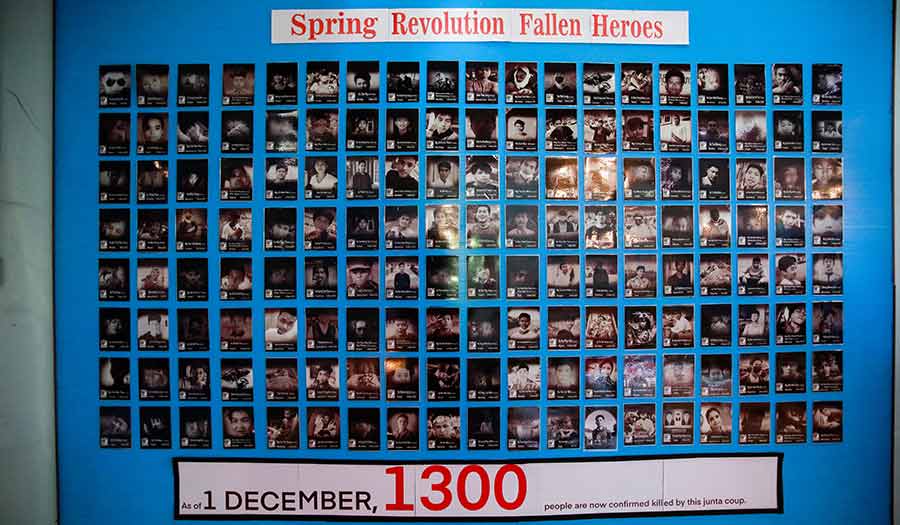
Over the past year, security forces have killed about 1,500 people, many of them demonstrators, and arrested nearly 12,000 people, according to the Assistance Association for Political Prisoners, a monitoring group. The military has said those figures are exaggerated.
Journalist So Pyay Aung told Reuters he filmed riot police using batons and shields to break up protests and livestreamed the video on the Democratic Voice of Burma, a news website. After authorities came searching for him, he said he hid in different locations in Myanmar before fleeing to Thailand with his wife and infant daughter. He was disowned by his father in November.
“I declare I am disowning my son because he did unforgivable activities against his parents’ wills. I will not have any responsibilities related to him,” said a notice posted by his father, Tin Aung Ko, in the state-owned Myanma Alinn newspaper.
“When I saw the newspaper that mentioned cutting ties with me, I felt a little sad,” So Pyay Aung told Reuters. “But I understand that my parents had fears of pressure. They might have worries of their house being seized or getting arrested.”
His father, Tin Aung Ko, declined to comment.
Two parents who disowned their children in similar notices, who asked not to be named for fear of attracting the attention of the military, told Reuters the notices were primarily intended to send a message to authorities that they should not be held responsible for their children’s actions.
“My daughter is doing what she believes, but I’m sure she will be worried if we got into trouble,” one mother said. “I know she can understand what I have done to her.”
Lin Lin Bo Bo said he hopes to one day go home and support his family. “I want this revolution to be over as soon as possible,” he told Reuters.
Such a reunification may be possible for some families torn apart in this way, according to Wai Hnin Pwint Thon, the rights activist.
“Unless they do it properly with lawyers and a will, then these things don’t really count legally,” she said of the disowning notices. “After a couple of years, they can go back to being family.”
So Pyay Aung, the journalist, said he fears his split with his parents is permanent.
“I don’t even have a home to go back to after the revolution,” he told Reuters. “I am so worried all the time because my parents are left under the military regime.”