Why Russia Won’t Leave Ukraine Alone
Tensions between Russia and Western powers in Eastern Europe swelled to their highest point since 2014 when Moscow amassed troops near Ukraine. Up to 190,000 soldiers were present near the border as U.S. officials continue to warn Russia could launch an attack against Ukraine in the coming days.
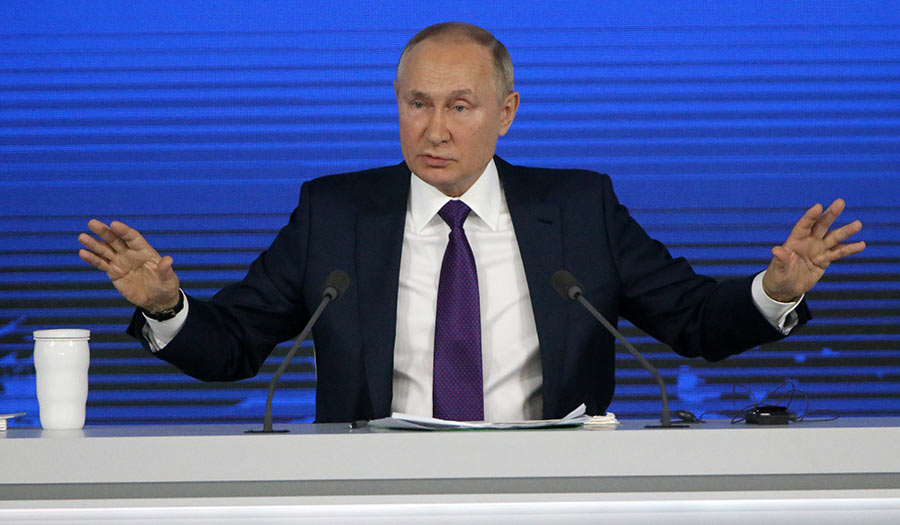
As the on-the-ground threats first mounted in December, Moscow published demands that NATO deny membership to Ukraine and other former Soviet countries and roll back the alliance’s military deployments in Central and Eastern Europe—ultimatums that were rejected by the U.S. and its allies. President Vladimir Putin reiterated the need for security guarantees in multiple video calls with U.S. President Joe Biden.
The recent flashpoint is the result of unresolved tensions from Russia’s annexation of Crimea in 2014. Since then, fighting between Ukrainian forces and Russia-backed separatists in eastern Ukraine has killed over 14,000 people and devastated Ukraine’s industrial heartland, known as the Donbas.
A 2015 peace deal, brokered by France and Germany, ended large-scale hostilities in Donbas, but efforts to reach a political settlement of the conflict have failed so far.
Ukraine, which was part of the Russian empire for centuries before becoming a Soviet republic, won independence as the USSR broke up in 1991. The country has moved to shed its Russian imperial legacy and forge increasingly close ties with the West.
A decision by Kremlin-leaning Ukrainian President Viktor Yanukovych to reject an association agreement with the European Union in favor of closer ties with Moscow sparked mass protests that led to his ouster in 2014. Russia responded by annexing Ukraine’s Crimean Peninsula and throwing its weight behind a separatist insurgency that broke out in Ukraine’s east.
Earlier in 2021, Mr. Putin ominously said a military attempt by Ukraine to reclaim the east would have “grave consequences for Ukrainian statehood.”
While Moscow sent tens of thousands of troops near Ukraine’s border, it accused Kyiv of its own troop buildup in the east, saying Ukrainian military could be planning to reclaim the rebel-held areas by force.
The Russian president has repeatedly described Russians and Ukrainians as “one people” and claims that Ukraine has unfairly received historic Russian lands during Soviet times.
For one, President Putin’s moves in and around Ukraine is a measure of self-defense. Yet some experts say it goes deeper. That for “Mr. Putin—and many other Russians—the nearly eight-year-old conflict with Ukraine is not simply about geopolitics; it is about a hurt national psyche, a historical injustice to be set right,” The New York Times reported. “One of his former advisers, Gleb O. Pavlovsky, in an interview described the Kremlin’s view of Ukraine as a ‘trauma wrapped in a trauma’—the dissolution of the Soviet Union coupled with the separation of a nation Russians long viewed as simply an extension of their own.”
Based on this view, as long as Moscow feels it is being deprived of its Soviet-era glory, it will continue to seek a stronger foothold in Ukraine.
Mr. Putin hinted at that in a July article. “It would be no exaggeration to say that the course of forced assimilation, the formation of an ethnically pure Ukrainian state aggressively oriented against Russia, is comparable in its consequences to the use of a weapon of mass destruction against us,” he wrote.