Armenia Says 49 Soldiers Killed in Attacks by Azerbaijan
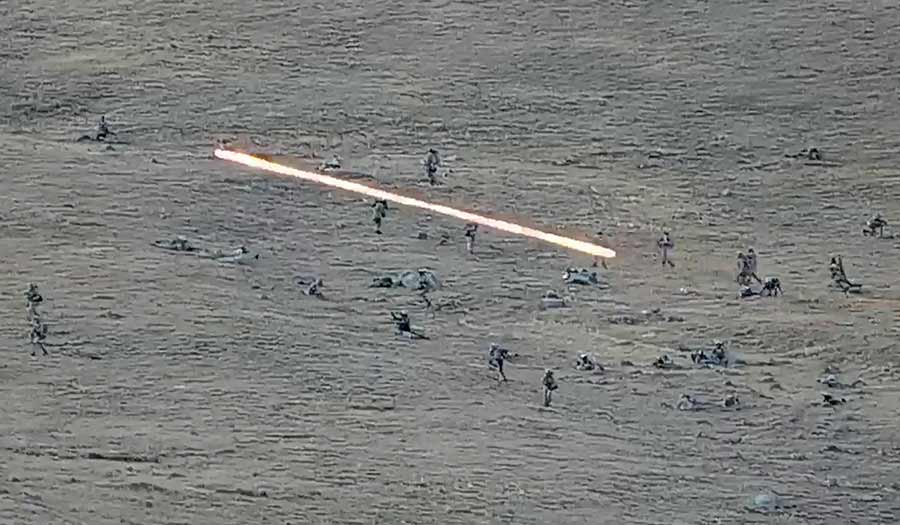
YEREVAN, Armenia (AP) – Azerbaijani forces shelled Armenia’s territory Tuesday and killed at least 49 Armenian soldiers, Armenia’s prime minister said, a large-scale attack that fueled fears of broader hostilities breaking out between the longtime adversaries.
The hostilities erupted minutes after midnight, with Azerbaijani forces unleashing an artillery barrage and drone attacks in many sections of Armenian territory, according to the Armenian Defense Ministry.
The ministry said fighting continued during the day despite Russia’s attempt to broker a quick cease-fire. It noted that the shelling grew less intense but said Azerbaijani troops still were trying to advance into Armenian territory.
The ministry added that the Azerbaijani shelling damaged civilian infrastructure and also wounded an unspecified number of people.
Azerbaijan charged that its forces returned fire in response to “large-scale provocations” by the Armenian military, claiming that the Armenian troops planted mines and repeatedly fired on Azerbaijani military positions, resulting in unspecified casualties and damage to military infrastructure.
Azerbaijan and Armenia have been locked in a decades-old conflict over Nagorno-Karabakh, which is part of Azerbaijan but has been under the control of ethnic Armenian forces backed by Armenia since a separatist war there ended in 1994.
Azerbaijan reclaimed broad swaths of Nagorno-Karabakh in a six-week war in 2020 that killed more than 6,600 people and ended with a Russia-brokered peace deal. Moscow, which deployed about 2,000 troops to the region to serve as peacekeepers under the deal, has sought to maintain friendly ties with both ex-Soviet nations.
Azerbaijan’s president, Ilham Aliyev, held a meeting with military officials to discuss the situation. “It was noted that the responsibility for the current tension rests squarely with the political leadership of Armenia,” his office said.
Turkey, an ally of Azerbaijan, also placed the blame for the violence on Armenia. Turkish Foreign Minister Mevlut Cavusoglu called for Yerevan to halt its “provocations,” and Defense Minister Hulusi Akar condemned “Armenia’s aggressive attitude and provocative actions.”
Speaking in parliament early Tuesday, Armenian Prime Minister Nikol Pashinyan said Azerbaijani shelling killed at least 49 Armenian soldiers. He squarely rejected the Azerbaijani claim that it was responding to Armenian provocations.
The governor of Gegharkunik province, one of the regions that came under Azerbaijani shelling, said there was a 40-minute lull in the fighting, apparently reflecting Moscow’s attempt to negotiate a truce, before it later resumed.
The governor, Karen Sarkisyan, said that four Armenian troops in his region were killed and another 43 were wounded by the shelling.
As the fighting raged overnight, Mr. Pashinyan quickly called Russian President Vladimir Putin and later also had phone calls with French President Emmanuel Macron, European Council President Charles Michel, Iranian President Ebrahim Raisi and U.S. Secretary of State Antony Blinken to discuss the hostilities.
Speaking in parliament, Mr. Pashinyan noted that the Azerbaijani action followed his recent European Union-brokered talks with Aliyev in Brussels that revealed what he described as Azerbaijan’s uncompromising stand.
The Armenian government said it would officially ask Russia for assistance under a friendship treaty between the countries and also appeal to the United Nations and the Collective Security Treaty Organization, a Moscow-dominated security alliance of ex-Soviet nations that includes Armenia.
Kremlin spokesman Dmitry Peskov refrained from comment on Armenia’s request but added during a conference call with reporters that Putin was “taking every effort to help de-escalate tensions.”
The Armenian Foreign Ministry said top officials from the security grouping held a meeting to discuss the fighting. Armenia’s representative at the grouping emphasized during the meeting that Yerevan expects its allies to take “efficient collective steps to ensure security, territorial integrity and sovereignty of Armenia.”
The Russian Foreign Ministry urged both parties “to refrain from further escalation and show restraint.”
Moscow has engaged in a delicate balancing act, maintaining strong economic and security ties with Armenia, which hosts a Russian military base, while also developing close cooperation with oil-rich Azerbaijan.