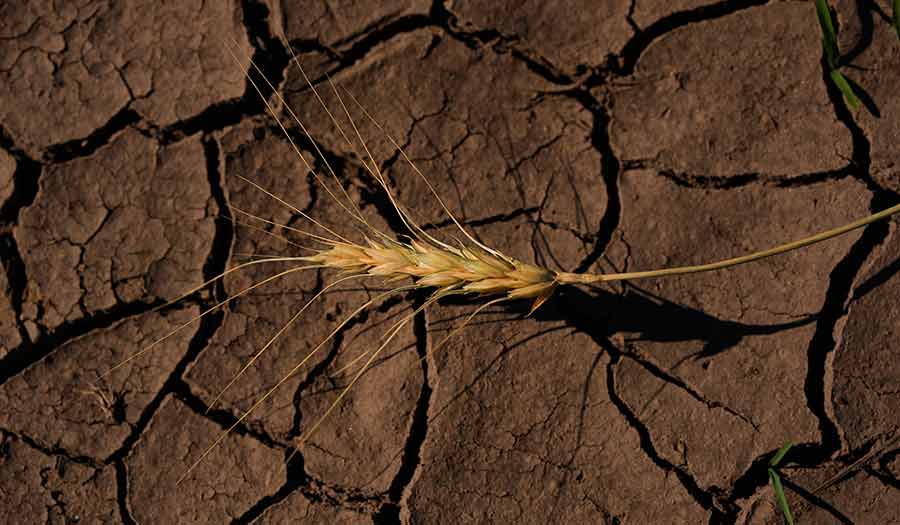
Farmers Struggle in Argentina as Drought Withers Their Crops
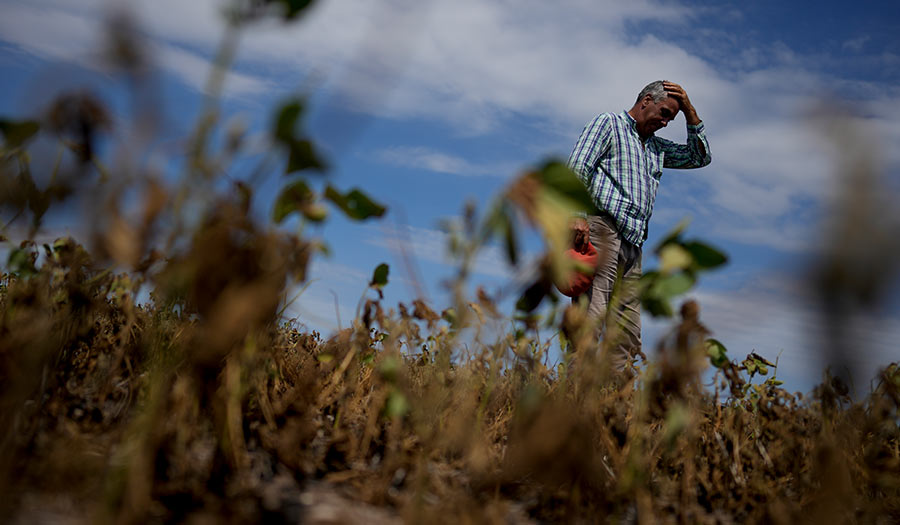
URQUIZA, Argentina (AP) – The ground crackles as Guillermo Cuitino walks across dry farmland that should be green and lush this time of year. He grabs a soy plant and easily disintegrates its leaves with his hands.
“This year’s drought was extreme,” the agricultural engineer said this week at the farm where he works in Urquiza, a town about 143 miles from Argentina’s capital.
Mr. Cuitino normally has a policy of not walking on cultivated land, but everything is so dry now that there is absolutely nothing to damage—even weeds aren’t growing.
That scene is repeated in farms across Argentina, where harvesting should be in full swing, but months of dry weather has ruined it. Farmers are scrambling to make ends meet, and a sharp drop in expected revenue from exported farm products will deal a severe blow to Argentina’s shaky economy.
“This drought is unprecedented,” farmer Martín Sturla said, standing in the middle of his dusty fields in nearby San Antonio de Areco. “It’s Dantesque. No one has seen anything like it.”
The situation is particularly dire because Argentina had already been suffering two years of unusually dry weather.
“The last two years were bad, but we always had some rain events that allowed us to get by,” Mr. Cuitino said.
Even experts are having trouble coming to terms with the crisis.
“There are no words to describe the impact of a campaign marked by all-time historical records: a deficit of rainfall for the third consecutive year in the summer, persistent heat waves until well into March, and agricultural frosts as late as October 2022 and as early as February 2023,” said a recent report by the Rosario Board of Trade that has sharply cut estimates for this year’s harvest.
“Crops, animals and natural resources have seen their conditions deteriorate week by week, leaving us on the eve of winter with a storm of losses,” it said.
In its latest weekly report, the Buenos Aires Grains Exchange said this year’s soybean production would be around 25 million tons, down 44 percent from the average for the last five cycles. Total wheat production, meanwhile, is forecast at 36 million tons, a 31 percent drop from the previous year.
Osvaldo Bo has seen this firsthand at his farm in Urquiza.
“We lost 90 percent,” Mr. Bo said while showing off a field of dry corn. “I’ve never seen a drought like this, because there have been droughts where there was no soybean, grain, but there was wheat and corn. But now, all harvests were lost.”
Taking into account the soybean, wheat and corn harvest, which make up 87 percent of Argentina’s grain production, losses will reach an estimated $14.14 billion, according to the Rosario Board of Trade. The Regional Consortium of Agricultural Experimentation said in a recent report that the current condition will lead to almost $20.5 billion in export losses.
Argentina has suffered the hottest summer since 1961, according to the country’s National Weather Service. In the capital, Buenos Aires, residents endured the hottest summer since records began in 1906.
Farmers are trying to figure out how to keep going.
“I’ve already done a couple of projections and I don’t have enough money to pay the bills of the year to plant again,” said Jorge Bianciotto, who manages the farm where Mr. Cuitino works.
“We’ve lost a lot of working capital and so what I’m doing know is trying to look for financing to cover the financial hole I have by asking for credit with the hope that next year will be better,” Mr. Bianciotto said. “One always believes that what’s coming is better than what happened.”