Saudi Arabia, Iran Restore Ties, Say They Seek Mideast Stability
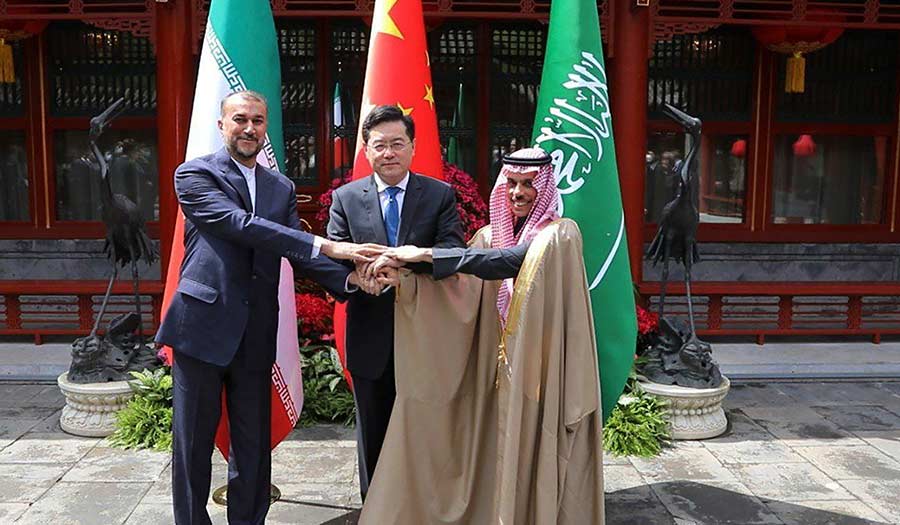
DUBAI, United Arab Emirates (AP) – Long-time Mideast rivals Iran and Saudi Arabia took another significant step toward reconciliation Thursday, formally restoring diplomatic ties after a seven-year rift, affirming the need for regional stability and agreeing to pursue economic cooperation.
The agreement was reached in Beijing during a meeting between the Iranian and Saudi foreign ministers, a month after China had brokered an initial reconciliation agreement between the two regional powerhouses.
The latest understanding further lowers the chance of armed conflict between the rivals, both directly and in proxy conflicts around the region. It could bolster efforts by diplomats to end a long war in Yemen, a conflict in which both Iran and Saudi Arabia are deeply entrenched.
Thursday’s announcement also represents another diplomatic victory for the Chinese as Gulf Arab states perceive the United States as slowly withdrawing from the wider region.
But it remains to be seen how far the reconciliation efforts will progress. The rivalry dates back to the 1979 revolution that toppled Iran’s Western-backed monarchy, and in recent years the two countries have backed rival armed groups and political factions across the region.
Iranian Foreign Minister Hossein Amirabdollahian laid out details of Thursday’s agreement in a tweet, after his talks with Saudi counterpart Prince Faisal bin Farhan Al Saud.
The minister wrote that Thursday marked the beginning of “official diplomatic relations...economic and commercial cooperation, the reopening of embassies and consulates general, and the emphasis on stability, stable security and development of the region.” Mr. Amirabdollahian said that the issues are “agreed upon and on the common agenda.”
The official Iranian news agency, IRNA, said that in addition to reopening embassies in the two capitals, diplomatic missions would start operating in two other major cities—Mashhad in Iran and Jeddah in Saudi Arabia. The report said both sides also agreed to study the prospects of resuming flights and official and private visits between the two nations, in addition to how to facilitate the visa process for their people.
China’s Foreign Ministry last month reported that both sides had agreed to reopen their embassies and missions within two months.
Chinese Foreign Ministry spokesperson Mao Ning said the two foreign ministers signed a joint statement and expressed their determination to improve ties in line with their talks in Beijing last month.
The state-run Saudi Press Agency carried a brief news item on the meeting, saying “discussions were held on joint relations and ways to enhance cooperation in many fields,” with both sides aiming to “enhance the security, stability, and prosperity of the two countries and peoples.”
Thursday’s talks in Beijing marked the first formal meeting of senior diplomats from the two nations since 2016, when the kingdom broke ties with Iran after protesters invaded Saudi diplomatic posts there. Saudi Arabia had executed a prominent Shiite cleric with 46 others days earlier, triggering the demonstrations.
The warming of ties shows that “regional countries have the will and ability to take the lead” in maintaining peace, Ms. Mao said at the briefing.
She said China is ready to support both sides in fostering good relations, urging the international community to help the Middle Eastern countries resolve their differences.
“The colonial hegemonic tactics of stirring up contradictions, creating estrangement and division should be rejected by the people all over the world,” she said.
The United States has welcomed diplomatic progress between Saudi Arabia, with which it has a close but complicated alliance, and Iran, which it considers a regional menace. But U.S. officials have also expressed skepticism about whether Iran will change its behavior.
“If this dialogue leads to concrete actions by Iran to curb its destabilizing activities in the region, including the proliferation of dangerous weapons, then of course, we would welcome that,” said Vedant Patel, the principal deputy State Department spokesman.
While the reopening of embassies would mark a major step forward, the extent of the rapprochement could depend on peace efforts in Yemen, where Saudi Arabia has been at war with the Iran-backed Houthi rebels since 2015, following the rebels’ capture of the capital and much of northern Yemen.
Saudi Arabia is also deeply suspicious of Iran’s nuclear program, which has advanced significantly since the U.S. unilaterally withdrew from a 2015 agreement with world powers to curb Iran’s atomic activities in exchange for sanctions relief.
“I know from my conversations with the Saudis, they are going to be watching the Yemen space,” Tim Lenderking, the Biden administration’s envoy for Yemen, told a think-tank audience in Washington earlier this week.
“If the Iranians want to show that they’re really turning a corner on the conflict, then there won’t be smuggling of weapons to the Houthis anymore in violation of U.N. Security Council resolutions.” He pointed to alleged Iranian involvement in smuggling narcotics as well.
Mr. Lenderking cited Iran’s support for an ongoing truce there as a recent positive sign and called on Iran to support political efforts for a lasting peace agreement.
U.N. Secretary-General Antonio Guterres said the restoration of relations between Saudi Arabia and Iran is “a very important development” to increase stability in the region, spokesman Stephane Dujarric said Thursday.