South Korea, U.S. to Share Nuclear Planning to Deter North Korean Threat
WASHINGTON (Reuters) – The United States on Wednesday pledged to give South Korea more insight into its nuclear planning over any conflict with North Korea amid anxiety over Pyongyang’s growing arsenal of missiles and bombs.
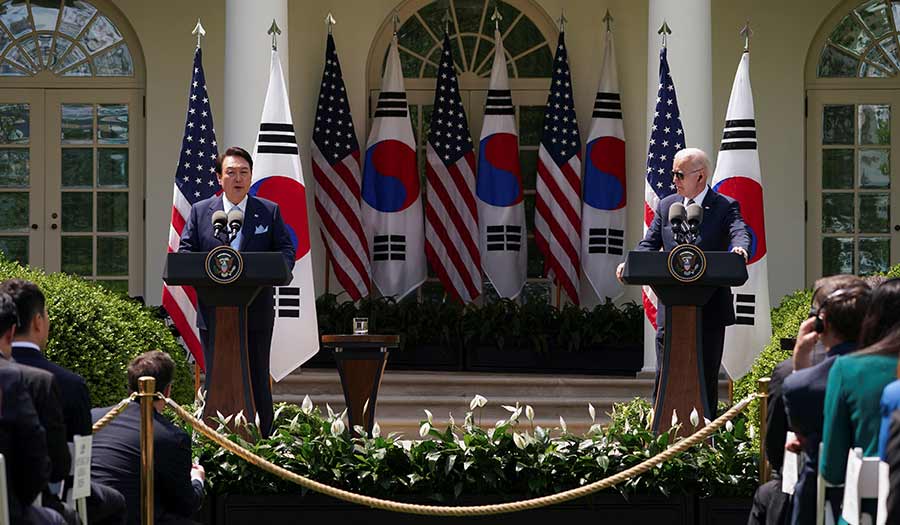
The announcement, which included a renewed pledge by Seoul not to pursue a nuclear bomb of its own, emerged from White House talks between U.S. President Joe Biden and South Korean leader Yoon Suk Yeol that covered issues including North Korea, semiconductor chips and trade, and the Ukraine war.
At a joint news conference, Mr. Yoon said he and Mr. Biden had agreed on steps to strengthen South Korea’s defenses in response to the threat posed by North Korea.
“Our two countries have agreed to immediate bilateral presidential consultations in the event of North Korea’s nuclear attack and promised to respond swiftly, overwhelmingly and decisively using the full force of the alliance, including the United States’ nuclear weapons,” Mr. Yoon said.
Mr. Biden reiterated the U.S. offer to North Korea to hold talks over its nuclear and missile programs, which has been ignored by North Korean leader Kim Jong Un.
Deterring North Korea
North Korea’s rapidly advancing weapons programs—including ballistic missiles that can reach U.S. cities—have raised questions about whether Washington would really use its nuclear weapons to defend South Korea under what it calls “extended deterrence.”
Opinion polls in South Korea show a majority want Seoul to acquire its own nuclear bombs, a step Washington opposes.
Under a new “Washington Declaration,” the U.S. will give Seoul detailed insights into, and a voice in, U.S. contingency planning to deter and respond to any nuclear incident in the region through a U.S.-ROK Nuclear Consultative Group, U.S. officials said.
Washington will also deploy a ballistic-missile submarine to South Korea in a show of force, the first such submarine visit since the 1980s, U.S. officials said.
But Mr. Biden made clear that no U.S. nuclear weapons would be stationed on South Korean territory.
“I have absolute authority as commander in chief and the sole authority to use a nuclear weapon, but…what the declaration means is that we’re going to make every effort to consult with our allies when it’s appropriate, if any action is so called for,” he said.
A Win for South Korea?
The agreed steps fall short of what some in South Korea have called for and are “unlikely to either persuade North Korea off its current course of WMD development and testing or to quiet the debate inside South Korea about its own nuclear future,” said Jenny Town of the Washington-based North Korea monitoring group 38 North.
Sue Mi Terry of the Wilson Center think tank saw the move as largely rhetorical and “a fig leaf” to dissuade South Korea from going nuclear.
“That’s what this is about,” she said. “But it remains to be seen if Korean public opinion will be satisfied.”
Ms. Terry said any resumption of nuclear bomb testing by North Korea for the first time since 2017 would increase alarm in South Korea and calls for its own nuclear arsenal—or for the redeployment of U.S. tactical nuclear weapons in the country.
Even so, increasing Seoul’s involvement in nuclear deliberations should allow Mr. Yoon to argue to his domestic audience that Washington is taking Seoul’s concerns seriously.
Duyeon Kim, an analyst with the Center for a New American Security, called the Washington Declaration “a big win for the alliance and especially for South Korea.”
She said one of the most notable developments was that the two sides were gaming out scenarios including a U.S. nuclear response, whereas in the past this had been considered too classified to share.
U.S. officials stressed that no U.S. nuclear weapons would be returned to the peninsula, and South Korea would continue not to have control over the U.S. nuclear arsenal.
Mr. Yoon’s is only the second state visit Mr. Biden has hosted since taking office two years ago—the first such guest was France’s president.
On Wednesday evening the leaders attended a glittering dinner catered by a chef whose mother emigrated from Korea.
The summit also produced agreements on cyber security, electric vehicles and batteries, quantum technology, foreign assistance and economic investment.
Mr. Biden and Mr. Yoon also discussed tensions between China and Taiwan and Chinese military activities in the South China Sea.
In a joint statement, the two presidents stressed the importance of preserving stability in the Taiwan Strait.
They also strongly opposed “any unilateral attempts to change the status quo in the Indo-Pacific, including through unlawful maritime claims, the militarization of reclaimed features, and coercive activities,” it said.
The U.S. planned to brief China on the steps with Seoul, U.S. officials said, signaling a desire to ease tense relations.