The Math Problem: How Can Schools Help Kids Catch Up?
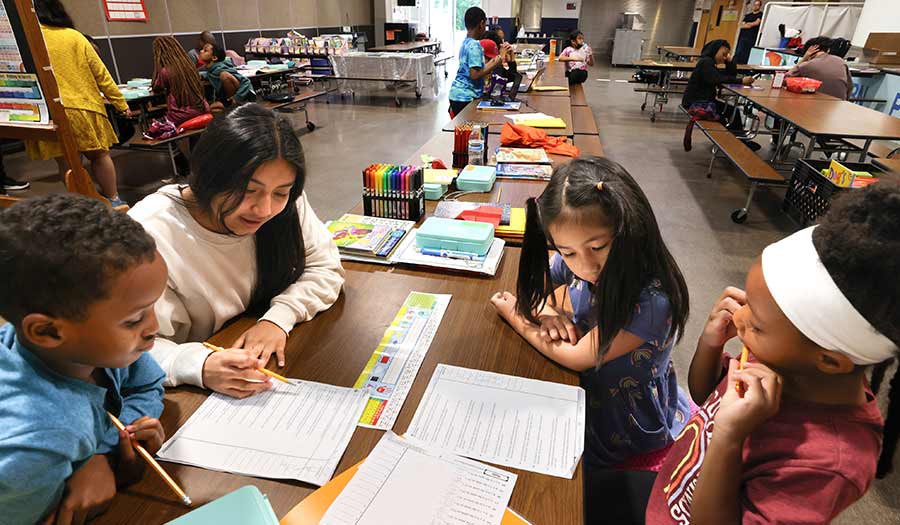
On a breezy July morning in South Seattle, a dozen elementary-aged students ran math relays behind an elementary school.
One by one, they raced to a table, where they scribbled answers to multiplication questions before sprinting back to high-five their teammate. These students are part of a summer program run by the nonprofit School Connect WA, designed to help them catch up on math and literacy skills lost during the pandemic. There are 25 students in the program, and all of them are one to three grades behind.
One 11-year-old boy couldn’t do two-digit subtraction. Thanks to the program and his mother, who has helped him each night, he’s caught up. Now, he says math is challenging, but he likes it.
Other kids have not fared so well.
Across the country, schools are scrambling to catch up students in math as post-pandemic test scores reveal the depth of missing skills. On average, students’ math knowledge is about half a school year behind where it should be, according to education analysts.
Children lost ground on reading tests, too, but the math declines were particularly striking. Experts say virtual learning has complicated math instruction, making it tricky for teachers to guide students over a screen or spot weaknesses in problem-solving skills. Plus, parents were more likely to read with their children at home than to practice math.
The result: Students’ math skills plummeted across the board, exacerbating racial and socioeconomic inequities in math performance. And students are not bouncing back as quickly as educators hoped, supercharging worries about how they will fare in high school and whether science, tech and medical fields will be available to them.
Students had been making incremental progress on national math tests since 1990. But over the past year, fourth and eighth grade math scores slipped to the lowest levels in about 20 years, according to data from the National Assessment of Educational Progress, known as the “Nation’s Report Card.”
“It’s a generation’s worth of progress lost,” said Andrew Ho, a professor at Harvard University’s Graduate School of Education.
At Moultrie Middle School in Mount Pleasant, South Carolina, Jennifer Matthews has seen the pandemic fallout in her eighth grade classes. Her students have shown indifference to understanding her pre-algebra and Algebra I lessons.
“They don’t allow themselves to process the material. They don’t allow themselves to think, ‘This might take a day to understand or learn,’ “she said.
And recently students have been coming to her classes with gaps in their understanding of math concepts. Basic fractions, for instance, continue to stump many of them, she said.
Using federal pandemic relief money, some schools have added tutors or piloted new curriculum approaches in the name of academic recovery. But that money has a looming expiration date: The September 2024 deadline for allocating funds will arrive before many children have caught up.
Like other districts across the country, Jefferson County Schools in Birmingham, Alabama, saw students’ math skills take a nosedive from 2019 to 2021. Leveraging pandemic aid, the district placed math coaches in all of their middle schools.
The coaches help teachers learn new and better ways to teach students. About 1 in 5 public schools in the United States have a math coach, according to federal data. The efforts appear to be paying off: State testing shows math scores have started to inch back up for most of the Jefferson County middle schools.
Adding to the challenge of catching kids up is the debate over how math should be taught. Over the years, experts say, the pendulum has swung between procedural learning, such as teaching kids to memorize how to solve problems step-by-step, and conceptual understanding, in which students grasp underlying math relationships.
“Stereotypically, math is that class that people don’t like...For so many adults, math was taught just as memorization,” said Kevin Dykema, president of the National Council of Teachers of Mathematics. “When people start to understand what’s going on, in whatever you’re learning but especially in math, you develop a new appreciation for it.”
Teaching math should not be an either-or situation, said Sarah Powell, a professor at the University of Texas at Austin who researches math instruction. A shift too far in the conceptual direction, she said, risks alienating students who haven’t mastered the foundational skills.
“We actually do have to teach, and it is less sexy and it’s not as interesting,” she said.
In Spring, Texas, parent Aggie Gambino has often found herself searching YouTube for math videos. Giada, one of her twin 10-year-old daughters, has dyslexia and also struggles with math, especially word problems. Ms. Gambino says helping her daughter has proved challenging, given instructional approaches that differ from the way she was taught.
She wishes her daughter’s school would send home information on how students are being taught.
“The more parents understand how they’re being taught,” she said, “the better participant they can be in their child’s learning.”
Even at a nationally recognized magnet school, the lingering impact of the pandemic on students’ math skills is apparent. At the Townview School of Science and Engineering in Dallas, the incoming ninth graders in Lance Barasch’s summer camp course needed to relearn the meaning of words like “term” and “coefficient.”
“Then you can go back to what you’re really trying to teach,” he said.
Mr. Barasch wasn’t surprised that the teens were missing some skills after their chaotic middle school years.
The hope is that by taking a step back, students can begin to move forward.
This report contains information from The Associated Press.