Cluster Munitions: Ukraine Overtakes Syria as Deadliest Battleground
AIN SHEEB, Syria (AP) – More than 300 people were killed and over 600 wounded by cluster munitions in Ukraine in 2022, according to an international watchdog, surpassing Syria as the country with the highest number of casualties from the controversial weapons for the first time in a decade.
Russia’s widespread use of the bombs, which open in the air and release scores of smaller bomblets or submunitions as they are called, in its invasion of Ukraine—and, to a lesser extent, their use by Ukrainian forces—helped make 2022 the deadliest year on record globally, according to the annual report released Tuesday by the Cluster Munition Coalition, a network of non-governmental organizations advocating for a ban of the weapons.
The deadliest attack in Ukraine, according to the country’s prosecutor general’s office, was a bombing on a railway station in the town of Kramatorsk that killed 53 people and wounded 135.
Meanwhile, in Syria and other war-battered countries in the Middle East, although active fighting has cooled down, the explosive remnants continue to kill and maim dozens of people every year.
The long-term danger posed to civilians by explosive ordnance peppered across the landscape for years—or even decades after fighting has ceased—has come under a renewed spotlight since the United States announced in July that it would provide them to Ukraine to use against Russia.
In Syria, 15 people were killed and 75 wounded by cluster munition attacks or their remnants in 2022, according to the coalition’s data. Iraq, where there were no new cluster bomb attacks reported last year, saw 15 people killed and 25 wounded. In Yemen, which also had no new reported attacks, five people were killed and 90 were wounded by the leftover explosives.
The majority of victims globally are children. Because some types of these bomblets resemble metal balls, children often pick them up and play with them without knowing what they are.
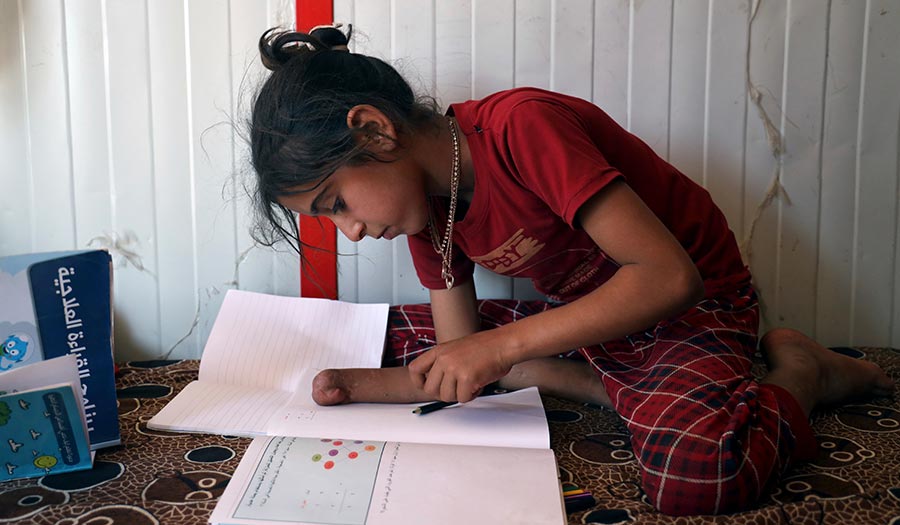
Among the casualties are 12-year-old Rawaa al-Hassan and her 10-year-old sister, Doaa, whose family has lived at a camp near the village of Ain Sheeb in northern Syria’s opposition-held Idlib province since being displaced from their hometown in Hama province six years earlier.
The area where they live in Idlib had frequently come under airstrikes, but the family had escaped from those unharmed.
During Ramadan last year, as the girls were coming home from school, their mother Wafaa said, they picked up an unexploded bomblet, thinking it was a piece of scrap metal they could sell.
Rawaa lost an eye, Doaa, a hand. In a cruel irony, the girls’ father had died eight months earlier after he stepped on a cluster munition remnant while gathering firewood.
The girls “are in a bad state, psychologically” since the two tragic accidents, said their uncle Hatem al-Hassan, who now looks after them and their mother. They have difficulty concentrating, and Rawaa often flies off the handle, hitting other children at school.
“Of course, we’re afraid, and now we don’t let them play outside at all anymore,” he said.
Near the village of Ram Hamdan, also in Idlib, Ali al-Mansour, 43, was tending his sheep one day in 2019 with his 5-year-old son in tow when the child handed him a metal object that looked like a toy and asked him to take it apart.
“I tried to take it apart and it wasn’t working, so I hit it with a rock, and it exploded on me,” al-Mansour said. He lost his eyes and his hands. Without a breadwinner, his family now lives on handouts from relatives.
Scattered submunitions often strike shepherds and scrap metal collectors, a common post-conflict source of livelihood, said Loren Persi, one of the editors of the Cluster Munition Coalition’s annual report. They also lurk in the fields where truffle hunters forage for the lucrative delicacy, he said.
Efforts to clear the explosives have been hampered by lack of funding and by the logistics of dealing with the patchwork of actors controlling different parts of Syria, Mr. Persi said.
Some 124 countries have joined a United Nations convention banning cluster munitions. The U.S., Russia, Ukraine and Syria are among the holdouts.
Deaths and injuries from cluster munition remnants have continued for decades after wars ended in some cases—including in Laos, where people still die yearly from Vietnam war-era U.S. bombing that left millions of unexploded cluster bomblets.
Alex Hiniker, an independent expert with the Forum on the Arms Trade, said casualties had been dropping worldwide before the 2011 uprising turned civil war in Syria.
“Contamination was being cleared, stockpiles were being destroyed,” she said, but the progress “started reversing drastically” in 2012, when the Syrian government and allied Russian forces began using cluster bombs against the opposition in Syria.
The numbers had dropped off as the war in Syria turned into a stalemate, although at least one new cluster bomb attack was reported in Syria in November 2022. But they quickly spiked again with the conflict in Ukraine.
U.S. officials have defended the decision to provide cluster bombs to Ukraine as necessary to level the playing field in the face of a stronger opponent and have insisted that they will take measures to mitigate harm to civilians. This would include sending a version of the munition with a reduced “dud rate,” meaning fewer unexploded rounds left behind after the conflict.
Ms. Hiniker said she and others who track the impacts of cluster munitions are “baffled by the fact that the U.S. is sending totally outdated weapons that the majority of the world has banned because they disproportionately kill civilians.”
The “most difficult and costly part” of dealing with the weapons, she said, “is cleaning up the mess afterwards.”