Ethnic Armenians Flee Karabakh After Breakaway Region’s Defeat
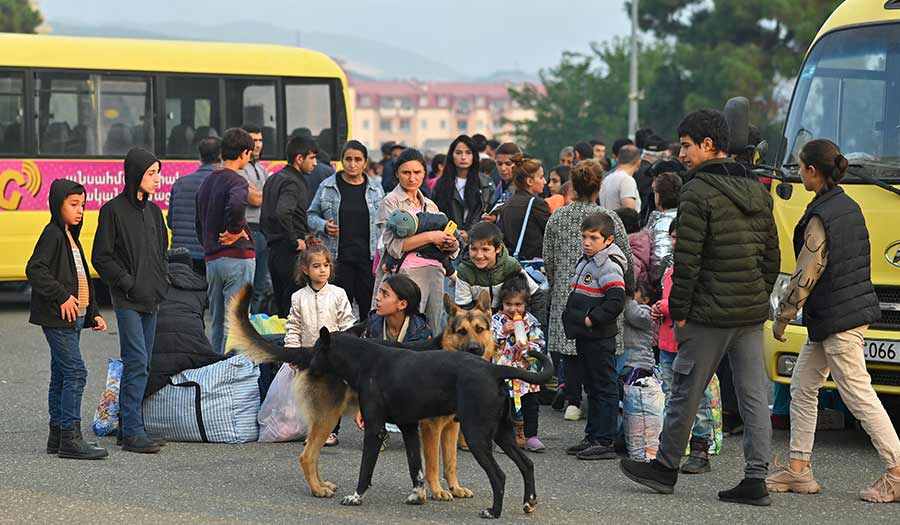
STEPANAKERT-KHANKENDI, Azerbaijan (Reuters) – Thousands of ethnic Armenians fled the breakaway region of Nagorno-Karabakh on Monday, queuing up for fuel and jamming the mountain road to Armenia after their fighters were defeated by Azerbaijan in a lightning military operation.
The leadership of the 120,000 Armenians who call Karabakh home told Reuters on Sunday that they did not want to live as part of Azerbaijan and that they would leave for Armenia because they feared persecution and ethnic cleansing.
In the Karabakh capital, known as Stepanakert by Armenia and Khankendi by Azerbaijan, crowds of people were loading belongings into buses and trucks as they left for Armenia.
The mass departures were marked by confusion.
An explosion at a gas storage depot on a road outside the capital injured more than 200 people, local news reports said, quoting Nagorno-Karabakh’s ombudsman Gegham Stepanyan. Most of the injured were in serious or very serious condition and needed to be taken out of the region urgently for treatment, Mr. Stepanyan said.
Refugees who reached Armenia told Reuters they believed the history of their breakaway state was finished.
“No one is going back—that’s it,” Anna Agopyan, who reached Goris, a border town in Armenia, told Reuters. “The topic of Karabakh is over now for good, I think.”
U.S. President Joe Biden said in a letter delivered to Armenian Prime Minister Nikol Pashinyan by U.S. Agency for International Development (USAID) chief Samantha Power that the United States would help address the humanitarian needs.
“You are aware that, unfortunately, the process of ethnic cleansing of the Armenians of Nagorno-Karabakh continues, it is happening right now, and it is a very tragic fact,” Mr. Pashinyan told Ms. Power, according to an Armenian government transcript.
Azerbaijan, which has repeatedly denied any claims of ethnic cleansing, said that the rights of Armenians in Karabakh, a territory internationally recognized as part of Azerbaijan, would be guaranteed.
But thousands of ethnic Armenians have already left. The Armenian government said at least 6,650 people from Nagorno-Karabakh had crossed into Armenia, up from about 4,850 people five hours earlier.
The ethnic Armenian leadership said it would remain in place until all those who wanted to leave what they call Artsakh were able to go. They urged residents to hold back from crowding the roads out but promised free fuel to all those who were leaving.
Azerbaijan’s President Ilham Aliyev hosted his ally Turkish President Tayyip Erdogan on Monday in the autonomous Nakhchivan exclave—a strip of Azerbaijani territory separated from the rest of the country by Armenia.
Mr. Aliyev hinted at the prospect of creating a land corridor from the strip to the rest of Azerbaijan through Armenia, which opposes the idea.
Karabakh
The Azerbaijani victory alters the delicate balance of power in the South Caucasus region, a patchwork of ethnicities crisscrossed with oil and gas pipelines where Russia, the United States, Turkey and Iran are jostling for influence.
Since the breakup of the Soviet Union, Armenia had relied on a security partnership with Russia, while Azerbaijan grew close to Turkey, with which it shares linguistic and cultural ties.
Russia warned Armenia’s Pashinyan that he only had himself to blame for Azerbaijan’s victory over Karabakh because he had insisted on flirting with the West rather than working with Moscow and Baku for peace.
Russia said Mr. Pashinyan had “shied away from working in rhythm with Russia and Azerbaijan and instead ran to the West” to resolve the Karabakh crisis. Mr. Pashinyan said on Sunday that Russia had not helped Yerevan over Karabakh.
Washington expressed its alarm at the Karabakh crisis.
“I’m here to reiterate the U.S.’s strong support and partnership with Armenia and to speak directly with those impacted by the humanitarian crisis in Nagorno-Karabakh,” said USAID chief Power.
The Armenians of Karabakh said Russia, the West and Armenia itself had abandoned them, and some spoke through tears of the end of an era for the Karabakh Armenians.
Srbuhi, a mother-of-three who reached Armenia, shed tears as she held her young daughter.
“I left everything there,” she said.
Azerbaijan’s Victory
Azerbaijan’s victory reverses a humiliating defeat the country suffered as the Soviet Union broke up, which left around a seventh of its population homeless and Armenians in control of swathes of territory around Karabakh.
Nagorno-Karabakh has over the centuries come under the sway of Persians, Turks, Russians, Ottomans and Soviets. It was claimed by both Azerbaijan and Armenia after the fall of the Russian Empire in 1917 and in Soviet times it was designated an autonomous region within Azerbaijan.
From 1988 to 1994, about 30,000 people were killed and more than a million people, mostly ethnic Azeris, were displaced as the Armenians threw off nominal Azerbaijani control in what is now known as the First Karabakh War.
Azerbaijan gained back territory in and around Nagorno-Karabakh in a second war in 2020, which ended with a Moscow-brokered peace deal and the deployment of a contingent of Russian peacekeepers.
Turkey’s Erdogan, who backed Azerbaijan with weaponry in the 2020 conflict, said last week he supported the aims of Azerbaijan’s latest military operation but played no part in it.
Armenia says more than 200 people were killed and 400 wounded in last week’s Azeri operation.