Japan Joins an Elite Club by Landing on the Moon. What Are Other Countries Doing?
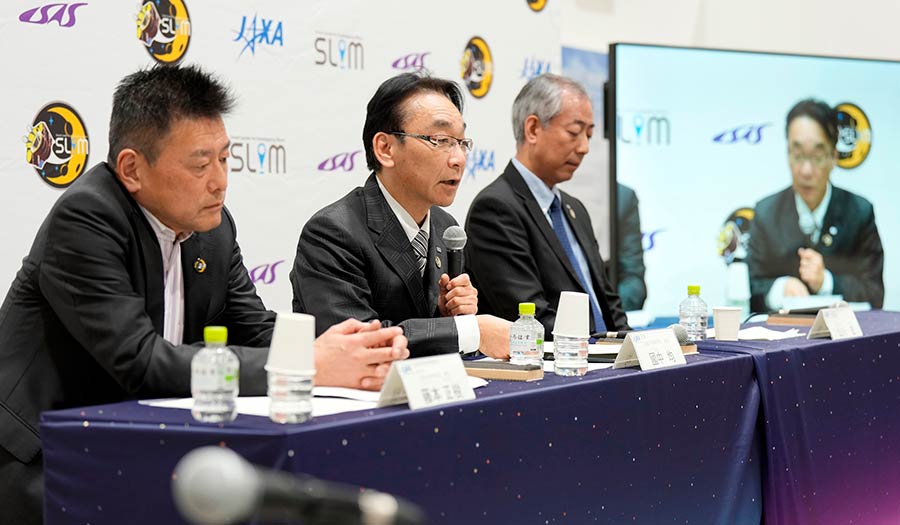
TOKYO (AP) – Japan landed a spacecraft on the moon Saturday, an attempt at the world’s first “pinpoint lunar landing.” The milestone puts Japan in a club previously occupied by only the United States, the Soviet Union, India and China.
A raft of countries and companies are also plotting moon missions. Success means international scientific and diplomatic accolades and potential domestic political gains. Failure means a very expensive, and public, embarrassment.
Here is a look at high-profile recent and upcoming attempts, and what they might mean.
The United States
NASA plans to send astronauts to fly around the moon next year, and to land there in 2026.
Just this week, however, a U.S. company, Astrobotic Technology, said its lunar lander will soon burn up in Earth’s atmosphere after a failed moonshot.
The lander, named Peregrine, developed a fuel leak that forced Astrobotic to abandon its attempt to make the first U.S. lunar landing in more than 50 years. The company suspects a stuck valve caused a tank to rupture.
NASA is working to commercialize lunar deliveries by private businesses while the U.S. government tries to get astronauts back to the moon.
For now, the United States’ ability to spend large sums and marshal supply chains gives it an advantage over China and other moon rivals. Private sector players such as SpaceX and Blue Origin have made crewed space missions a priority.
Another U.S. company, Intuitive Machines, plans to launch its own lunar lander next month.
India
Last year, India became the first country to land a spacecraft near the moon’s south pole, where scientists believe that perpetually darkened craters may hold frozen water that could aid future missions.
In 2019, a software glitch caused an Indian lander to crash on its lunar descent. So the $75 million success in August brought widespread jubilation, with people cheering in the streets and declaring India’s rise as a scientific superpower.
Indian scientists said that the next step is a manned lunar mission.
The success is seen as key to boosting Prime Minister Narendra Modi’s popularity before a crucial general election this year.
India has been pushing for a space program since the 1960s and aims to visit the International Space Station next year in collaboration with the United States.
New Delhi also sees victory in space as important in its rivalry with nuclear-armed neighbor China. Relations between India and China have plunged since deadly border clashes in 2020.
China
China landed on the moon in 2013, and last year launched a three-person crew for its orbiting space station. It hopes to put astronauts on the moon before the end of the decade.
In 2020, a Chinese capsule returned to Earth from the moon with the first fresh lunar rock samples in more than 40 years. China’s first manned space mission in 2003 made it the third country after the USSR and the United States to put a person into space.
China’s space ambitions are linked to its rivalry with the United States as the world’s two largest economies compete for diplomatic, political and military influence in Asia and beyond.
China built its own space station after it was excluded from the International Space Station, in part because of U.S. objections over the Chinese space program’s intimate ties to the military.
China and the United States are also considering plans for permanent crewed bases on the moon. That has raised questions about competition and cooperation on the lunar surface.
Russia
Also last year, Russia’s Luna-25 failed in its attempt to land in the same area of the moon that India reached.
It came 47 years after the Soviets landed on the moon, and Russian scientists blamed that long break, and the accompanying loss of space expertise, for the recent failure.
The Soviets launched the first satellite in space in 1957 and put the first human in space in 1961, but Russia’s program has struggled since the 1991 collapse of the Soviet Union amid widespread corruption and Western sanctions that have hurt scientific development.
Russia is planning for another moon mission in 2027.
Russia’s failures and the growing role of private companies like Elon Musk’s SpaceX have cost Russia its once-sizable niche in the lucrative global space launch market.
Just as India’s success was seen as evidence of its rise to great power status, Russia’s failure has been portrayed by some as casting doubt on its global influence and strength.