Global Anti-Corruption Efforts Are Faltering, Survey Finds
BERLIN (AP) – Efforts to fight public sector corruption are faltering around the world, in part because of a “global decline in justice and the rule of law since 2016,” according to a corruption index released Tuesday.
Transparency International, which compiles the annual Corruption Perceptions Index, found 23 countries at their worst level since the global ranking began almost three decades ago, including both high-ranking democracies and authoritarian states.
On the reported decline in justice, the group said that “the rise of authoritarianism in some countries contributes to this trend, and even in democratic contexts, the mechanisms that keep governments in check have weakened.”
“Corruption will continue to thrive until justice systems can punish wrongdoing and keep governments in check,” Transparency International chair Francois Valerian said in a statement. He added that “leaders should fully invest in and guarantee the independence of institutions that uphold the law and tackle corruption.”
The organization measures the perception of public sector corruption according to 13 data sources including the World Bank, the World Economic Forum and private risk and consulting companies. It ranks 180 countries and territories on a scale from a “highly corrupt” 0 to a “very clean” 100.
Among the countries hitting their lowest level were relatively high-scoring democracies such as Iceland, the Netherlands, Sweden and Britain. Authoritarian countries including Iran, Russia and Venezuela also dropped.
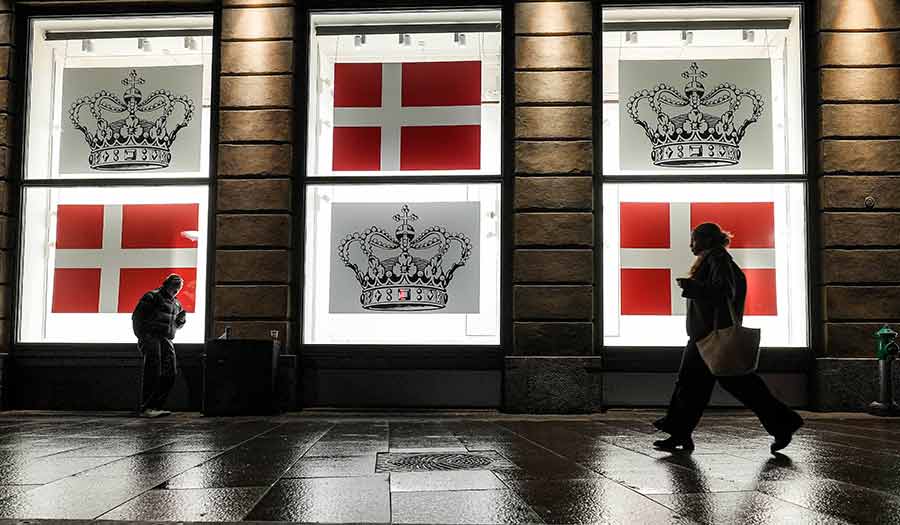
Denmark led the index with the highest score for the sixth consecutive year, with 90. It was followed by Finland with 87 and New Zealand with 85. The others in the top 10 were Norway, Singapore, Sweden, Switzerland, the Netherlands, Germany and Luxembourg.
The United States was unchanged with a score of 69, putting it in 24th place.
At the other end, Somalia again had the weakest score with 11. It was followed by South Sudan, Syria and Venezuela with 13 each; Yemen with 16; and Equatorial Guinea, Haiti, North Korea and Nicaragua with 17 each.
The global average was unchanged at 43 for the 12th consecutive year, and more than two-thirds of countries scored below 50.
The report found “little to no meaningful progress” toward curbing corruption in the Asia-Pacific region, and expressed concerns about “opacity and undue influence” in justice systems in Latin America and the Caribbean.
Arab countries’ average score on the index hit an all-time low of 34, and sub-Saharan Africa remained stagnant at 33.
Even in western Europe and the European Union, the best-performing region, Transparency International found that “weak accountability and political corruption are diminishing public trust and enabling narrow interest groups to exert excessive control over political decision-making.”
It pointed to “weaknesses in judicial systems” in Poland, with a score of 54, and Hungary with 42.
On Poland, the report noted the previous governing party’s “systematic efforts...to monopolize power at the expense of public interest.” It acknowledged the new government’s commitment to uphold the rule of law, but said the ousted governing party continues to exert “considerable influence” over the judiciary.
Ukraine, with a score of 36, continued an 11-year improvement despite Russia’s invasion by focusing on reforms of the judicial system, which are an element of its bid to join the EU. But the report said that “the existence of a significant number of high-level corruption cases remains a major concern.”
Russia’s score dropped to 26. Transparency International said that the government’s “pervasive control of public institutions facilitates the widespread abuse of power without accountability” while judicial independence is eroding.