India Begins to Flex Naval Power as Competition with China Grows
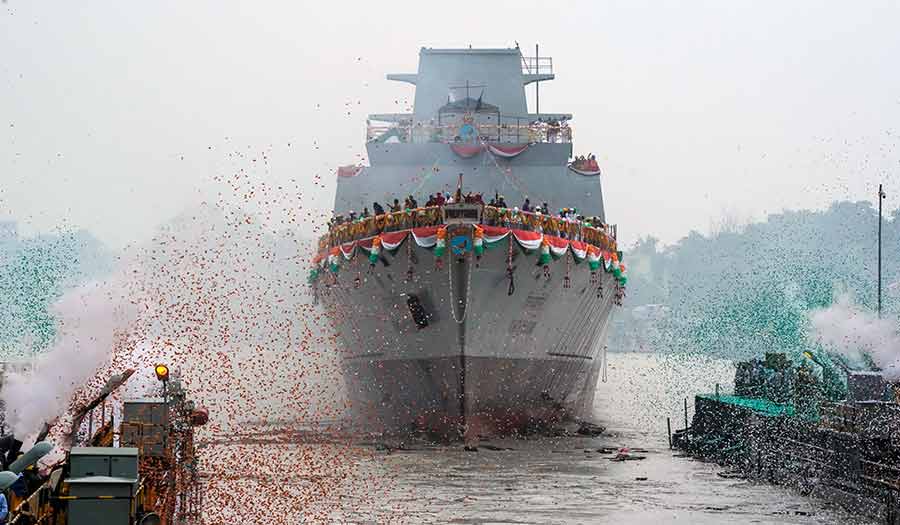
SRINAGAR, India (AP) – For decades, India has focused its defense policy on its land borders with rivals Pakistan and China. Now, as its global ambitions expand, it is beginning to flex its naval power in international waters, including anti-piracy patrols and a widely publicized deployment close to the Red Sea to help protect ships from attacks during Israel’s war with Hamas.
India sent three guided missile destroyers and reconnaissance aircraft in November when Yemen-based Houthi rebels began targeting ships in solidarity with Hamas, causing disruptions in a key trading route that handles about 12 percent of global trade.
The deployment highlights the country as a “proactive contributor” to international maritime stability, said Vice Admiral Anil Kumar Chawla, who retired in 2021 as head of India’s southern naval command.
“We are not doing it only out of altruism. Unless you are a maritime power you can never aspire to be a global power,” Mr. Chawla said. India, already a regional power, is positioning itself “as a global player today, an upcoming global power,” he said.
India is widely publicizing the deployments, signaling its desire to assume a wider responsibility in maritime security to the world and its growing maritime ambitions to regional rival China.
“It is a message to China that, look, we can deploy such a large force here. This is our backyard. Though we don’t own it, but we are probably the most capable and responsible resident naval power,” Mr. Chawla said.
The Indian navy has helped at least four ships, three of which were attacked by Houthi rebels and another that Washington blamed on Iran, a charge denied by Tehran. It has also conducted several anti-piracy missions.
Iran-backed Houthi rebels have targeted dozens of ships in the Red Sea, saying they are seeking a cease-fire in the Gaza Strip. The U.S. and its allies have responded with multiple rounds of bombings of rebel positions. India has not joined the U.S.-led force battling the Houthis.
On January 26, the Indian guided missile destroyer INS Visakhapatnam assisted the crew of a Marshall Islands-flagged tanker in fighting a fire after it was hit by a missile in the Gulf of Aden. About 10 days earlier, the Visakhapatnam responded to a distress call by the U.S.-owned Genco Picardy merchant vessel following a drone attack in the same waters.
“Maritime security has not been a strong pillar of India’s foreign policy engagements in a way we are beginning to see now,” said Darshana M. Baruah, a fellow at the Carnegie Endowment for International Peace. “China is a factor in this.”
The rivals are already locked in a military standoff along their disputed border high in the mountains.
China has built up its presence over the years in the Indian Ocean, a key route for its energy supplies. It has the world’s largest navy by number of ships, more than three times the size of the Indian navy. China also operates a powerful fleet of large coast guard ships and what is referred to as its maritime militia consisting of fishing vessels that cooperate with the coast guard in asserting territorial claims in the South China Sea.
Beijing has deepened its engagement in the Indian Ocean mainly through infrastructure deals with India’s neighbors, including Bangladesh, Sri Lanka and most recently the Maldives.
“The Chinese are looking for more and more naval bases in the extended Indian Ocean,” said Lt. General D. S. Hooda, a former Indian military officer and now a strategic expert. “Seeing that, India doesn’t have any other option but to keep building up its own.”
The Maldives government last week gave clearance to a Chinese research ship to dock in its port. Similar Chinese ships have made port calls in Sri Lanka in 2022 and 2023 amid fears in India that they could be used to surveil the region. India’s concerns led Sri Lanka earlier this year to declare a one-year moratorium on foreign research ships entering its waters.
Experts say the growing competition with China is energizing India to acquire more advanced ships, submarines and aircraft and invest more in technology and infrastructure. The navy’s share of India’s burgeoning defense budget, which reached $72.6 billion last year, has increased to 19 percent from about 14 percent. The Indian army has traditionally received the lion’s share of the military budget.
The navy has also built strategic partnerships through participation in joint exercises with other nations in the region and beyond.
Ms. Baruah, who directs the Indian Ocean Initiative at the Carnegie Endowment, said there is a “need for Delhi’s strategic thinking to be maritime-oriented, not just as an option for crisis response but as a theater to advance India’s most pressing geopolitical and strategic priorities in the Indo-Pacific.”
India, the U.S., Australia and Japan are members of the Indo-Pacific strategic alliance known as the Quad, which has repeatedly accused China of flexing its military muscles in the South China Sea and aggressively pushing its maritime territorial claims. The navies of the four countries regularly hold drills seen as part of an initiative to counter China’s growing assertiveness in the Pacific.
Beijing maintains that its military is purely defensive to protect what it says are its sovereign rights, and calls the Quad an attempt to contain its economic growth and influence.
For Indian naval planners, the South China Sea remains a top concern, with about 60 percent of India’s cargo passing through shipping lanes in the Beijing-dominated region.
Mr. Chawla said India does not have “strength to project power into the South China Sea right now” because of the vast Chinese maritime assets there.
“Frankly, if it comes to a shooting war, India does not really have the capability and Quad does not have the mandate,” he said. “You know, it’s not a NATO-like alliance yet.”