What to Know about the U.S. Strikes in Iraq and Syria and Its Attacks with the UK in Yemen
BEIRUT (AP) – British forces on Saturday joined their American allies in new attacks against militia in Yemen. The U.S. military earlier launched strikes on dozens of sites manned by Iran-backed fighters in western Iraq and eastern Syria in retaliation for a drone strike in Jordan in late January that killed three U.S. service members and wounded dozens.
Tensions have been rising in the region since the Israel-Hamas war started on October 7. A week later, Iran-backed fighters, who are loosely allied with Hamas, began carrying out drone and rocket attacks on bases housing U.S. troops in Iraq and Syria. A deadly strike on the desert outpost known as Tower 22 in Jordan near the Syrian border further increased tensions.
What Happened in Yemen?
The United States and Britain said they launched a barrage of strikes against Houthi targets in Yemen from fighter jets and warships in the Red Sea.
The strikes hit 36 Houthi targets in 13 locations, according to the U.S. and UK militaries. It is the third time in two weeks that the U.S. and Britain have conducted a large joint operation to strike Houthi weapon launchers, radar sites and drones.
The strikes came in response to almost daily missile or drone attacks against commercial and military ships in the Red Sea and Gulf of Aden.
Defense Secretary Lloyd Austin said Australia, Bahrain, Canada, Denmark, the Netherlands and New Zealand supported the latest wave of strikes intended to “defend lives and the free flow of commerce in one of the world’s most critical waterways.”
What Jets Were Used in the Yemen Strikes?
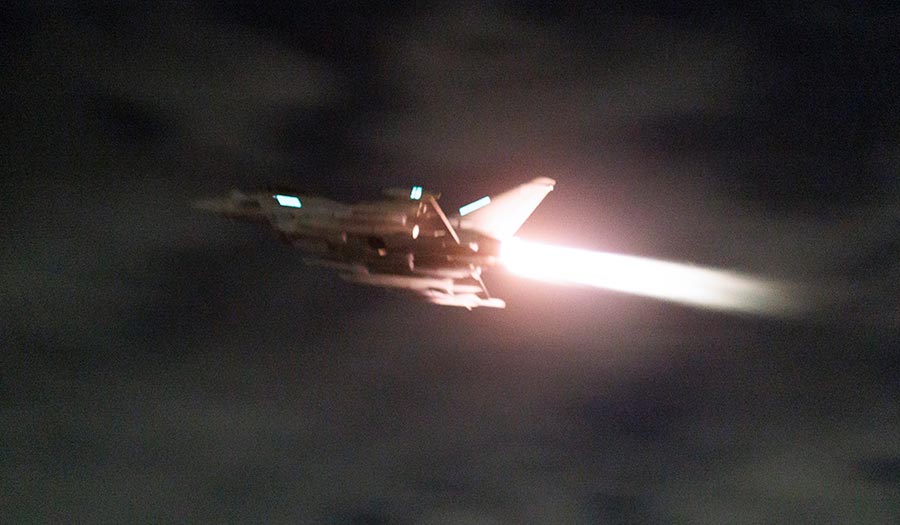
The Houthi targets were struck by U.S. F/A-18 fighter jets from the USS Dwight D. Eisenhower aircraft carrier, by British Typhoon FGR4 fighter aircraft and by the Navy destroyers USS Gravely and the USS Carney firing Tomahawk missiles from the Red Sea, according to U.S. officials and the UK Defense Ministry.
Who Was Targeted in Syria and Iraq, and Why?
The strikes on Friday came in retaliation for the drone strike that killed three U.S. troops in Jordan on January 28.
U.S. forces struck 85 targets in seven locations in a strategic region where thousands of Iran-backed fighters are deployed to help expand Iran’s influence from Tehran to the Mediterranean coast.
U.S. bases in Syria’s eastern province of Deir el-Zour and the northeastern province of Hassakeh have come under attack for years. The Euphrates River cuts through Syria into Iraq, with U.S. troops and American-backed Kurdish-led fighters on the east bank and Iran-backed fighters and Syrian government forces to the west.
Bases for U.S. troops in Iraq have come under attack too.
Iran-backed militias control the Iraqi side of the border and move freely in and out of Syria, where they man posts with their allies from Lebanon’s powerful Hezbollah and other Shiite armed groups.
What Was Hit in Iraq and Syria? How Many People Were Killed?
The U.S. military said the barrage of strikes hit command and control headquarters; intelligence centers; rockets and missiles, drone and ammunition storage sites; and other facilities connected to the militias and the Iranian Revolutionary Guard’s Quds Force, which handles Tehran’s relationship with, and arming of, regional militias.
Syrian opposition activists said the strikes hit the Imam Ali base near the border Syrian town of Boukamal, the Ein Ali base in Quriya, just south of the strategic town of Mayadeen, and a radar center on a mountain near the provincial capital that is also called Deir el-Zour.
Rami Abdurrahman, who heads the Britain-based Syrian Observatory for Human Rights, said 29 rank-and-file fighters were killed in those strikes.
The attacks also hit a border crossing known as Humaydiya, where militia cross back and forth between Iraq and Syria, according to Omar Abu Layla, a Europe-based activist who heads the Deir Ezzor 24 media outlet. He said the strikes also hit an area inside the town of Mayadeen known as “the security quarter.”
Iraqi government spokesperson Bassim al-Awadi said the border strikes killed 16 people and caused “significant damage” to homes and private properties.
The Popular Mobilization Force, a coalition of Iran-backed militia that is nominally under the control of the Iraqi military, said the strikes in western Iraq hit a logistical support post, a tanks battalion, an artillery post and a hospital. The PMF said 16 people were killed and 36 wounded, and that authorities were searching for other missing people.
Will Iran-Backed Fighters Retaliate?
Iran and groups it backs in the region aim to put pressure on Washington to force Israel to end its crushing offensive in Gaza, but do not appear to want all-out war. The defeat of Hamas would be a major setback for Tehran, which considers itself and its allies the main defenders of the Palestinian cause.
The Islamic Resistance in Iraq, an umbrella group for Iran-backed groups, said it carried out two explosive drone attacks Saturday on bases housing U.S. troops in the northern Iraqi city of Irbil and a post in northeast Syria near the Iraqi border.
The only Iran-backed faction that has been escalating are the Houthi rebels in Yemen, and they have made clear that they have no intention of scaling back their campaign.