Analysis: Many Iranian Options to Retaliate Against Israel, But All Carry Risk
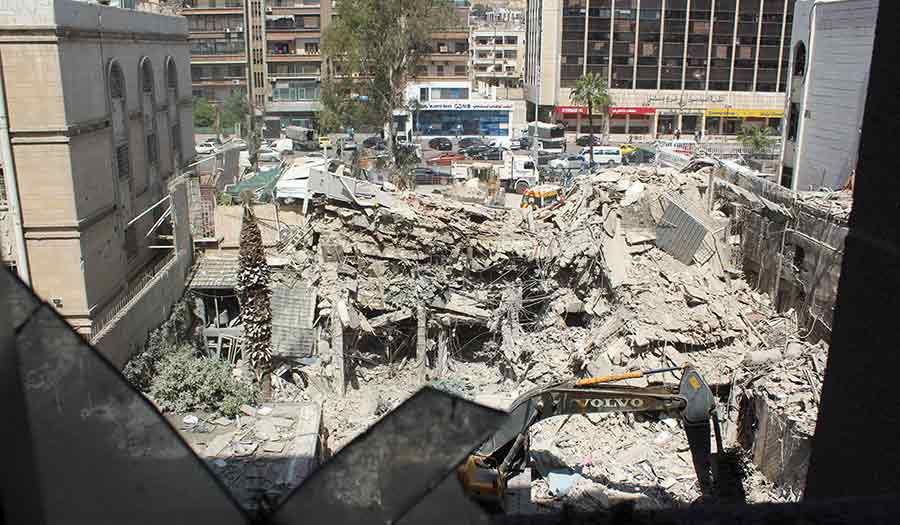
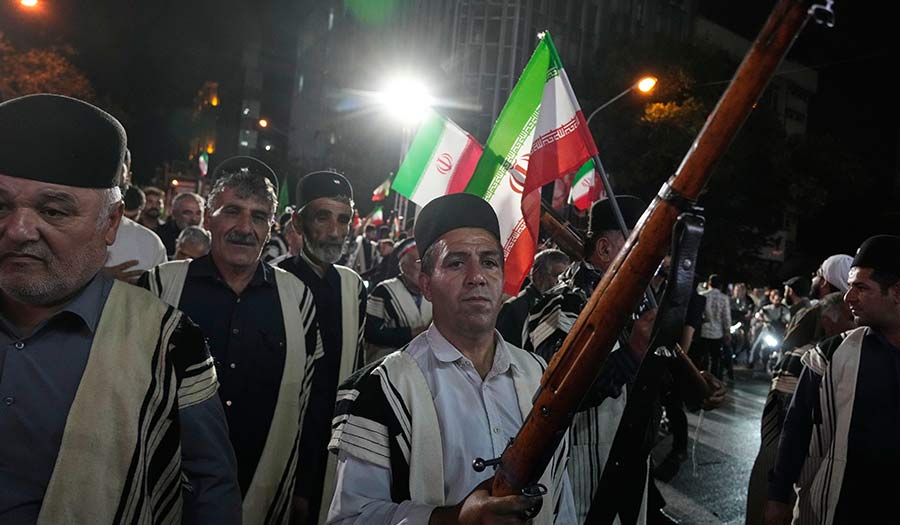
WASHINGTON (Reuters) – Iran faces a dilemma following an Israeli attack on its embassy in Syria: how to retaliate without sparking a wider conflict that Middle East analysts say Tehran does not appear to want.
Monday’s strike, which killed two Iranian generals and five military advisers at Iran’s embassy compound in Damascus, comes as Israel accelerates a long-running campaign against Iran and the armed groups it backs. Iranian Supreme Leader Ayatollah Ali Khamenei has vowed revenge.
Tehran has options. It could unleash its proxies on U.S. forces, use them to strike Israel directly, or ramp up its nuclear program, which the United States and its allies have long sought to rein in.
Speaking on condition of anonymity, U.S. officials said they were watching closely to see if, as in the past, Iran-backed proxies would attack U.S. troops based in Iraq and Syria after Monday’s Israeli strike.
Such Iranian attacks ceased in February after Washington retaliated for the killing of three U.S. troops in Jordan with dozens of air strikes on targets in Syria and Iraq linked to Iran’s Revolutionary Guard Corps and militias it backs.
U.S. officials said they had not yet picked up intelligence suggesting Iran-backed groups were looking to attack U.S. troops following Monday’s attack, which Iranian media said killed IRGC members including Mohammad Reza Zahedi, a brigadier general.
The United States on Tuesday bluntly warned Tehran against attacking its forces.
“We will not hesitate to defend our personnel and repeat our prior warnings to Iran and its proxies not to take advantage of the situation...to resume their attacks on U.S. personnel,” said Deputy U.S. Ambassador to the UN Robert Wood.
Avoiding All-Out War
One source who tracks the issue carefully and who spoke on condition of anonymity said Iran faced the conundrum of wanting to respond to deter further such Israeli strikes while avoiding an all-out war.
“They have faced this real dilemma that if they respond they could be courting a confrontation which they clearly don’t want,” he said. “They are trying to modulate their actions in a way that shows that they are responsive but not escalatory.”
“If they don’t respond in this case, it really would be a signal that their deterrence is a paper tiger,” he added, saying Iran might attack Israel proper, Israeli embassies or Jewish facilities abroad.
The U.S. official said given the significance of the Israeli strike, Iran may be forced to respond by attacking Israeli interests rather than going after U.S. troops.
Elliott Abrams, a Middle East expert at the Council on Foreign Relations U.S. think tank, also said he believed Iran did not want an all-out war with Israel but could target Israeli interests.
“I think Iran does not want a big Israel-Hezbollah war right now, so any response will not come in the form of a big Hezbollah action,” Mr. Abrams said, referring to the Lebanese group seen as Tehran’s most powerful military proxy.
“They have many other ways to respond...for example by trying to blow up an Israeli embassy,” he added.
Iran could also respond by accelerating its nuclear program, which Tehran has ramped up since former U.S. President Donald Trump in 2018 abandoned the 2015 Iran nuclear deal designed to constrain it in return for economic benefits.
But the two most dramatic steps—increasing the purity of its enriched uranium to 90 percent, which is considered bomb grade, or reviving work to design an actual weapon—could backfire and invite Israeli or U.S. strikes.
“Either one of those would be viewed by Israel and by the U.S. as a decision to acquire a bomb. So...they are really taking a big risk. Are they ready to do it? I would not think so,” said the source who tracks the issue closely.
Jon Alterman, director of the Middle East program at the CSIS think tank in Washington, said he does not expect a massive Iranian response to the attack on its embassy.
“Iran is less interested in teaching Israel a lesson than [in] showing its allies in the Middle East that it isn’t weak.”