The Losing Battle Against Greece’s Tumbling Birthrate
ORMENIO, Greece (Reuters) – Army sergeant Christos Giannakidis was planning to have a second child when Greece’s debt crisis exploded last decade, straining his finances and erasing hope of extending the family.
One son is expensive enough, he says, especially the cost of ferrying him around his remote corner of northeastern Greece where the number of children has plummeted in recent years.
Most afternoons he drives 13-year-old Nicholas 31 miles to play soccer with the few other children scattered across the region. If Nicholas needs a pediatrician, it is even further.
“To have a family these days, you need to become a hero,” Mr. Giannakidis said on the sideline of a recent soccer practice. “To have a second child, more money must come into the house.”
As much of Europe struggles with tumbling birthrates that experts say threaten long-term economic wellbeing, Greece is a stark example of how hard it will be to reverse the trend.
In 2022, it recorded the lowest number of births in 92 years, according to most recent data, driven by the debt crisis that led to years of austerity and emigration, and changed attitudes among the young. Preliminary unofficial data indicate another drop in 2023.
Greece’s fertility rate is one of the lowest in Europe: Some villages have not recorded a single birth in years.
The government is planning in May to unveil new measures to boost birthrates, officials told Reuters.
The plan includes cash benefits for families, affordable housing for young people, financial incentives for assisted reproduction, and incorporating migrants into the workforce, according to officials drafting the initiatives including the family minister.
The full size and cost of the plan is not yet clear.
However, similar measures have fallen flat in other EU countries in recent decades, and demographers expect little difference in Greece. Even those behind the plans have doubts.
“If I were to tell you that any given minister at any given ministry...can reverse the trend, it would be a lie,” Sofia Zacharaki, Greece’s minister for social cohesion and family affairs, told Reuters.
Still, she said, “We need to keep trying.”
Streets Devoid of Children
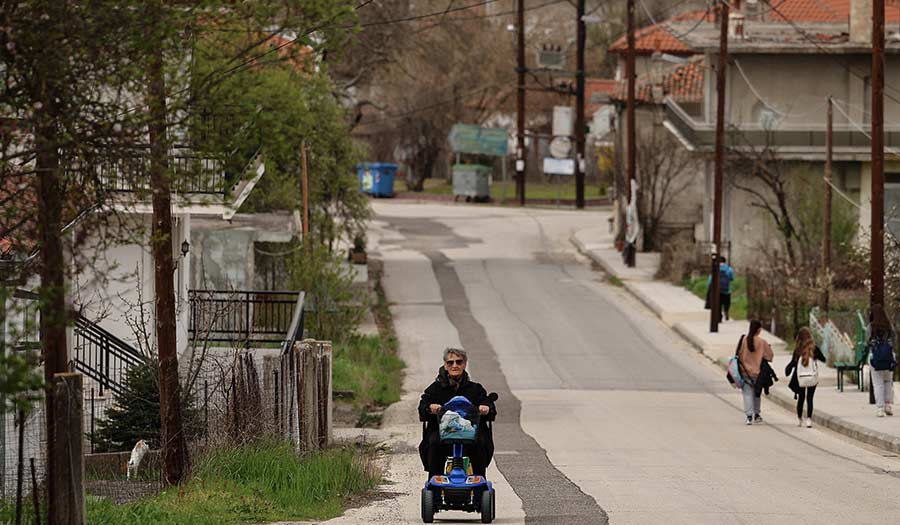
Mr. Giannakidis’ village of Ormenio and the wider Orestiada municipality—one of the country’s poorest—reveal the magnitude of the problem.
The population of Orestiada, a crop-growing area bordering Turkey and Bulgaria, shrank 16 percent between 2011 and 2021, census data show. Ormenio used to be full of children, but now two-thirds of the 300 residents are over 70, said village president Stratos Vasiliadis.
Nicholas, the only 13-year-old in Ormenio, spends much of his weekends playing video games alone. He wants to leave at 18.
“I might send him to my sister in Germany to study,” his father said.
The silence that blankets Ormenio is occasionally broken by church bells that peal over shuttered businesses and an empty playground, and by the mobility scooters elderly men drive to the cafe for games of backgammon.
Most of the church pews are unoccupied at Sunday mass. Trains that pass through Ormenio used to bring visitors but today haul tanks bound for Ukraine.
A newly extended border fence in the area, part of the conservative government’s toughening immigration policy, keeps undocumented migrants out.
“We used to gather at weddings, at baptisms. Now we meet at funerals,” said 61-year-old Chrysoula Ioannidou. “There are very few births.”
Mr. Vasiliadis’ brother Thodoris, a speech therapist, organizes art workshops for 20 or so children from surrounding villages. He said isolation had stunted their social skills. One boy’s stutter worsened because he had no friends to talk to, he said. Another cycles the village’s empty streets alone.
Ormenio’s situation is mirrored to varying degrees across Greece and the EU, where governments including France, Italy, Norway and Spain have spent billions of euros on pro-child measures—often to little avail.
Greece’s economy has rebounded in recent years, but falling birthrates are, according to Prime Minister Kyriakos Mitsotakis, a “national threat” and a “ticking time bomb” for pensions.
Priority Policy
Even before the incentives planned for May, the government created a birth allowance and tax breaks on baby items and extended private sector maternity benefit.
These have shown little sign of working.
“This is one of the most serious problems we face not only in Greece but in the EU as a whole,” Finance Minister Kostis Hatzidakis told Reuters. “It is our priority...whatever it takes.”
Part of the government’s challenge is to overcome the trauma of the debt crisis. Just a few years ago, as protests raged over the government’s austerity policies, youth unemployment was over 60 percent. It remains around 25 percent.
Hundreds of thousands of young Greeks left. Those that remain are often priced out of the property market due to inflation and soaring rents. Many live with parents into their 30s.
Orestiada municipality suffered heavily. A sugar factory that provided hundreds of jobs shut down and is fenced off in an overgrown lot. Scores of other businesses are boarded up.
The nearest primary school to Ormenio, which serves 17 villages, is thinning out. The whole first grade—four children—can fit in their teacher’s morning embrace. Next year there will be none, headmaster Dimitris Rossidis said.
“The future doesn’t look bright,” he said.
First grade teacher Nektaria Mouropoulou says she would like to have a family but she earns 1,000 euros ($1,083) a month, a third of which goes to renting a tiny flat. She crosses into Turkey to buy cheaper gasoline, and her mother helps with bills.
“When you’re in your 30s and earning 1,000 euros, of course you’ll think whether to have a family,” she said, adding that politicians were missing the point.
“That they’ll give 20 euros for the first child, or 50 or 100, doesn’t solve the problem.”