With Niger Exit, U.S. Intelligence Dims on Growing West Africa Insurgencies
GABORONE (Reuters) – As the U.S. military packs up what is left of its equipment and counter-terrorism personnel in Niger, American officials are warning it is becoming increasingly difficult to monitor growing West African insurgencies.
Niger’s military rulers have given the U.S. until September 15 to remove its troops from the country, which also means leaving a $100 million drone base near Agadez in central Niger that had provided a crucial source of intelligence about groups allied to al Qaeda and Islamic State.
“Our ability to monitor the threat is degraded because of the loss of Agadez,” one U.S. official told Reuters in an interview, speaking on condition of anonymity.
U.S. officials are particularly concerned about the growth of Islamic State as well as Jama’a Nusrat ul-Islam wa al-Muslimin (JNIM), an al Qaeda affiliate.
Michael Langley, the four star Marine general who leads U.S. forces in Africa, said the big challenge for his command will be detecting when militant groups could grow to the point where they could mount a threat to the United States or Europe.
“It has the potential [to become a threat to the United States] as they grow in numbers. But we want to be able to monitor...to see if it metastasizes into increased capability,” Mr. Langley said, speaking on the sidelines of a conference of African chiefs of defense in Botswana.
Experts caution that it will not be easy, and some draw comparisons to Afghanistan, where intelligence collection on al Qaeda and Islamic State are a fraction of what they were before the U.S. pullout and Taliban takeover in 2021.
“When we leave an area like the Sahel, and Afghanistan, we not only cannot [act on] an immediate threat with military and intelligence forces, we don’t know about the plotting of an attack because of our reduced [intelligence] collection capabilities,” said Mick Mulroy, a former senior Pentagon official and CIA officer.
Operational Setbacks
Since 2020, soldiers in Mali, Burkina Faso and Niger have carried out coups blaming civilian leaders for allowing Islamist militants to gain ground. Once in power, juntas have torn up defense agreements with the U.S., French and UN forces and invited Russians to take their place.
“We have to not only figure the best way to handle what are tactical and operational setbacks, but also how to prevent them from becoming a strategic reverse,” said J. Peter Pham, a former special U.S. envoy to the Sahel.
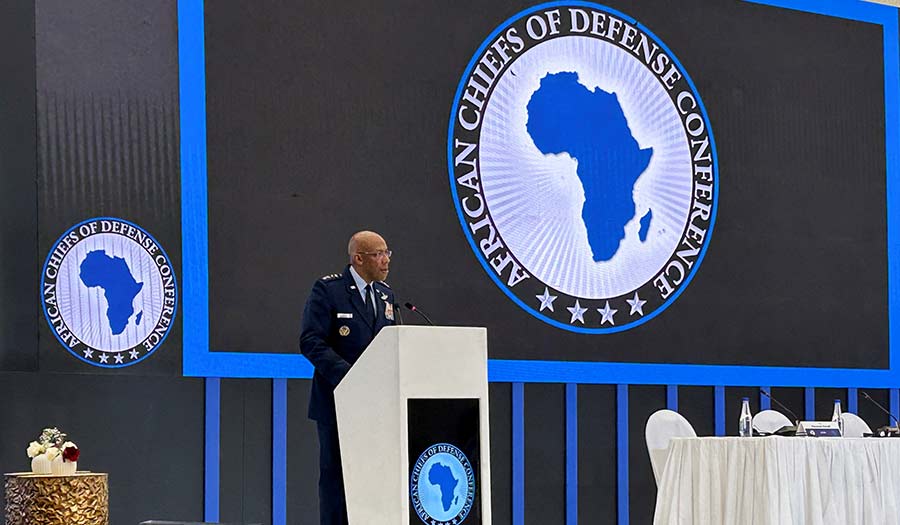
Trying to plot a way forward, Air Force General C.Q. Brown, chairman of the Joint Chiefs of Staff, traveled to Botswana to speak with African military leaders. It was the first time the most senior U.S. military officer has visited sub-Saharan Africa in 30 years.
In a keynote address to the conference on Tuesday, Mr. Brown emphasized the need to listen to African partners and underscored non-military approaches to address challenges in Africa.
“To achieve lasting, shared peace, prosperity, and security, it’s not about one country dominating or deciding what will work for another,” Mr. Brown said. “It’s about using our shared insights, experiences, and perspectives.”