Hamas and Fatah Agree to Form a Government. What Does It Mean and Who Are These Palestinian Groups?
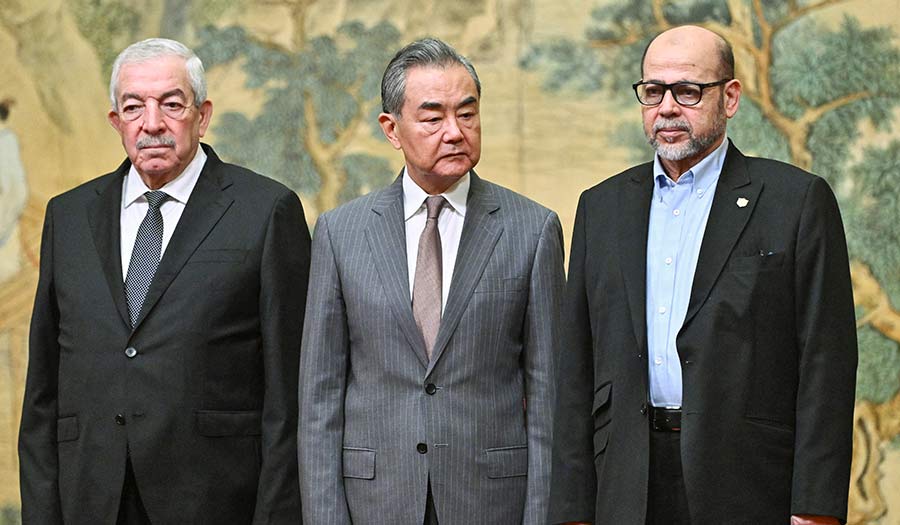
RAMALLAH, West Bank (AP) – Palestinian factions and bitter foes Hamas and Fatah signed a declaration in China vowing to form a unity government to govern the occupied West Bank and Gaza Strip following the end of the Israel-Hamas war.
The agreement announced in Beijing on Tuesday, which also included 12 smaller Palestinian parties, could start the thawing of relations and potential reconciliation of the two heavyweights of Palestinian politics who have long been at odds over the governance of the Palestinian territories.
Israel has ruled out any initiative that would lead to Hamas or the Fatah-dominated Palestinian Authority governing Gaza, and the China deal offers only a broad outline on how Fatah and Hamas would work together.
Here is a look at the relationship between the two and the challenges that lie ahead.
An Agreement Between Old Palestinian Foes
The secular Fatah party and Hamas, a Sunni Islamist party, have been at loggerheads since the late 1980s.
Tensions between the two climaxed after the second Intifada, or uprising, that ended in 2005. Hamas narrowly won Palestinian legislative elections in 2006 and seized power in Gaza the following year in a violent takeover. During the fighting, Fatah members were arrested and some were killed.
Hamas has ruled Gaza since, though Israel’s campaign since Hamas’ October 7 attacks has driven it underground.
The Fatah-dominated Palestinian Authority controls parts of the Israeli-occupied West Bank and has spent the last decade clamping down on dissent, rounding up and arresting Hamas members—many of whom are wanted by Israel—and posing little resistance to Israeli raids.
It is widely viewed as corrupt and many Palestinians consider it a subcontractor of the Israeli occupation because of their unpopular security coordination. Since the latest war in Gaza began, Israel has increased its operations in the West Bank and imposed sanctions on the Palestinian Authority.
Hamas and Fatah signed reconciliation agreements in Cairo, Egypt, in 2011, and 11 years later in Algiers, Algeria, but their provisions were never implemented.
The Beijing declaration calls for a Palestinian state based on borders that were in place before Israel captured the West Bank, the Gaza Strip and east Jerusalem in a 1967 war. But it offers only the broadest outline as to how the two factions would work together and provides no timeframe for its implementation.
The deal also does not address the groups’ diverging views on Israel; Hamas has long refused to officially recognize Israel, while the Palestinian Authority has recognized Israel since they signed peace deals in the early 1990s and it supports a two-state solution.
Tahani Mustafa, an analyst with the Crisis Group, an international think tank, doubts that the Beijing agreement will mark a turning point.
“A lot of this was just a PR stunt,” Mr. Mustafa said, adding that given the current situation, both factions had little to lose by signing it.
Israel Says No to “Hamastan” and “Fatahstan”
Israel denounced the deal hours after it was signed, and has repeatedly said Hamas will have no involvement in the running of Gaza after the war. The U.S. and other Western countries have previously refused to accept any Palestinian government that includes Hamas unless it expressly recognizes Israel.
The joint declaration comes at a sensitive time in the 10-month war. Israel and Hamas are weighing an internationally backed cease-fire proposal that would wind down the war and free dozens of Israeli hostages held by Hamas. Who will run Gaza after the war remains one of the thorniest unresolved issues in the negotiations in Cairo.
Israeli Prime Minister Benjamin Netanyahu has said he does not want the Palestinian Authority to participate in the future running of Gaza either.
“I am not prepared to switch from Hamastan to Fatahstan,” Mr. Netanyahu announced in April, accusing both groups of posing security threats to Israel.
Mr. Netanyahu’s government and Israel’s parliament have rejected the creation of a Palestinian state. Israel has not presented a cohesive vision for running post-war Gaza, raising the possibility of prolonged Israeli military control over the territory.
Beijing Brokering Peace in the Middle East
Perhaps the most significant thing about the deal was the location and the broker: China.
Beijing has sought to position itself as a mediator in the region, despite not being part of the formal peace negotiations between Israel and Hamas. The move is widely seen as part of Xi Jinping’s efforts to increase Beijing’s global stature and act as a counterweight to Western influence.
The declaration in Beijing comes a year after China brokered a deal to normalize ties between Saudi Arabia and Iran after years of severed relations.
“If the Palestinian factions (especially Hamas and Fatah) are able to put into practice the reconciliation stated in the Beijing Declaration, then China’s diplomatic influence in the Middle East will surely be boosted,” James Char, a research fellow at the Institute of Defense and Strategic Studies at Nanyang Technological University in Singapore, said in an email.