Protests Toppled Bangladesh’s Government and Drove Powerful PM into Exile. How Did They Get Here?
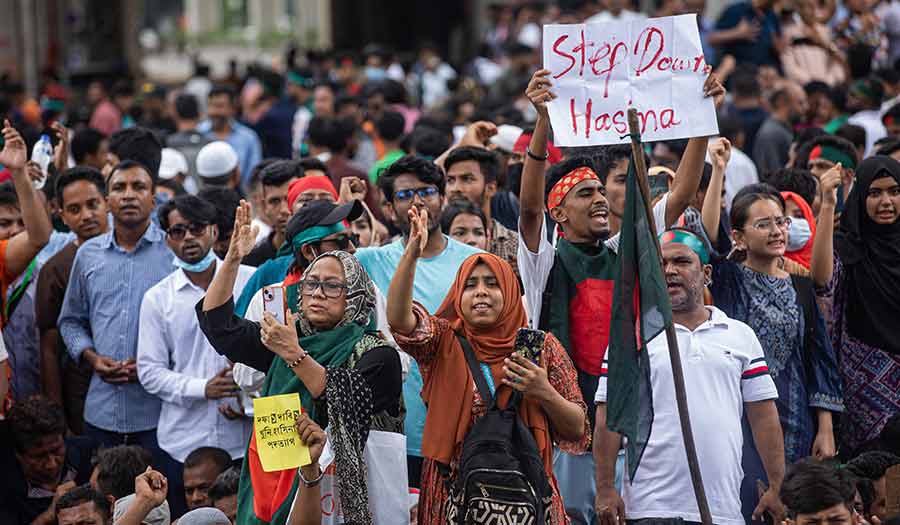
DHAKA, Bangladesh (AP) – What began as peaceful protests by students in Bangladesh against a quota system for government jobs eventually turned into an uprising that forced Prime Minister Sheikh Hasina to resign and flee the country by helicopter.
The end to her 15 years in power came after weeks of violent unrest during which nearly 300 people died, according to local media reports.
The government repeatedly tried to quell demonstrations they blamed on sabotage and opposition parties with bullets, curfews and internet outages, but these heavy-handed moves backfired, fueling outrage and further protests.
On Monday, protesters defied a military curfew to march into the capital’s center, following a weekend of violence that left dozens of people dead. As troops pulled back and internet access was restored, tens of thousands of people began to celebrate in the streets, and thousands stormed the leader’s official residence.
Military chief General Waker-uz-Zaman said the army would seek the president’s guidance to form an interim government as he called for calm in a public address Monday afternoon.
Here is what we know.
How Did the Protests Start?
The protests, which have drawn hundreds of thousands, began in July with students demonstrating against a controversial quota system that allocated government jobs.
It turned violent on July 15 as student protesters clashed with security officials and pro-government activists, prompting authorities to disperse tear gas, fire rubber bullets close schools and impose a curfew with a shoot-on-sight order. The internet and mobile data were also turned off.
The government says nearly 150 people died last month, while local media have reported that more than 200 were killed.
Why Were They Protesting?
At first, the demonstrations were against a quota system that set aside up to 30 percent of government jobs for family members of veterans who fought in Bangladesh’s 1971 war of independence against Pakistan.
Protesters said the system was discriminatory and benefited supporters of Prime Minister Sheikh Hasina’s Awami League party, which led the independence movement.
The furor highlighted the extent of economic distress in Bangladesh, where exports have fallen and foreign exchange reserves are running low. There is a lack of quality jobs for young graduates, who increasingly seek the more stable and lucrative government jobs.
As the violence crested, the Supreme Court last month ruled that the veterans’ quota must be cut to 5 percent, with 93 percent of jobs to be allocated on merit. The remaining 2 percent will be set aside for members of ethnic minorities and transgender and disabled people.
The government accepted the decision, and restored the internet thinking that the situation would ease. But the protests grew, with new demands for investigations into the deadly crackdowns, and eventually for Ms. Hasina and her cabinet to step down.
What’s Next?
Thousands of protesters celebrated in the capital, waving Bangladeshi flags as the news broke, while others looted her official residence, carrying out furniture and even fish from the kitchens. But after 15 years of her administration, it is not clear what comes next.
General Waker-uz-Zaman promised that the military would stand down, and to launch an investigation into the deadly crackdowns that fueled outrage against the government.
“Keep faith in the military, we will investigate all the killings and punish the responsible,” he said. “I have ordered that no army and police will indulge in any kind of firing.”
He asked for patience as a new government is formed.
“Now, the students’ duty is to stay calm and help us,” he added.