Ukraine’s Surprise Cross-border Incursion Seen as a Tactical Reply to Russia’s Grinding Gains
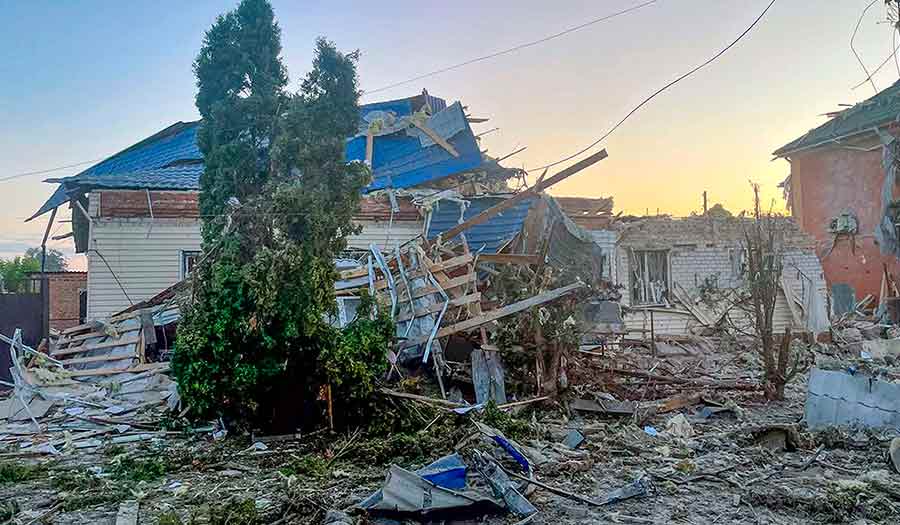
KYIV, Ukraine (AP) – The Ukraine army’s surprise charge into Russia this week was a stunning maneuver that caught the Kremlin’s forces unawares.
The strategic goal of Ukraine’s biggest cross-border incursion in almost 900 days of the war remains unclear, but it counters Russia’s unrelenting effort in recent months to punch through Ukrainian defenses at selected points along the front line in eastern Ukraine.
The Russian offensive’s slow, grinding momentum has achieved only modest gains and brought heavy losses of troops and armor. But, bit by bit, the advances are adding up.
These summer months are critical for Ukraine and its depleted army. It must hold at bay its bigger and better-equipped enemy on the battlefield, while repairing—before winter arrives—a national power grid smashed by Russian missiles.
What Does Ukraine’s Eastern Front Battlefield Look Like?
The roughly 600-mile front line remains largely deadlocked.
But at points in the east, especially in the Donetsk region, Russia is making a concerted push. Its army is exploiting the dry land to move its armor, the bushy tree lines for infantry cover, and the clear skies to launch powerful glide bombs that obliterate Ukrainian defenses.
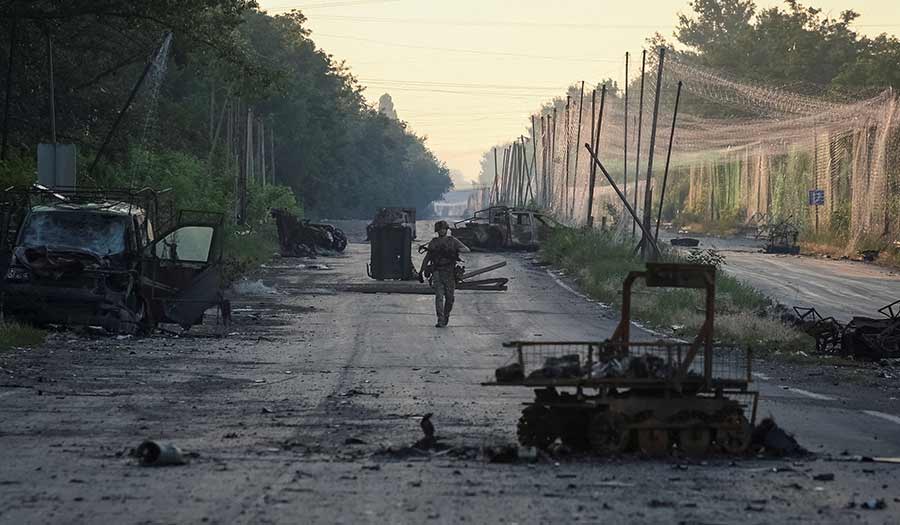
The Russian advance is slow but relentless. Russia’s hallmark tactics are to use its artillery, missiles and bombs to reduce villages and hamlets to ruins, denying Ukrainians defensive cover and compelling them to pull back.
Moscow’s forces look to exploit weaknesses in the Ukrainian lines, driving a wedge into sections where troop levels are lower or where soldiers are being rotated out, analysts say.
The Russians are now menacing some key Ukrainian strongholds, whose fall would put the rest of the Donetsk region at risk: Pokrovsk, Toretsk and Chasiv Yar.
Russian forces are now 10 miles from Pokrovsk, an important logistics hub that supports Ukrainian forces in the region, the UK Defense Ministry said Friday. Russia also continues to consolidate gains in Niu-York and is advancing toward Toretsk, the ministry said.
“Right now, the momentum is clearly on Russia’s side,” says Charles Kupchan, a senior fellow at the Council on Foreign Relations, a think tank in Washington. Even so, he says, the overall battlefield situation is “much closer to a stalemate.”
Russia makes gains but its advance may soon peter out
Though it currently has the momentum and appears bent on chalking up some battlefield triumphs before the weather turns, Russia also has nagging problems.
Moscow’s army sustained more than 1,000 casualties a day in May and June as it bore down on Donetsk, according to the UK Defense Ministry.
And while it has overrun a string of small Ukrainian settlements—some of them little more than a ribbon of roadside houses—its advances “will likely slow further as Russian forces advance into a line of larger and more urban settlements,” the Institute for the Study of War, a Washington-based think tank, said last week.
Mr. Kupchan, of the Council on Foreign Relations, is not expecting a major Russian breakthrough. Even if Russia can punch a hole in the line, “organizing a column that could advance deep behind Ukrainian lines is complicated” because of logistical and organizational demands that the military cannot satisfy.
“It’s not a high-quality force,” he said of the Russian army. But he added: “In a war of attrition, numbers matter.”
Kostiantyn Mashovets, an expert at Ukraine’s Center for Military and Political Research, reckons Russia is pushing hard now, because it “has reached the peak in building up its [military] forces and power.”
A turning point will come by the end of this year, he says, when the Kremlin will have to decide whether to launch a partial or full mobilization.
Ukraine’s Surprise Tactic: A Drive into Russia’s Kursk Region
Ukraine added a new twist to the war by invading Russia’s Kursk province on August 6. Officials in Kyiv have been tight-lipped about the advance of Ukrainian troops into Russia, not confirming it but not denying it either.
The surprise incursion launched from Ukraine’s northeastern Sumy region appears to be a tactic that opens a new area of conflict and, significantly, on Russian soil. The United States and Western allies who supply Ukraine with weapons have said little so far about Ukraine’s incursion. U.S. officials have confirmed that the Kursk incursion is a cross-border operation in which the use of U.S.-supplied weapons is acceptable.
Some analysts say it is a short-term foray, but others say it could be the start of a concerted push to seize the city of Kursk and a nearby nuclear power plant. It is not certain what Ukraine’s strategy would be to hold territory inside Russia.
Myhailo Podolyak, a top adviser to President Volodymyr Zelenskyy, said Thursday that border region attacks will cause Russia to “start to realize that the war is slowly creeping inside of Russian territory.” He also suggested such an operation would improve Kyiv’s hand in the event of negotiations with Moscow.
“When will it be possible to conduct a negotiation process in the way that we can push them or get something from them? Only when the war is not going on according to their scenarios,” he said.
For Ukraine, the Situation Is Grim but Not Hopeless
Ukraine’s troops are straining to hold back Russia’s military might and do not have the manpower or weapons to launch their own offensive.
It is also having difficulty equipping new brigades, it lacks air defenses, and many of its front-line troops are exhausted, according to analysts.
The army is soaking up the Russian pressure by making tactical retreats and pushing back elsewhere along the line.
“Every moment for Ukraine is getting tougher and tougher,” says Mathieu Boulegue, a defense expert at the Chatham House think tank in London. “I don’t see at this stage how things can get much better than this” for Ukraine.
Ukraine is hitting back by firing drones and missiles at rear areas, hitting Russian oil depots, airfields and other logistical support hubs. The recent arrival of some F-16 fighter jets donated by Western countries should also help Ukraine resist.
What Are the Prospects for Peace?
The negotiating positions of Moscow and Kyiv remain far apart. Russian President Vladimir Putin wants Ukraine’s capitulation, and Mr. Zelenskyy demands that Russian forces leave his country.
Both sides seek leverage from the battlefield situation to eventually help achieve a palatable peace deal.
Mr. Putin appears happy to keep fueling a low-intensity conflict that gradually—he hopes—drains the West’s willingness to keep sending billions of dollars in aid to Ukraine.
Mr. Zelenskyy complains that his hands are tied: He told the NATO summit in July that Ukraine cannot win the war unless the U.S. scraps the limits on the use of its weapons to attack targets in Russia.
In the background are November’s U.S. elections, which could change both sides’ fortunes, and in the fall, a possible second international diplomatic gathering on ending the war where—unlike last time—Russia might get a seat at the table.
The front-line stalemate, international political developments and the possibility of an escalation of the war in the Middle East, and uncertainty over the West’s future level of support for Ukraine hint at a way forward, Mr. Kupchan says.
“I think we’re heading toward some kind of sustained diplomatic effort” to end the war, he said.
But Mr. Boulegue of Chatham House says the war hasn’t come to a crossroads yet: “As long as both parties have things to throw at each other, they will keep doing it.”