Myanmar’s Civil War Reshaped in Past Year with Coordinated Offensive by Powerful Resistance Groups
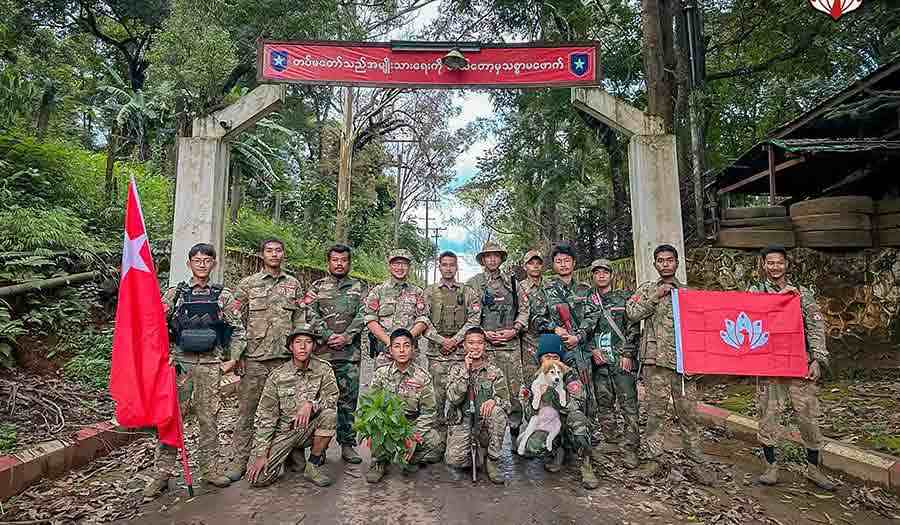
BANGKOK (AP) – Three well-armed militias launched a surprise joint offensive in northeastern Myanmar a year ago, breaking a strategic stalemate with the regime’s military with rapid gains of huge swaths of territory and inspiring others to attack around the country.
Before the offensive, the military’s control had seemed firmly ensconced with its vast superiority in troops and firepower, aided with material support from Russia and China. But today it is increasingly on the back foot, with the loss of dozens of outposts, bases and strategic cities that even its leaders concede will be challenging to regain.
How Did the Offensive Unfold?
The military seized power from the elected government of Aung San Suu Kyi in February 2021, giving rise to intensified fighting with long-established armed groups associated with Myanmar’s ethnic minority groups, and sparking the formation of new pro-democracy militias.
But until the launch of Operation 1027, eponymously named for its October 27 start, the military, known as the Tatmadaw, had largely been able to prevent major losses around the country.
Operation 1027 brought coordinated attacks from three of the most powerful ethnic armed groups—the Myanmar National Democratic Alliance Army, the Arakan Army and the Ta’ang National Liberation Army, together known as the Three Brotherhood Alliance—and they were able to quickly capture towns and overrun military bases and outposts along the Chinese border in northeastern Shan state.
Two weeks later the Arakan Army launched attacks in its home western state of Rakhine, and since then other militia groups and PDFs have joined in around the country.
A year later into the offensive, resistance forces now fully or partially control a vast horseshoe of territory that reaches from Rakhine state in the west, across the north, and then south into Kayah and Kayin states along the Thai border. The Tatmadaw has pulled back toward the center around the capital Naypyidaw and largest city of Yangon.
What Comes Next?
Many expect the military to launch a counteroffensive when the rainy season soon comes to an end, bolstered with the influx of some 30,000 new troops since activating conscription in February and its continued complete air superiority.
But at the same time, resistance groups are closing in on Mandalay, Myanmar’s second largest city in the center of the country.
Facing threats from all around the country, “it doesn’t look like there’s any viable route back for the military to recapture any of the territory that it’s lost,” said Connor Macdonald of the Special Advisory Council for Myanmar advocacy group.
“The military is on the defensive all over the country, and every time it puts its energy into one part of the country, it basically has to shift troops and then is vulnerable in other parts,” he said.
What Has Happened to Myanmar’s Civilian Population?
As the military has faced setbacks in the fighting on the ground, it has been increasingly relying on indiscriminate air and artillery strikes, resulting in a 95 percent increase in civilian deaths from airstrikes and a 170 percent increase in civilians killed by artillery since the 1027 offensive began, according to a report last month by the United Nations’ Office of the High Commissioner for Human Rights.
The Tatmadaw has been accused of deliberately targeting civilians in retribution for perceived support for the resistance militias, something it denies.
Hundreds of thousands of civilians have been displaced by the fighting, and there are now more than 3 million internally displaced people in Myanmar overall, and some 18.6 million people in need, according to the UN.
What Happens if the Military Regime Falls?
As the front has expanded, it has seen militias advancing out of their own ethnic areas, like when Rakhine-based Arakan Army in January seized the Chin town of Paletwa, which has given rise to some friction between groups—foreshadowing possible future problems should the Tatmadaw eventually fall.
At the moment there is a degree of solidarity between the disparate ethnic groups with the focus on a common enemy, but Aung Thu Nyein, director of communications for the Institute for Strategy and Policy-Myanmar think tank said that does not translate to common aspirations.
Should the Tatmadaw fall, that could lead to the fragmentation of Myanmar unless the groups work hard to resolve political and territorial differences.
“The resistance being able to bring down the junta is unlikely, but I cannot discount this scenario,” he said. “If we cannot build trust and common goals, it could lead to the scenario of Syria.”
Complicating the political picture is the influence of neighboring China, which is believed to have tacitly supported the 1027 offensive in what turned out to be a successful bid to shut down organized crime activities that had been flourishing along its border.
In January, Beijing used its close ties with both the Tatmadaw and the Three Brotherhood groups to negotiate a ceasefire in northern Shan, which lasted for five months until the ethnic alliance opened phase two of the 1027 offensive in June, accusing the military of violating the ceasefire.
China has been displeased with the development, shutting down border crossings, cutting electricity to Myanmar towns and taking other measures in a thus-far unsuccessful attempt to end the fighting.