Gaza Is in Ruins, and It Is Unclear How It Will Be Rebuilt
Associated Press – Palestinians in the Gaza Strip are eager to leave miserable tent camps and return to their homes if a long-awaited ceasefire agreement halts the Israel-Hamas war, but many will find there is nothing left and no way to rebuild.
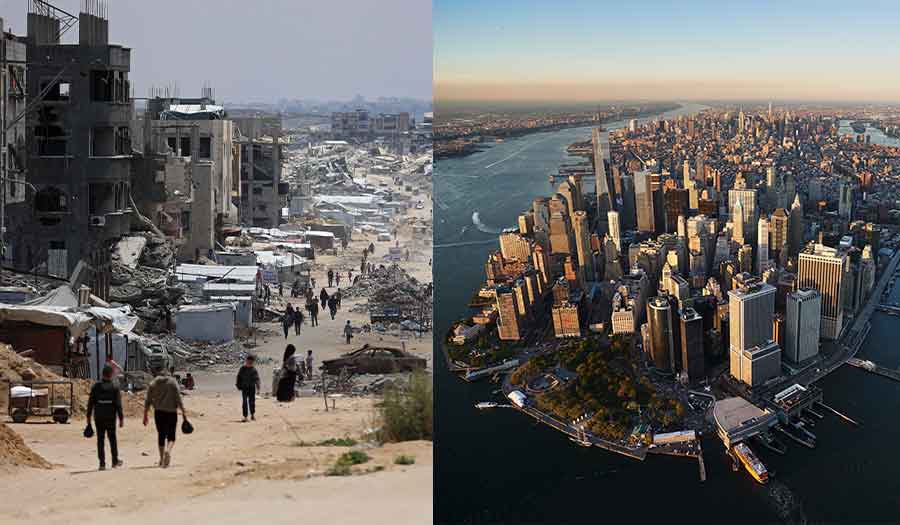
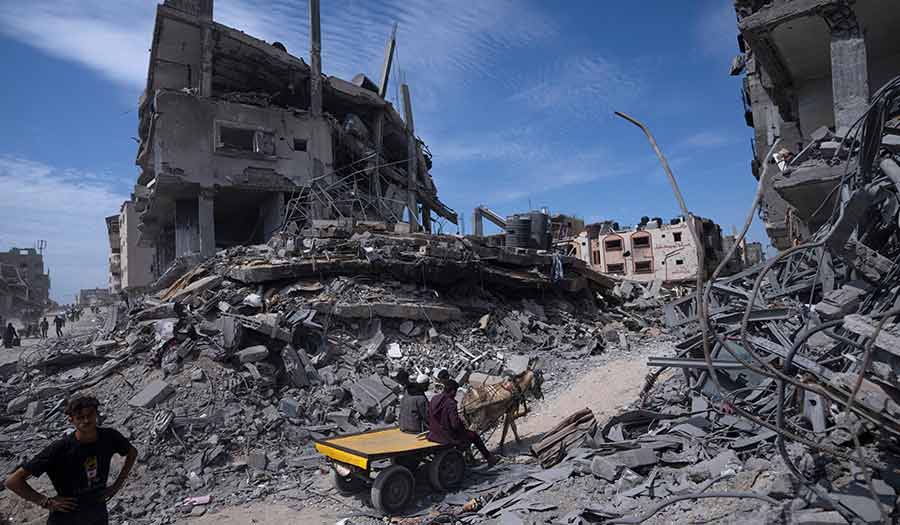
Israeli bombardment and ground operations have transformed entire neighborhoods in several cities into rubble-strewn wastelands, with blackened shells of buildings and mounds of debris stretching away in all directions. Major roads have been plowed up. Critical water and electricity infrastructure is in ruins. Most hospitals no longer function.
And it is unclear when—or even if—much will be rebuilt.
The agreement for a phased ceasefire and the release of hostages held by Hamas-led militants does not say who will govern Gaza after the war, or whether Israel and Egypt will lift a blockade limiting the movement of people and goods that they imposed when Hamas seized power in 2007.
The United Nations says that it could take more than 350 years to rebuild if the blockade remains.
Two-thirds of All Structures Destroyed
The full extent of the damage will only be known when the fighting ends and inspectors have full access to the territory. The most heavily destroyed part of Gaza, in the north, has been sealed off and largely depopulated by Israeli forces in an operation that began in early October.
Using satellite data, the United Nations estimated last month that 69 percent of the structures in Gaza have been damaged or destroyed, including over 245,000 homes. The World Bank estimated $18.5 billion in damage—nearly the combined economic output of the West Bank and Gaza in 2022—from just the first four months of the war.
Israel blames the destruction on Hamas, which ignited the war with its October 7, 2023, attack into Israel, killing some 1,200 people, mostly civilians, and abducting another 250. Israel’s retaliatory offensive has killed over 46,000 Palestinians, more than half of them women and children, according to Gaza’s Health Ministry, which does not say how many of the dead were fighters.
Israel says it has killed over 17,000 militants, without providing evidence. The military has released photos and video footage showing that Hamas built tunnels and rocket launchers in residential areas, and often operated in and around homes, schools and mosques.
Mountains of Rubble to Be Moved
Before anything can be rebuilt, the rubble must be removed—a staggering task in itself.
The UN estimates that the war has littered Gaza with over 50 million tons of rubble—roughly 12 times the size of the Great Pyramid of Giza. With over 100 trucks working full time, it would take over 15 years to clear the rubble away, and there is little open space in the narrow coastal territory that is home to some 2.3 million Palestinians.
Carting the debris away will also be complicated by the fact that it contains huge amounts of unexploded ordnance and other harmful materials, as well as human remains. Gaza’s Health Ministry says thousands of people killed in airstrikes are still buried under the rubble.
No Plan for the Day After
The rubble clearance and eventual rebuilding of homes will require billions of dollars and the ability to bring construction materials and heavy equipment into the territory—neither of which is assured.
The ceasefire agreement calls for a three- to five-year reconstruction project to begin in its final phase, after all the remaining 100 hostages have been released and Israeli troops have withdrawn from the territory.
But getting to that point will require agreement on the second and most difficult phase of the deal, which still must be negotiated.
Even then, the ability to rebuild will depend on the blockade, which critics have long decried as a form of collective punishment. Israel says it is needed to prevent Hamas from rebuilding its military capabilities, noting that cement and metal pipes can also be used for tunnels and rockets.
Israel might be more inclined to lift the blockade if Hamas were no longer in power, but there are no plans for an alternative government.
The United States and much of the international community want a revitalized Palestinian Authority to govern the West Bank and Gaza with the support of Arab countries ahead of eventual statehood. But that is a nonstarter for Israel’s government, which is opposed to a Palestinian state and has ruled out any role in Gaza for the Western-backed authority.
International donors are unlikely to invest in an ungoverned territory that has seen five wars in less than two decades, which means the sprawling tent camps along the coast could become a permanent feature of life in Gaza.