How Will Germany’s Election Bring Change to the EU’s Leading Power?
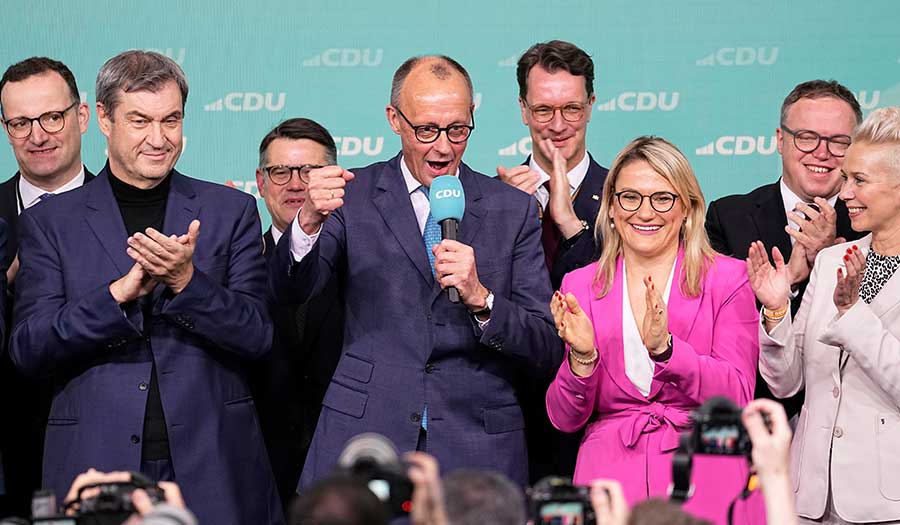
BERLIN (AP) – Germany faces its second change of leader in fewer than four years after the head of the center-right opposition, Friedrich Merz, won Sunday’s election, which saw a surge for a far-right party and a stinging defeat for outgoing Chancellor Olaf Scholz.
After the collapse of Mr. Scholz’s three-party government in November, it is now up to Mr. Merz to restore stability to the European Union’s most populous country and traditional political heavyweight, which also has the continent’s biggest economy.
Mr. Merz Faces a Difficult Task. But It Could Have Been Worse
Mr. Merz has one realistic option to form a government: a coalition with Mr. Scholz’s Social Democrats. His Union bloc and its center-left rival have a combined 328 seats in the 630-seat parliament.
He says he hopes to do the deal by Easter. That is a challenging timeframe: The possible partners will have to reconcile contrasting proposals for revitalizing the economy, which has shrunk for the past two years, and for curbing irregular migration—an issue that Mr. Merz pushed hard during the campaign. That will likely require diplomacy and a readiness to compromise that often were not evident in recent weeks.
It is still a much easier task than it might have been. For hours on Sunday night, it looked likely that Mr. Merz would need to add a second center-left partner, the environmentalist Greens, to put together a parliamentary majority.
Germany’s Traditional Heavyweights Erode Further
The Union and Social Democrats were post-World War II Germany’s heavyweights. But their support has been eroding for at least two decades as the political landscape has become more fragmented. Their combined showing Sunday was their weakest since the postwar federal republic was founded in 1949.
The Social Democrats had their worst postwar showing with just 16.4 percent of the vote. The Union had its second-worst with 28.5 percent. This is only the second time that the winning party polled less than 30 percent. The first was in 2021.
Geographical Divide: The Far Right Leads in the East
The far-right, anti-immigration Alternative for Germany, or AfD, emerged as the strongest party across the country’s formerly communist and less prosperous east. That cemented its primacy in a region that has long been its stronghold, and where it won its first state election last year.
Other parties were stronger in only a few eastern constituencies outside Berlin. In western Germany, which accounts for most of the country’s population, AfD trailed Mr. Merz’s Union and sometimes other parties too but still polled strongly on its way to 20.8 percent of the nationwide vote, the highest postwar score for a far-right party.
Young Voters Lead a Hard-left Revival
While AfD made the biggest gains, the Left Party made the most unexpected. The party appeared headed for electoral oblivion at the start of the campaign but pulled off a resounding comeback to take 8.8 percent of the vote.
The Left Party appealed to young voters with very liberal positions on social and migration issues and a tax-the-rich policy, backed up by a savvy social media campaign.
It benefited from polarization during the campaign after a motion that Mr. Merz put to parliament calling for many more migrants to be turned back at the border passed thanks to votes from AfD. Mr. Merz’s conservatives have long refused to work with the Left Party, so there was no prospect of it putting him in the chancellery.
Ukraine Can Still Expect German Support
Mr. Merz has been a staunch supporter of Ukraine as it fends off Russia’s invasion. He wrote on social network X Monday that “more than ever, we must put Ukraine in a position of strength.” He added that “for a fair peace, the country that is under attack must be part of peace negotiations.”
Germany became Ukraine’s second-biggest weapons supplier after the United States under Mr. Scholz. Mr. Merz has at times criticized the outgoing government for doing too little, notably calling for Germany to supply Taurus long-range cruise missiles to Kyiv. Mr. Scholz refused to do that.
Mr. Merz, like Mr. Scholz, has been tightlipped so far on whether Germany might contribute to a possible peacekeeping force, suggesting that the discussion is premature.
Where Did Mr. Scholz Go Wrong?
Mr. Scholz pulled off a narrow come-from-behind victory in 2021 after presenting himself as the safest pair of hands available.
But his government’s agenda was quickly upended by the Ukraine war and the ensuing energy and inflation crises. His coalition became notorious over time for infighting and poor communication. Mr. Scholz has suggested recently that he maybe should have ended it sooner than he did.
Mr. Scholz sought another unlikely comeback. But too many voters, and even some in his own party, had cooled on the unpopular chancellor.