What to Know About Earthquakes Like the One That Hit Myanmar
Associated Press – Early Friday, a major 7.7 magnitude earthquake that originated near Mandalay, Myanmar, shook the Earth as far as Bangkok, about 800 miles away.
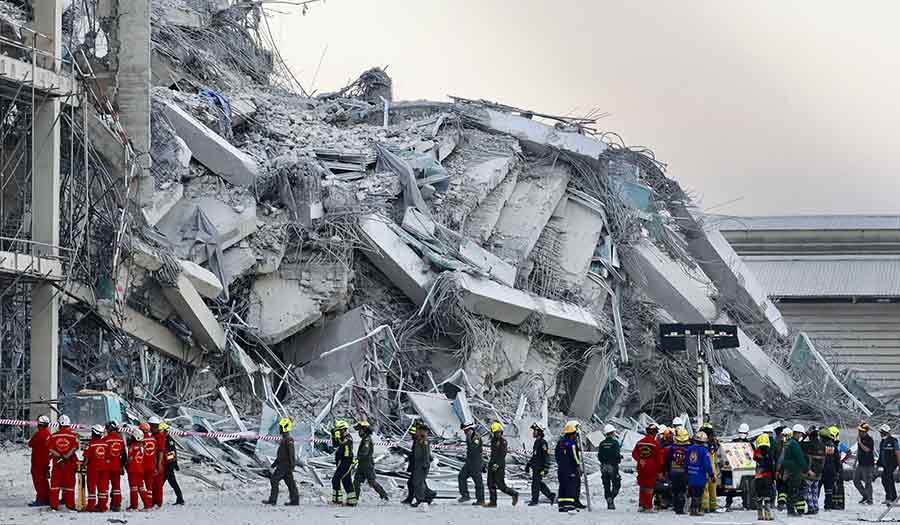
Two hard-hit cities in Myanmar suffered extensive damage, with images from the capital, Naypyidaw, showing rescue crews pulling victims from the rubble of collapsed buildings. Authorities in Bangkok said deaths had occurred at three construction sites, including a high-rise that collapsed.
Experts say the earthquake, which occurred along the Sagaing Fault, was close to the Earth’s surface, generating intense seismic forces. Preliminary estimates by the U.S. Geological Survey show that nearly 800,000 people in Myanmar may have been within the zone of the most violent shaking and that death tolls exceeding 1,000 people, and perhaps much higher, are probable.
What Are Earthquakes and Why Do They Happen in Certain Parts of the World?
The Earth’s crust is broken up into several pieces called tectonic plates, which fit together like a jigsaw puzzle.
This formation is “mostly stable, but along the edges they are moving,” Columbia University geophysicist Michael Steckler said.
Pressure builds up when sliding plates get stuck, increasing “very slowly for decades or for hundreds of years, and then all of a sudden the rock plates will jump,” triggering shaking that causes an earthquake, Dr. Steckler said.
Earthquakes typically occur along edges of tectonic plates. But their impacts may be felt in a broader region.
Earthquakes that occur in the ocean do not always attract attention, but those that occur close to where people live can cause deaths and injuries, most often from collapsed buildings.
What Do Scientists Know About Earthquakes in Advance?
Scientists have a good idea of where earthquakes are likely to occur, “but we can’t predict when they’ll occur,” USGS seismologist Will Yeck said.
However, after the initial big earthquake, researchers are able to project that other smaller earthquakes nearby, called aftershocks, are likely.
Aftershocks are triggered “because of changes to stress in the Earth from the main shock,” Dr. Yeck said.
Given the magnitude of the quake in Myanmar, “you will probably see aftershocks for the next several months,” Dr. Steckler said.
What Should You Do if You Are in a Building When Earthquake Shaking Begins?
In regions of the world with known active fault lines, including California and Japan, building codes are often designed to withstand earthquakes. But that is not true everywhere.
“If you feel shaking, the guidance depends on where you are in the world,” Dr. Yeck said.
In many countries, including the United States, if you are inside when an earthquake occurs, it is advisable to drop to the ground, cover your head—for example, by crawling under a desk or other sturdy structure—and hold onto that structure, he said. Try to avoid areas near glass windows and do not use building elevators.
If you are outside, try to remain in an area away from buildings or trees that could fall.
Depending on the location, there may be secondary hazards triggered by earthquakes, such as landslides, fires or tsunamis, he said.