Yoon Suk Yeol Removed as South Korea’s President Over Short-lived Martial Law
SEOUL, South Korea (AP) – South Korea’s Constitutional Court unanimously removed Yoon Suk Yeol from office Friday, ending his tumultuous presidency and setting up a new election, four months after he threw the nation into turmoil with an ill-fated declaration of martial law.
The verdict capped a dramatic fall for Mr. Yoon, a former star prosecutor who became president in 2022, just a year after he entered politics.
In a nationally televised hearing, the court’s acting chief Moon Hyung-bae said the eight-member bench found Mr. Yoon’s actions were unconstitutional and had a grave impact.
“By declaring martial law in breach of the constitution and other laws, the defendant brought back the history of abusing state emergency decrees, shocked the people and caused confusion in the society, economy, politics, diplomacy and all other areas,” Mr. Moon said.
“Given the negative impact on constitutional order caused by the defendant’s violation of laws and its ripple effects are grave, we find that the benefits of upholding the constitution by dismissing the defendant far outweigh the national losses from the dismissal of the president,” the justice concluded.
Protesters Erupt in Jubilation and Sorrow
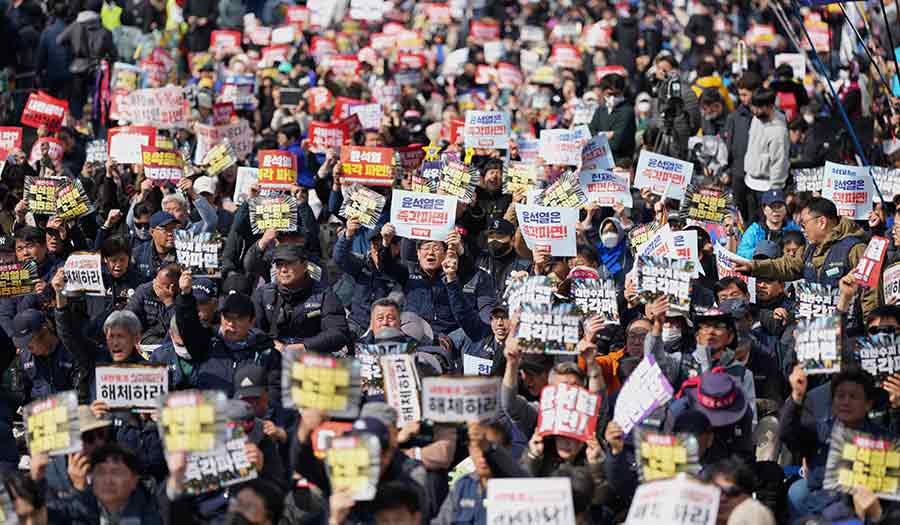
Anti-Yoon protesters near the court erupted into tears and danced when the verdict was announced in the late morning. Two women wept as they hugged and an old man near them leapt to his feet and screamed with joy. The crowd later marched through Seoul streets.
Outside Mr. Yoon’s official residence, many supporters cried, screamed and yelled at journalists when they saw the news of the verdict on a giant TV screen. But they quickly cooled down after their organizer pleaded for calm.
“We will absolutely not be shaken!” a protest leader shouted on stage. “Anyone who accepts this ruling and prepares for an early presidential election is our enemy.”
No major violence has been reported by late afternoon.
“Political risks related to domestic polarization and policy instability remain,” Leif-Eric Easley, a professor at Ewha University in Seoul, said. “But the Constitutional Court’s unanimous ruling has removed a major source of uncertainty. Korean government institutions have withstood a volatile mix of legislative obstruction and executive overreach that posed the greatest challenge to democracy in a generation.”
Korea Faces an Election with Deep Divisions
An election will be held within two months for a new president. But a festering divide over Mr. Yoon’s impeachment could complicate South Korea’s efforts to deal with crucial issues like U.S. President Donald Trump’s tariffs and other “America First” policies, observers say.
Mr. Yoon said in a statement issued via his defense team that he deeply regrets failing to live up to the public’s expectations, but stopped short of explicitly accepting the verdict. There have been fears he would incite efforts to resist his removal, as he earlier vowed to fight to the end.
He added that he will pray for the country and its people. “It has been the greatest honor of my life to serve our nation,” Mr. Yoon said.
Mr. Yoon’s ruling People Power Party said it would accept the decision, but one of Mr. Yoon’s lawyers, Yoon Kap-keun, called the ruling “completely incomprehensible” and a “pure political decision.”
Prime Minister Han Duck-soo, the country’s acting leader, vowed to maintain public safety and order and ensure a smooth transition to the next administration.
Surveys show Lee Jae-myung, leader of the main liberal opposition Democratic Party, is the early favorite to win the upcoming presidential by-election, though he faces several trials for corruption and other charges.
“It will be an uphill battle for the conservative party to win a snap presidential election,” said Duyeon Kim, a senior analyst at the Center for a New American Security in Washington. “If Lee wins, South Korea’s foreign policy will likely look very different from what the U.S. and like-minded countries have enjoyed during Yoon’s presidency because of the demands of the progressive base.”
Mr. Lee welcomed the ruling and credited the South Korean people for “protecting our democratic republic.”
Crisis Started with a Night of Chaos Four Months Ago
Martial law lasted only six hours, but left behind a political crisis, rattling financial markets and unsettling the country’s diplomatic partners.
After announcing martial law late at night on December 3, Mr. Yoon, a conservative, sent hundreds of soldiers to the liberal opposition-controlled National Assembly, election offices and other sites. Special operations soldiers smashed windows at the assembly and scuffled with protesters, evoking traumatic memories of the country’s past military rules among many South Koreans.
Enough lawmakers, including some from the ruling party, managed to enter the assembly to vote down Mr. Yoon’s decree unanimously.
Some senior military and police officers sent to the assembly testified Mr. Yoon ordered them to drag out lawmakers to block the vote on his decree or to detain his political rivals. Mr. Yoon says the troops were deployed to the assembly simply to maintain order.
Mr. Yoon was impeached by the National Assembly on December 14. The assembly accused him of violating the constitution and other laws by suppressing assembly activities, attempting to detain politicians, and undermining peace across the country.
In his final testimony at the Constitutional Court hearing, Mr. Yoon said his decree was a desperate attempt to draw away public support of his fight against the “wickedness” of the Democratic Party, which had obstructed his agenda, impeached top officials and slashed the government’s budget bill. He earlier called the National Assembly “a den of criminals” and “anti-state forces.”
The Constitutional Court ruled Mr. Yoon infringed upon the assembly’s right to demand martial law be lifted, the freedom of political party activities and the neutrality of the military. It also said Mr. Yoon’s political impasse with the opposition was not the type of emergency situation that required martial law and that Mr. Yoon’s decree lacked required legal procedures such as deliberation by a formal Cabinet meeting.
Mr. Yoon Still Faces Criminal Charges
Mr. Yoon has been indicted on charges of rebellion in connection with his decree, a charge that carries the death penalty or a life sentence if convicted. He became the first South Korean president to be arrested or indicted while in office.
Mr. Yoon was released from jail in March after a Seoul district court canceled his arrest. That allows him to stand trial without detention.
His removal from office also costs Mr. Yoon the presidential immunity that protected him from most criminal prosecutions. This means he could face other criminal charges, such as abuse of power, in connection with his martial law decree, some observers say.
To learn more, read {%578990}.