French Parliament Ousts Prime Minister, Deepening Political Crisis
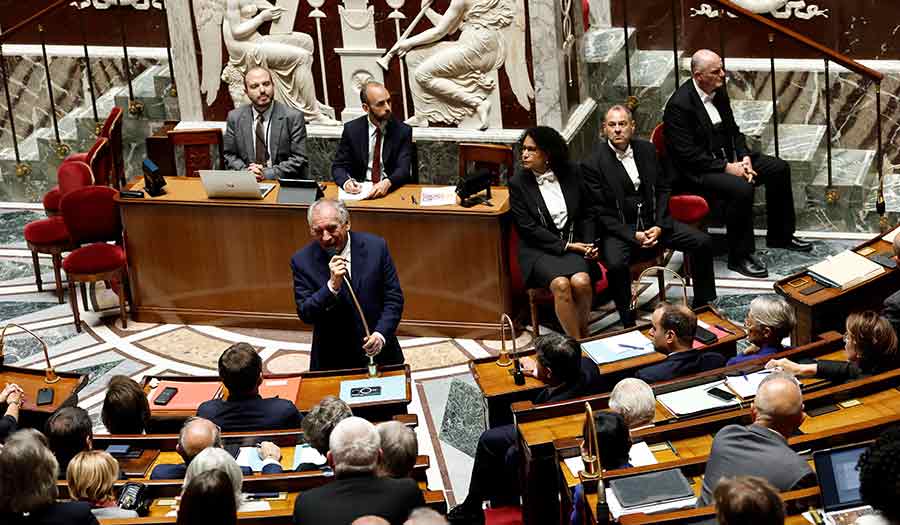
PARIS (Reuters) – France’s parliament brought down the government on Monday over its plans to tame the ballooning national debt, deepening a political crisis that is weakening the euro zone’s second-largest economy.
Lawmakers voted to oust Prime Minister Francois Bayrou and his minority government with 364 votes against the veteran centrist politician and 194 in his favor.
President Emmanuel Macron, who is facing calls from the opposition to dissolve parliament and resign, will instead hunt for his fifth prime minister in less than two years. His office said he would appoint one in the next few days.
The next government’s most pressing task will be to pass a budget, the same challenge Mr. Bayrou faced when he took office nine months ago. Securing the backing of a very divided parliament will be equally hard.
“You have the power to bring down the government, but you do not have the power to erase reality,” Mr. Bayrou told lawmakers before losing the confidence vote.
“Reality will remain relentless: expenses will continue to rise, and the burden of debt, already unbearable, will grow heavier and more costly,” he said.
Mr. Bayrou will tender his resignation on Tuesday, his office said.
He had called the confidence vote to try to win parliamentary support for his strategy to lower a deficit that stands at nearly double the European Union’s 3 percent ceiling, and to start tackling a debt pile equivalent to 114 percent of GDP.
But opposition parties were in little mood to rally behind his planned savings of 44 billion euros ($51.51 billion) in next year’s budget, with an election for Mr. Macron’s successor looming in 2027.
“This moment marks the end of the agony of a phantom government,” far-right leader Marine Le Pen said, pushing for a snap parliamentary election, which Mr. Macron has so far ruled out.
“Macron is now on the front line facing the people. He too must go,” Jean-Luc Melenchon, leader of the hard-left France Unbowed, said on X.
Who Is Next?
A lengthy period of political and fiscal uncertainty risks undermining Mr. Macron’s influence in Europe at a time when the United States is talking tough on trade and security, and war is raging in Ukraine on Europe’s eastern flank.
The French president could now nominate a politician from his own centrist minority ruling group or from the ranks of conservatives as the next premier, but that would mean doubling down on a strategy that has failed to yield a stable alliance.
He also could tack to the left and nominate a moderate socialist, or choose a technocrat.
No scenario would be likely to hand the next government a parliamentary majority. It was inevitable that the need to form a new government would result in a dilution of the deficit reduction plan, Finance Minister Eric Lombard said before the vote.
Mr. Macron may eventually decide the only path out of the crisis lies in calling a snap election, but he has so far resisted calls from Ms. Le Pen’s National Rally and from France Unbowed to dissolve parliament a second time.
Fiscal Mess
Financial markets had anticipated the confidence vote would fail and there was little immediate reaction on Monday. French markets face another test on Friday, when Fitch Ratings reviews its sovereign rating for France. Moody’s and S&P Global follow with their own rating reviews in October and November.
“Over the near-term, I’m sure everyone in markets expects paralysis and downward pressure on ratings,” said Chris Scicluna, head of economic research for Daiwa Capital Markets. As for now, “the outcome was as expected, so markets should react in a modest way.”
France’s EU peers will be watching closely.
France holds the highest deficit as a percentage of GDP in the euro zone—the bloc using the EU’s single currency. It pays more to service its debt than Spain and spreads against benchmark German 10-year bonds are at their highest level in four months.
A rating downgrade would hamper France’s ability to raise money at low interest rates from investors, potentially deepening its debt problems.
The Socialists have offered a counter-budget that would impose a tax of at least 2 percent on personal wealth greater than 100 million euros ($117.5 million) and generate savings of 22 billion euros—a proposal that would be tough to marry with the pro-business reform agenda of Mr. Macron’s presidency.
Discontent may also start brewing on the streets. A grassroots protest movement called “Bloquons Tout” (“Let’s Block Everything”) is calling for nationwide disruption on Wednesday. Trade unions are plotting walkouts the week after.
Like many in France, Mohamed, 80, who sells produce at the Aligre market in Paris, does not think the politicians will find a way out.
“Come back in 10 days and you’ll see nothing will have changed. There won’t be a majority, there will be no budget.”