Explainer: What’s Next for the Gaza Ceasefire, and Will the Truce Last?
Reuters – More than two months after Israel and Hamas agreed to a ceasefire halting two years of devastating warfare in Gaza, most fighting has stopped.
However, both sides accuse each other of major breaches of the deal and look to be no closer to accepting the much more difficult steps envisaged for the next phase.
What Have They Agreed To?
Ceasefire steps are outlined in three different documents.
The most detailed is a 20-point plan issued by U.S. President Donald Trump in September for an initial truce followed by steps towards a wider peace. It ultimately calls for Hamas to disarm and have no governing role in Gaza and for Israel to pull out of the territory. The sides have not fully agreed to everything in it.
On October 9 Israel and Hamas did sign a more limited ceasefire deal involving only the first parts of Mr. Trump’s plan—a hostage and prisoner release, a halt to warfare, partial Israeli withdrawal and a surge in aid.
The Trump plan was then endorsed by a third document, a United Nations Security Council resolution that also authorized a transitional governing body and international stabilization force in Gaza.
How Has It Worked Out?
All 20 remaining living hostages were returned, as well as hundreds of Palestinian prisoners and detainees. Returning dead hostages has taken longer, with one body remaining in Gaza and 27 returned. Palestinian bodies have been returned in exchange for each Israeli body.
There is a dispute over aid. Hamas says fewer trucks are entering Gaza than was agreed. Aid agencies say there is far less aid than required, and that Israel is blocking many necessary items from coming in. Israel denies that and says it is abiding by its obligations under the truce.
The Rafah border crossing into Egypt was meant to be opened in the first phase of the ceasefire. It remains closed and Israel has said it will only be opened for Palestinians entering and leaving Gaza when the body of the last hostage is returned.
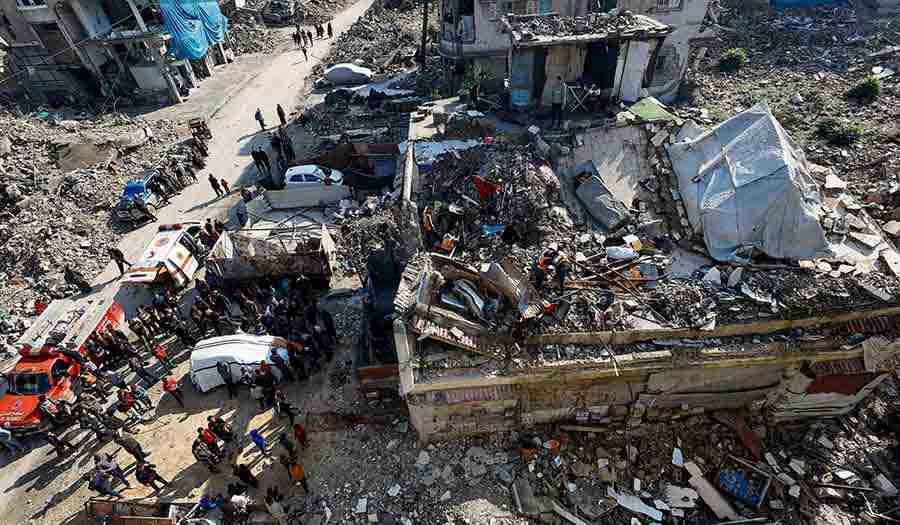
Gaza remains in ruins, with residents pulling bars from the rubble to construct tents.
The UN children’s agency said in December that a “shockingly high” number of Gazan children were still acutely malnourished, while heavy rain has flooded thousands of tents and swept sewage and garbage across the territory, adding to a health crisis.
Some violence has continued. Palestinian militants have launched attacks on Israeli forces in Gaza, killing at least three. Israeli fire at people near the demarcation line, and during operations that Israel says are targeting Hamas, has killed around 400 Palestinians, according to Gaza health officials.
Which Issues Have Not Been Agreed On Yet?
An international stabilization force is supposed to ensure security and peace inside Gaza but its composition, role and mandate are all up in the air. Indonesia and Pakistan may play a role. Israel wants any such force to disarm Hamas, a job few countries would relish handing their troops.
A technocratic Palestinian body without Hamas representation is meant to govern for a transitional period but there have been no public announcements about how or when it will be formed.
The Palestinian Authority, which governs parts of the Israeli-occupied West Bank, is supposed to carry out unspecified reforms before ultimately taking a role in Gaza. But these have not been announced either.
The Gaza government should be overseen by an international Board of Peace chaired by Mr. Trump. He has said this will be announced early in 2026, but its composition remains unclear.
Under the Trump plan, Hamas is meant to disarm but the group has not agreed to that, saying it will only give up its weapons once there is a Palestinian state. Further Israeli pullbacks within Gaza are tied to disarmament.
Will the Ceasefire Last?
Israel has repeatedly indicated that if Hamas is not disarmed peacefully, it will resume military action to make it do so, though a return to full-blown war does not look close.
However, many Israelis and Palestinians suspect the Trump plan will never be fully realized and that the current frozen conflict will continue indefinitely.
Israelis fear Hamas could rearm and threaten another attack like that of October 7, 2023.
Palestinians fear Israel will never finish pulling out of Gaza or allow full reconstruction, leaving the territory in ruins and its people without a future.
Military deployments and construction plans point to a possible de facto partition of the enclave into a zone directly controlled by Israel where it has been cultivating anti-Hamas groups, and a Hamas-held area without reconstruction or services.
What Are the Chances of Long-Term Peace?
Israelis and Palestinians have rarely trusted each other less and the two-state solution, seen by most countries as the best chance of a lasting peace, has never looked so remote—despite growing international recognition for a Palestinian state.
The Trump plan recognizes self-determination and statehood as the aspiration of the Palestinian people, but Israeli Prime Minister Benjamin Netanyahu has repeatedly ruled this out.
Elections are due in Israel in 2026, but there is no indication that any potential new government would accept Palestinian independence.